Skip to content

Posts by Askja Energy

Icelandic researchers transforming the geothermal industry?

“The worldwide market is moving towards double-digit growth,” said Karl Gawell, executive director of the Geothermal Energy Association (GEA) during the organization’s recent International Geothermal Showcase in Washington, DC. “There’s lots of exciting things going on. Several years ago there were projects in 24 countries, this year almost 700 projects are under development in 76 countries across the globe.”
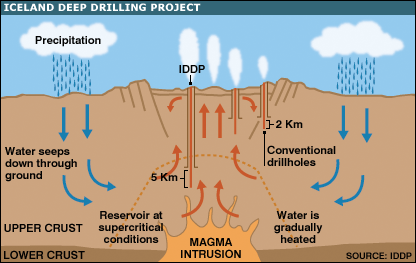
Iceland_Geothermal_Deep_Drilling_ExplainedWhat is especially interesting in this context, is how researchers in Iceland have found a new way to transform the heat generated by volcanic magma into electricity. The advancement could be especially valuable in Iceland, that has capitalized to derive a quarter of its electricity production and around 90 per cent of household heating from geothermal energy.

The Icelandic know-how may be creating interesting possibilities for high-growth in utilization of geothermal resources worldwide. Currently, the main interest seems to be from the United States (USA). In the western USA, geothermal prospects are on the rise, especially in Nevada and California. California already has the largest geothermal field in the world, the Geysers, which contains 22 geothermal power plants amid 45-square miles in the Mayacamas Mountains north of San Francisco.

With greenhouse gases rising just as sharply as energy production, climate change is creating a similar global push for a paradigm shift to clean, sustainable sources in the electricity sector. In all this, geothermal has a powerful role to play. Unlike intermittent renewable power sources, such as wind and solar, geothermal can provide consistent energy 24-hours a day, making it an appealing baseload replacement for coal and nuclear power that are responsible for keeping the power supply stable and reliable.
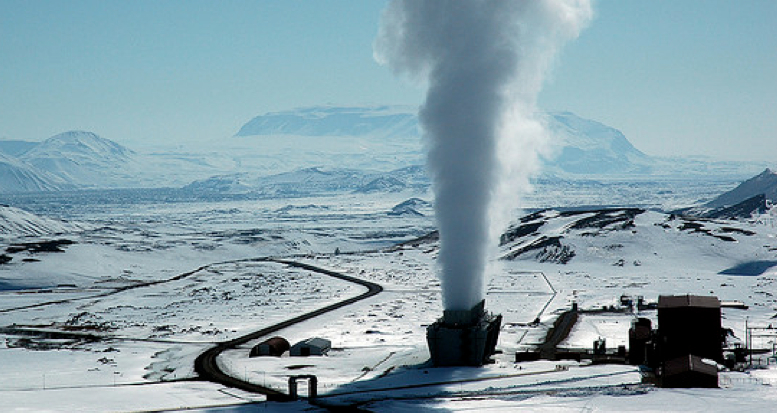
Krafla-geothemal-power-stationWhile electricity-generating geothermal technology is advancing, the bulk of the time and cost expended goes to exploration and drilling for the resource. Recent advances in oil and gas drilling, which can translate over to geothermal sensing, exploration and drilling techniques, are helping to facilitate innovation in the area. And because geothermal energy is not intermittent like wind or solar power, which generate when the wind blows or sun shines, it can fill the role that has long been played by fossil fuels and serve as a baseload power source. That not only helps to lower emissions but provides needed stability to the electric grid.

Internationally, the geothermal industry is growing fast. The new GEA report (pdf) released at the recent GEA showcase found that there were almost 700 projects under development in dozens of countries across the globe. With the international power market booming, geothermal showed a sustained growth rate of around five per cent. And the best thing about this expansion of geothermal energy, is that it competes with other energy sources on a pure cost basis.
The importance of diversifying Europe’s energy sources

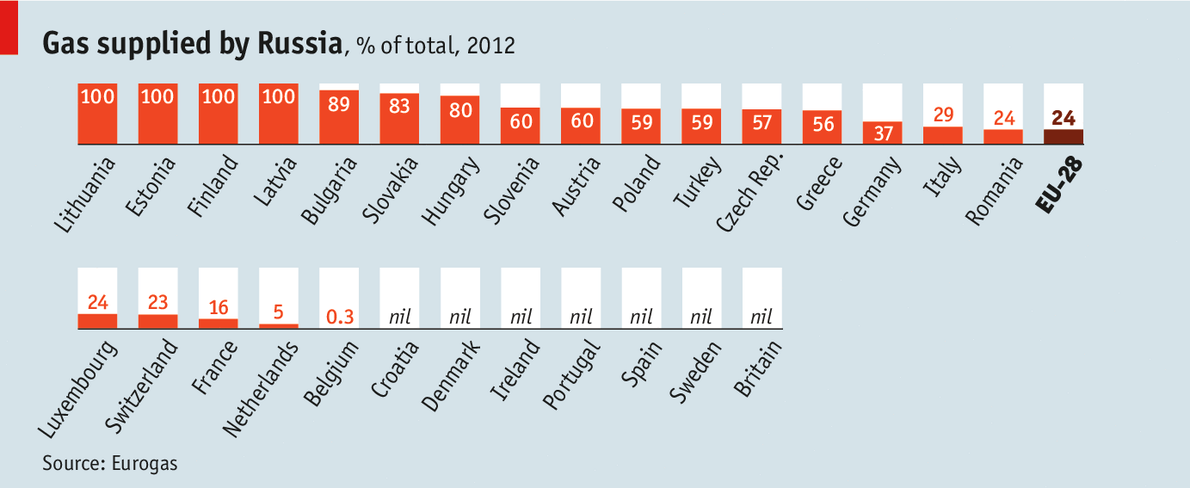
Economist-Euorope-Energy-Security-april-2014-3The Economist recently wrote about how Europe is highly vulnerable to Russian control over gas supplies – and how Europe can reduce its reliance on Russia by changing generating technology. In the article, it states that “better electricity interconnectors could reduce that need for gas by making it easier to export electricity from renewables-rich markets like Germany on sunny or windy days and to import it on dark or still ones.“ This brings attention to the great importance of strengthening the electric grid in Europe and construct new electric cables, such as to Norway and to Iceland.

The Economist correctly points out that interconnectors can help substitute one type of renewable energy for another. Hydropower (like gas-fired power stations) can easily be turned on – when the wind in Germany or United Kingdom  falters. But hydropower is not evenly spread. As stated in the article, “Sweden and, particularly, Norway have a lot of it, Germany and Benelux not so much.” Iceland is a country with abundant hydropower, that by far exceeds the country’s own electricity needs. In addition, Iceland also has extensive geothermal resources, that offer stable electricity generation for domestic use and for exports via submarine electric cable(s). Thus, Icelandic energy can be an excellent option for diversifying Europe’s energy sources.

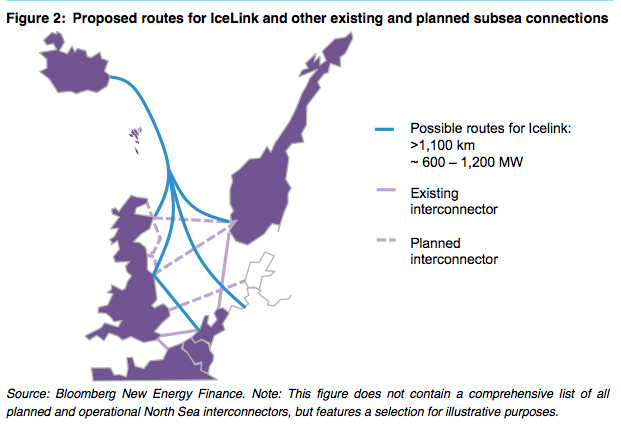
Icelink-Bloomberg-HVDC-2“Forging such links requires a pan-European push”, the Economist-article continues. To make it work on a large scale will require new pricing strategies to recompense the owners of fossil-fuel plants pushed off the grid when renewable energy from other countries flows in. According to the Economist, Norway could generate much more hydropower, given a market. The Economist states that there are currently plans for up to five new interconnectors from Norway to the EU to be built by 2020, with a capacity of up to 5GW. An inteconnector to Iceland would easily offer 1 GW more.

In last March (2014) the EU’s Heads of Government told the EU Commission to produce a plan for reducing energy dependence. The plan is to be finalized by June, and some of the key elements of the strategy are to include an in-depth study of EU energy security and plan for the diversification of supply. That is likely to give a push to storage capacity and both more and larger interconnectors. Iceland is the world’s number one electricity generator per capita and still has substantial unharnessed hydro- and geothermal resources. Thus, the development and implementation of such an action plan may offer very interesting possibilities for the Icelandic energy sector.

Feasibility of IceLink (Iceland-UK interconnector)

The Icelandic Energy Portal is cooperating with the University of Iceland and Reykjavik University, as scientific and educational partners. Thus, we sometimes introduce research by university scholars and students. Today, we will focus on the findings in a recent thesis towards MSc in Sustainable Energy at Reykjavik University, by Mr. Randall Morgan Greene.

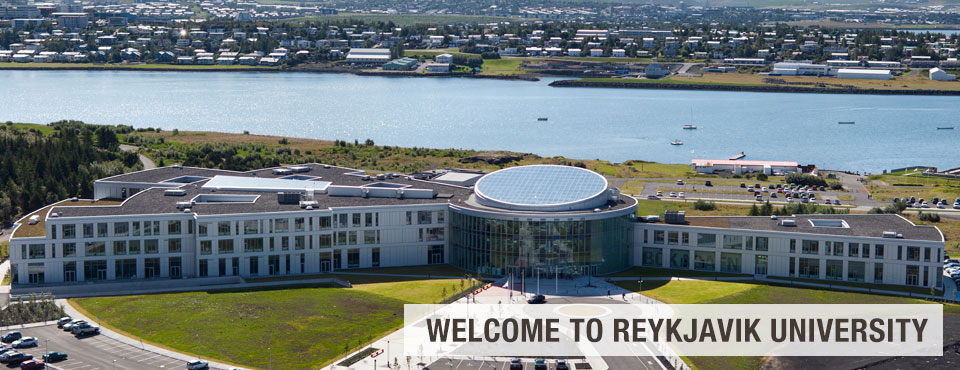
HR-RU-WelcomeThe title of the thesis is “Iceland-UK Interconnector: Strategy for Macroeconomic and Legal Feasibility”. According to the thesis, the UK must undertake drastic changes in their energy system if they are to achieve energy policy goals of competitive electricity prices, ensuring security of supply, and decarbonization of generation. Interconnection with Iceland, which is dominated by renewable energy, could offer an enticing, cost-competitive alternative to building new low-carbon generation in the UK and carries the potential for positive economic and technical benefits for both countries.

However, the author points out that the structure of EU and UK electricity systems and legislation places some blockades in this project attaining legal and macroeconomic feasibility. While there is some regulatory uncertainty associated with it, there is a potential that the status quo merchant interconnection investment model could be applied to the Iceland-UK in order to attain the aforementioned feasibility – especially if there is a potential for the application of the emerging legal precedent and business model framework in the Imera/ElecLink merchant interconnection exemption request (at this stage the concept of ElecLink seem to be advancing faster).

LV-HVDC-Iceland-UK-London-august-2012-1The macroeconomic feasibility of this framework could potentially be strengthened if there is a possibility to apply the UKs new Feed-in-Tariffs with Contract-for-Difference (FiT CfD) to generators in Iceland. The Imera/ElecLink framework adequately covers investor concerns over stable, long term returns while satisfactorily addressing regulator concerns over competition and third-party access rules for transmission assets. When combined with the FiT CfD program, there is a strong potential that this project can attain macroeconomic feasibility while still being feasible under EU energy legislation.

However, due to the ElecLink exemption not being due till spring 2014 and there being no clear precedent concerning the application of the UKs FiT CfD program to non-UK generators, this potential still requires more in-depth investigation. For more information, this link will take you to the whole text (pdf) of the thesis “Iceland-UK Interconnector: Strategy for Macroeconomic and Legal Feasibility”.

UK is looking to Iceland for electricity

In last March (2014), UK’s National Grid published a new paper exploring the potential benefits of greater electricity interconnection. According to the paper, new interconnectors will have positive economic and environmental effects. The benefits include lower energy prices for consumers, enhanced energy security, a cleaner environment and wider macro-economic effects. National Grid believes that a full understanding of the benefits of greater interconnection is important to inform the debate on an appropriate ambition to meet the country’s need, and the timeframe within which it should be achieved

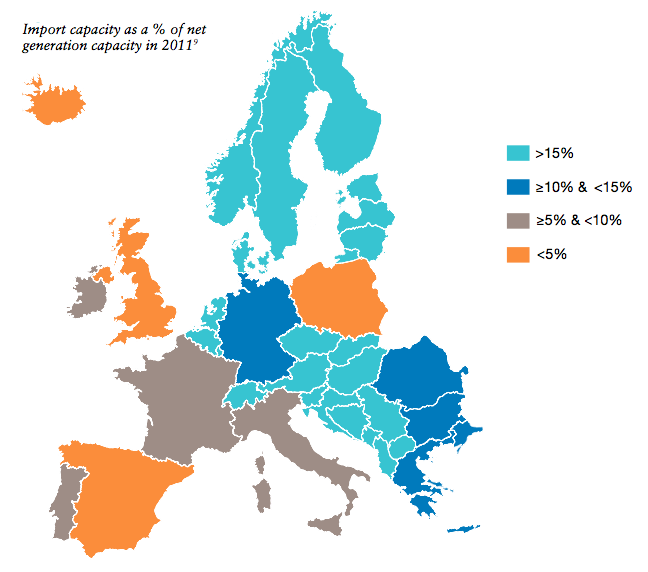
UK_National-Grid-Interconnectors-fig4-march-2014The debate on how the United Kingdom (UK) can best meet its energy needs has intensified over recent months. There is broad agreement that energy should be affordable, greenhouse gas emissions need to be reduced, and energy supplies need to be reliable for businesses and consumers to facilitate the UK’s economic recovery. Despite these benefits, Britain’s 4 GW of existing interconnector capacity is relatively small; representing around 5%of total installed electricity generating capacity. This compares with the benchmark highlighted by the European Commission in January 2014 for all EU Member States to have a level of electricity interconnection equivalent to at least 10% of theirinstalled production capacity to realize the full benefits of the Internal Energy Market.

In order to reach this benchmark Britain would need to double its existing interconnector capacity.Britain is therefore poised to complete the final design elements of the new regulatory regime, enabling developers to secure the considerable capital required to deliver these complex and technically challenging projects. Through continuing to work together, the above stakeholders are now well placed to build on the successful momentum developed to date, to secure the necessary regulatory and investment decisions for a 4-5 GW portfolio of new links in 2014/2015 and unlock the benefits including a GBP 1 billion wholesale electricity price reduction per year by 2020.

UK_National-Grid-Interconnectors-fig3-march-2014As renewable electricity forms an increasing part of the energy mix, interconnection is becoming an important tool in managing the intermittent power flows associated with these sources. Based on the consumer, energy security, environmental and economic benefits which could be accessed, greater GB electricity interconnection is considered a ‘no regrets’ investment by a wide range of informed stakeholders within the UK and beyond. This consensus includes the UK Government, the regulator, consumer organizations, green groups, think tanks, academics and the main European Union institutions.

An interconnector between UK and Iceland (sometimes referred to as the IceLink) could become an important part of the additional interconnection. UK already has four interconnectors to France, Holland, Ireland, and Northern Ireland. These links, with a total capacity of 4 GW, represent around 5% of the existing electricity generation capacity in the UK. However, this level remains low compared to the 10% benchmark proposed by the EU Commission and there is strong consensus that this gap should be filled.

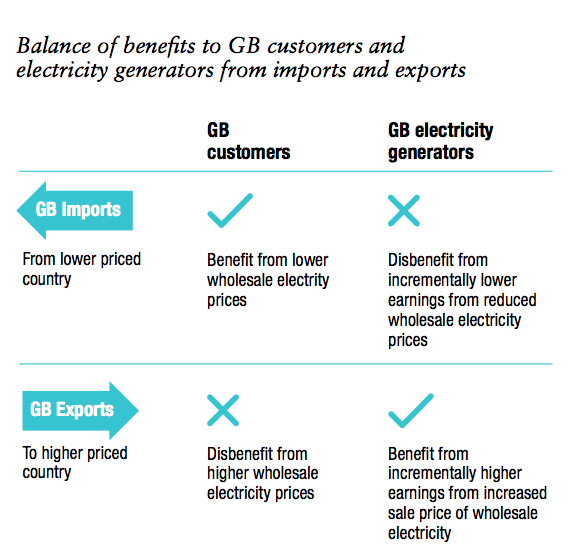
While GB remains a net importer of power, economic benefits are available through greater disposable income from lower domestic electricity prices, and enhanced competitiveness for businesses benefitting from reduced energy input costs. Were a portfolio of new projects to be commissioned, the economy would also benefit from new jobs created in activities such as planning, construction and maintenance. They could also catalyse new domestic manufacturing industries in areas such as sub-sea cabling.

Electric interconnectors allow low carbon electricity to flow between European countries more easily and could enable carbon and renewables targets to be met more cost effectively. Significant volumes of low carbon electricity could, for instance, be imported into UK from hydropower in Norway, wind power in Ireland and Denmark, nuclear in France and hydropower / geothermal energy in Iceland.

Copyright statement regarding the NG Paper: © National Grid Interconnector Holdings Limited 2014, all rights reserved.

New electric interconnector: Sweden-Germany

On March 27th 2014, plans for one more electric cable connecting the European mainland with the Nordic countries were revealed. The plans involve a new high voltage interconnector between Sweden and Germany. The interconnector is called Hansa PowerBridge.

Svenska-kraftnat-logoThis took place at the Annual Stakeholder Meeting of the Swedish National Grid (Svenska kraftnät) in Stockholm. The day after (March 28th 2014), Mr. Mikael Odenberg, CEO of Svenska kraftnät, and Mr. Boris Schucht, CEO the German Transmission System Operator 50Hertz, signed a Memorandum of Understanding (MOU) at the German Embassy in Stockholm. The signing was made in the presence of Mr. Rainer Baake, German State Secretary at the Ministry for Economics and Energy and Mr. Christian Pegel, Minister for Energy in Mecklenburg-Vorpommern.

50hertz-logoAccording to a press release from 50Hertz and Svenska kraftnät, the main objective under the MOU is to examine the feasibility for such a new link between Sweden and Germany. In a joint statement from the companies, such an interconnector is said to be another step towards a better integrated European grid and will allow for increased electricity trade between Germany and Sweden and contribute to the security of supply.

Such a new interconnector between Germany and Sweden is believed to make sense both from a commercial and from an environmental point of view. It links directly the huge storage potentials in Sweden to the wind electricity production centres in Northeastern Germany, thus creating value for both partners. The new interconnector is intended to be put into operation within the next decade. This is one more interesting project to have in mind, regarding the possible interconnector between Iceland and Europe.

Iceland is far shead of EU’s renewable energy targets

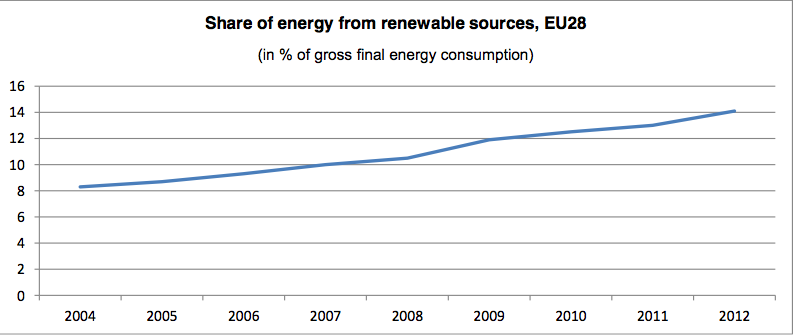
In 2012, energy from renewable sources within the European Union (EU) was estimated to have contributed 14.1% of gross final energy consumption in the Union, compared with 8.3% in 2004 (the first year for which this data is available).

EU-Energy-Renewable-Sources-Share_2004-2012The share of renewables in gross final energy consumption is one of the headline indicators of the Europe 2020 strategy. The target to be reached by 2020 for the EU is a share of 20% renewable energy use in gross final energy consumption. The national targets take into account the EU’s Member States’ different starting points, renewable energy potential and economic performance.

Since 2004, the share of renewable sources in gross final consumption of energy grew in all the EU Member States. The highest shares of renewable energy in final energy consumption in 2012, within the EU Member States, was found in Sweden (51.0% of energy from renewable sources in gross final consumption of energy), and the lowest in Malta (1.4%), Luxembourg (3.1%), the United Kingdom (4.2%) and the Netherlands (4.5%).

EU-Iceland-gross-final-energy-consumption-renewable-share-2012-and 2020-targetsIn 2011, Estonia was the first EU Member State to reach its 2020 target and in 2012 Bulgaria, Estonia and Sweden already achieved their 2020 targets (16%, 25% and 49% respectively). Since 2004, the share of renewable sources in gross final consumption of energy grew in all the EU Member States. The largest increases during this period were recorded in Sweden (from 38.7% in 2004 to 51.0% in 2012), Denmark from 14.5% to 26.0%), Austria (from 22.7% to 32.1%), Greece (from 7.2% to 15.1%) and Italy (from 5.7% to 13.5%).

This is a good progress. However, this is very far from the share of renewable energy in Iceland, which now account for close to 76% of the gross final consumption of all energy in the country (already higher than the 2020 target of 72%). See further information in the Icelandic National Renewable Energy Action Plan (published in December 2012).

Upcoming silicon plant and new hydropower station

The National Power Company of Iceland, Landsvirkjun, will provide electricity to a new power a metallurgical grade silicon metal production plant being, built by German PCC Group. The plant is to be constructed in Bakki near Húsavík on Northeast Iceland.

PCC-Silicon-logoPCC Group is a privately owned industrial holding and participation company based in Duisburg in Germany. The group operates in 16 countries with a total workforce of around 2,800 employees. PCC’s silicon plant in Iceland will be a 32,000 ton facility and is scheduled to start operating in early 2017. It will require 58 MW of power, which will be derived entirely from the renewable energy sources of Icelandic hydro and geothermal power. The contract is subject to certain conditions set to be finalised later this year. These include the appropriate licensing and permit requirements, financing for the project, as well as the approval of the Boards of both parties.

The Icelandic Landsvirkjun is one of Europe’s leading renewable energy companies. Landsvirkjun is Iceland’s largest generator of electricity, currently operating 16 renewable hydro- and geothermal power stations, producing approximately 75% of all electricity in Iceland. The company has for over 45 years generated renewable electricity from hydro, geothermal and onshore wind power sources.

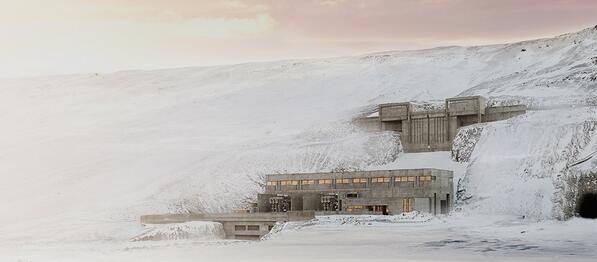
Budarhals-Landsvirkjun-Hydropower-Iceland-WinterRecently, Landsvirkjun was also starting up its newest hydropower station in Iceland. This is the Búðarháls Hydropower Station, and the official start-up ceremony was on March 7th (2014). The Búðarháls Station is Landsvirkjun’s 16th power station and the seventh largest power station owned and operated by Landsvirkjun. This new station utilises the 40 metre head in the Tungnaá River from the tail water of the Hrauneyjafoss Hydropower Station to the Sultartangi Reservoir. The installed capacity of the Búðarháls Hydropower Station is 95 MW and it will generate approximately 585 GWh of electricity per year for the national grid. Most of the electricity added by Búðarháls has already been purchased by long term agreement with Rio Tinto Alcan’s smelter in Straumsvík in Southwestern Iceland.

Study on cost of IceLink: 2.7 billion USD

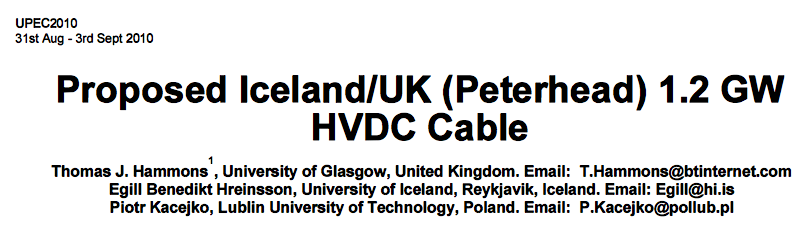
The cost of a 1,200 MW HVDC electric submarine cable between Iceland and the United Kingdom (UK) is likely to be GBP 1.58-1.68 billion (USD 2.63-2.80 billion). This includes the cable (with a capacity of 1,200 MW), converters, cable mobilization, and installation. These cost-figures are presented in a research paper from 2010; Proposed Iceland / UK (Peterhead) 1.2 GW HVDC Cable. The authors are three engineers; Thomas J. Hammons from University of Glasgow in Scotland, Egill Benedikt Hreinsson from University of Iceland, and Piotr Kacejko from Lublin University of Technology in Poland.

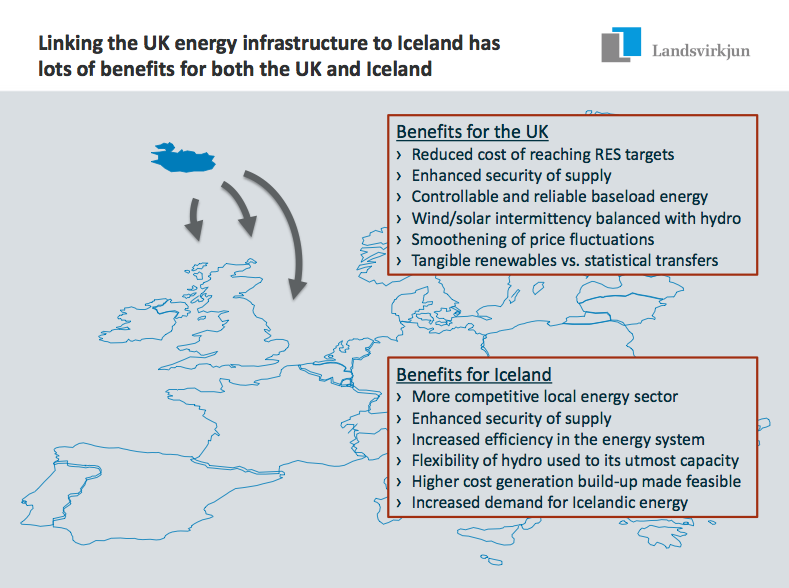
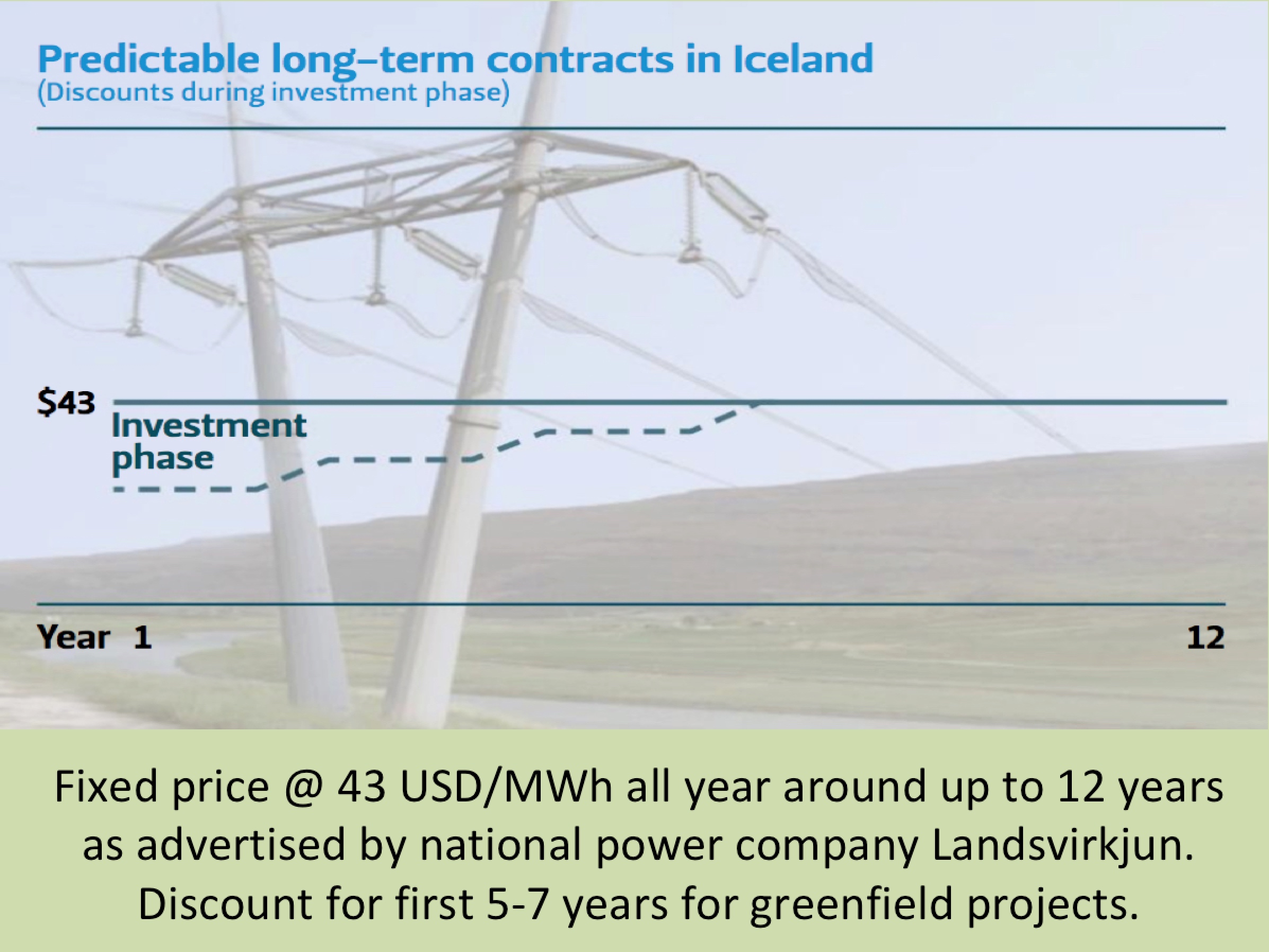
LV-HVDC-Iceland-UK-London-august-2012-2The subject of the paper is a 1,200 MW connector from Iceland to a landing point at Peterhead Scotland (a distance of 1,170km). The paper addresses market considerations with cost of electricity in UK (from new offshore and inland wind power, gas, coal, and nuclear), investments for the development of hydro resources in Iceland, investments for submarine cables and converter plant, and overall capacity of the link. Also reviewed by the authors, is the exploration of deep unconventional geothermal resources in Iceland that could be harnessed in future and developed for the IceLink. The economics, availability, and reliability of geothermal plants are reviewed. [The slide above is from a recent presentation by the Icelandic power company Landsvirkjun}

According to the paper, there should be no major difficulties in the manufacture and laying of submarine cables of length and type necessary for the IceLink connector. What is no less interesting is the finding that the cost of delivered energy would be very competitive with offshore and onshore wind, and of new coal/gas and nuclear plant. Also, the connection would offer high reliability; at least equal to that of new coal/gas and nuclear plant in the UK.

The main conclusions are as follows:

  1. Cost of electricity delivered would be very competitive with that from new wind-farms, nuclear, modern gas/coal fired plant, and tidal barrage / tidal stream power.
  2. Availability of the connection should at least equal that from nuclear, and gas/coal fired plant.
  3. No major difficulties are anticipated in manufacturing, laying and repairing the submarine cables or in construction of hydro schemes for the Link.
  4. Expected life for hydro developments is at least 60 years, submarine cables 50 years, and rectifier/inverter stations 30-40 years.
  5. The link could be considerably expanded in future to utilize deep-well geothermal power when the technology is proven.
  6. The contribution would make a significant contribution towards UK and European targets for renewable energy. The development would benefit the Icelandic economy, rather than demanding huge amounts out of a heavily damaged economy without supporting necessary recovery.
  7. The Icelandic hydroelectric system is likely to be a perfect match for interacting with the UK/North sea wind energy resources in a similar way as the Norwegian hydroelectric power system.
  8. The HVOC UK-Iceland link can serve partly as a one­ way exporter of hydroelectric or geothermal energy from Iceland to the UK or it can be considered as a short term bilateral medium for hourly interaction of hydro with marketslwind based on market signals or short term shadow prices. This dual role should be further defined in a negotiation process between the respective national authorities.

IceLink-Study-University-of-Iceland-2010The study can be downloaded here (pdf) from the website of University of Iceland.

Icelandic electricity would be competitive in the UK

In a recent study, Bloomberg New Energy Finance (BNEF) assessed the political, technological and economic feasibility of an 1,100 km interconnector to bring green Icelandic electricity to the United Kingdom (the project is called IceLink).

BNEF-logoAccording to BNEF, the prospects for implementation of such a project seem quite positive. All the technological and economic barriers regarding the IceLink are believed to be surmountable.

Regarding the economics , BNEF claims that the project is competitive in relation to other zero-carbon options. This for example applies to new offshore wind-farms in the UK and also to the recently agreed Hinkley Point C nuclear project. Electricity produced in Iceland and delivered in the UK, could be lower priced than the confirmed contract-for-difference (CfD) strike prices that have been confirmed for new renewable electricity projects in the UK (as announced by the UK Department of Energy and Climate Change; DECC).

The electricity from the IceLink would have a levelized cost of 86 GBP/MWh (close to 145 USD/MWh) as central estimate by BNEF. This number is based on BNEF’s analysis of the costs of high voltage direct current (HVDC) cable development and geothermal build-out in Iceland. In comparison, DECC’s announced strike price for electricity produced in the UK by hydropower is 100 GBP/MWh (165 USD/MWh), and 140-145 GBP/MWh (235 USD/MWh) for geothermal power.

BNEF-summit-2014What is even more interesting, regarding the competitiveness of the green Icelandic electricity, is the UK strike price for electricity from wind power; 140-155 GBP/MWh (approximately 250 USD/MWh). Wind power is the UK’s major source for increasing renewable electricity. However, this technology is substantially more costly than buying electricity from Iceland via subsea cable. In addition, the wind power is very unstable, while the Icelandic hydro- and geothermal power is a very stable power source. Thus, the cable could be excellent business for the UK. At the same time it could create strong new export revenues for Iceland.

Introducing Startup Energy Reykjavik

On January 16th 2014, Startup Energy Reykjavík was presented by their founders in an open day meeting at the headquarters of Arion Bank in Reykjavík.

startup-energy-reykjavik-logoFocused on energy related business, Startup Energy Reykjavik is a mentorship-driven seed stage investment program with a strong focus on energy related business ideas. Startup Energy Reykjavik is a first of a kind program in Iceland. It offers a unique opportunity for entrepreneurs, not only to develop their ideas, but also to network with others in the energy business.

The program is open to different ideas related to the energy-field. Projects include company research or prototype development. International applications In business are highly valued. Early stages ideas are also welcomed to apply.

startup-energy-reykjavik-ideaApplicants are welcome from companies, groups or individuals. Applications are open until February 16th. The top twenty ideas will then be pre-selected by February 20th followed by the selection of the final seven on February 27th. The project is scheduled to start March 10th.

As announced on the website of the program, finalists will receive USD 40,000 in seed funding. The program runs for 10 weeks, participants working 3 days a week at the facilities provided at the University of Reykjavik (including weekly mentor meetings with the program founders).

Startup Energy Reykjavik was founded by LandsvirkjunArion Bank, GEORG and Innovation Center Iceland in December 2013. The program is facilitated by KlakInnovit and Iceland Geothermal. Further information can be seen on the program’s website.