Skip to content

Posts from the ‘EU Energy Policy’ Category

European Union welcomes Icelandic geothermal know-how

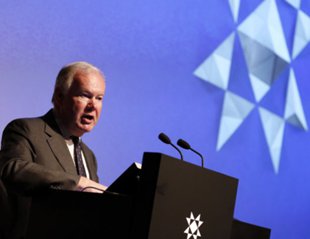
Earlier this month the Energy Commissioner of the European Union (EU), Mr. Günther Oettinger, emphasized the importance of Icelandic geothermal experience and know-how for EU’s energy policy.
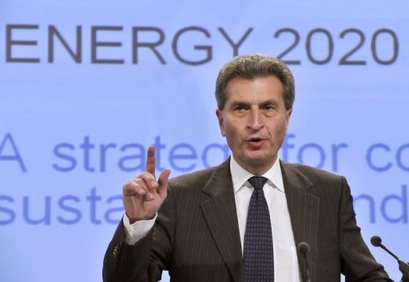
oettinger-geothermal-energy-eu-policyIn his closing speech at the Iceland Geothermal Conference 2013 in Reykjavik, Mr. Oettinger backed binding targets for renewable energy for 2030, noting that geothermal energy can “help us reach our energy and climate goals, and that we can expect the utilization of geothermal energy  to become more and more prominent”.

In European context, geothermal is currently just slightly over 0.1% of the total electricity generation. Around 1% of the renewable power generation within the EU comes from geothermal and geothermal accounts for approxemately 3% of EU’s renewable heat production.

Mr. Oettinger pointed out that the EU can learn a lot from Iceland regarding utilization of geothermal energy. Iceland alone generates almost as much electricity from geothermal sources as the rest of the EU put together. While all the 27 member states of the EU produce close to 6 TWh of electricity from geothermal sources annually, the figure in Iceland is 4,7 TWh. Another comparison Mr. Oettinger mentioned in his speech, is that Iceland produces more than ten times as much geothermal heating as Germany.

With this said, Mr. Oettinger expressed that it is “no surprise that the United Nations decided in 1978 to base its University Geothermal Training Programme in Iceland”. He went on stressing that Iceland has shown that by getting the energy policy and prices right, the jobs and businesses will follow.

Iceland-Geothermal-Station-PipesMr. Oettinger said that geothermal can help EU’s member states achieving their energy policy goals on sustainability, competitiveness, security of supply, and geopolitical security. Of course geothermal will never be taking off in the EU the same way as in Iceland – the geography and geology is simply too different for that. “But we reckon that if we played it right, we could get 5% of our energy demand from geothermal within 10 years.”

This is a very interesting suggestion of a possible goal by Mr. Oettinger. Not only would this call for a massive investment in the geothermal sector, but at the same time offer great possibilities for Icelandic businesses, with their extensive knowledge of geothermal utilization. In this respect it is worth mentioning the Icelandic engineering firms are already is working on several geothermal projects on the European continent and elsewhere in the world.

Possibly, geothermal utilization for heating and cooling (by geothermal heat pumps) could be the best option for the EU in growing its use of geothermal energy. Thus, it is not surprising that in his speech Mr. Oettinger especially mentioned that although the EU does have “nowhere near the geothermal resources that Iceland has, there is plenty of potential in Europe, in particular for heating”. This may for example apply to countries like Germany, Hungary, Romania and Slovenia, just to name a few of EU’s member states.
Iceland-Geothermal-Conference-2013-Gekon-logoFrom Mr. Oettinger’s speech at the Iceland Geothermal Conference, it seems clear that we may expect more cooperation in the field of geothermal energy between the EU and Iceland. Mr. Oettinger expressed EU’s interest in increasing financial support for more geothermal research. In this regard he mentioned the European GEOFAR project (Geothermal Finance and Awareness in European Regions), and stressed his aim to get bankers and investors more interested, as well as conventional extractive industries, including oil and gas.

Next Iceland Geothermal Conference will be taking place in April 2016.

Mannvit Engineering awarded EU energy funding

Recently, the Commission of the European Union (EU) awarded more than EUR 1.2 billion to several highly innovative renewable energy technology projects within the EU. One of the selected projects is Hungary’s first Enhanced Geothermal System (EGS), with the participation of Icelandic engineering firm Mannvit.

EU-climate_action-logoThe Hungarian EGS project was selected by the Hungarian Ministry of National Development amongst a series of project proposals to participate on behalf of Hungary in a special programme called NER300. The NER300 programme is one of the world’s largest funding programmes for innovative low-carbon energy demonstration projects. The programme will act as a catalyst for the demonstration of environmentally safe carbon capture and storage (CCS) and innovative renewable energy sources (RES) technologies on a commercial scale within the EU.

The programme is run by the European Comission on member state basis. It is funded by the sale of 300 million emission allowances from the New Entrants Reserve (NER) set up for the third phase of the EU Emissions Trading System (ETS). NER300 funding is expected to leverage a considerable amount of private investment and/or national co-funding across the EU, boost the deployment of innovative low-carbon technologies and stimulate the creation of jobs in those technologies within the EU.

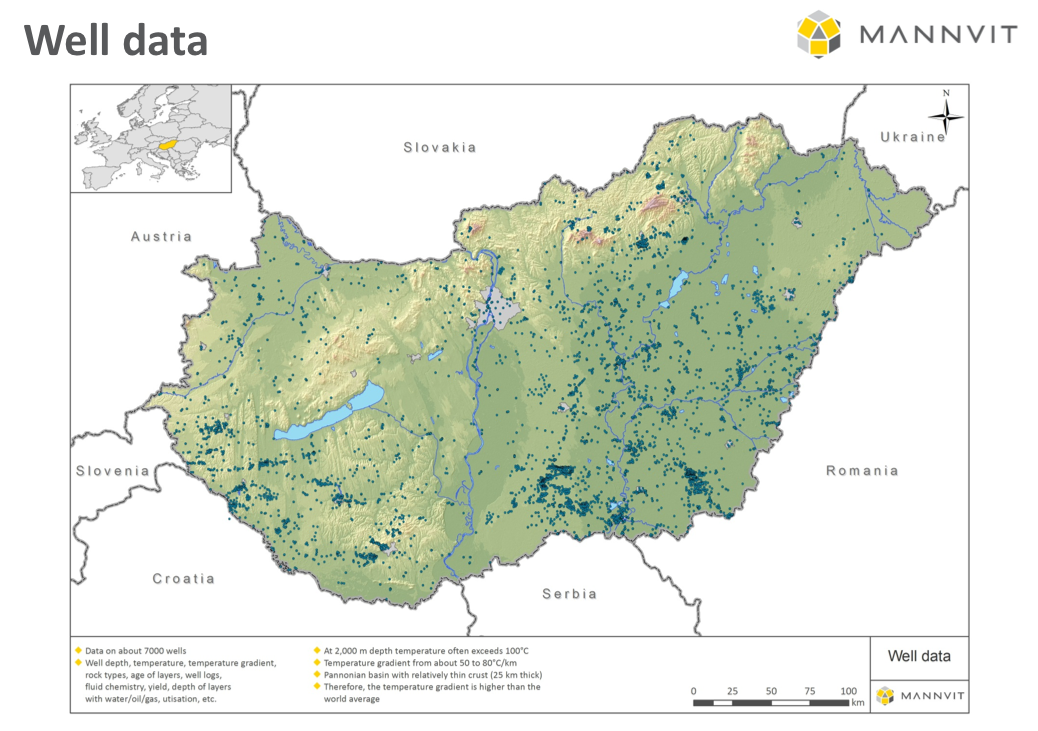
Mannvit-Hungary-Well-Data-MapThe project Mannvit is participating in is led by a consortium formed by Mannvit Hungary and EU-FIRE, which is a Hungarian real estate investment and consultant company. Mannvit Hungary is a subsidiary of Mannvit in Iceland, the veteran leader in geothermal power development with decades of experience in developing geothermal resources. The consortium is in a close cooperation with the Hungarian Ministry of National Development. Further development and execution of the project will require input from various engineering and scientific partners, both international and domestic.

The project was awarded almost EUR 40 million, while the total investment cost amounts to over EUR 100 million. This is a pioneering endeavor of creating a commercially viable geothermal resource for power generation in hot dry geological formations in Southeast Hungary. Geothermal energy systems constitute a sustainable source of electricity that is almost entirely free of greenhouse gas emissions. The Hungarian EGS project will produce electricity in an environmental friendly and sustainable way. The project will also provide various opportunities to strengthen the community with prospects in the fields of long-term employment in various sectors, knowledge transfer and development of secondary green industrial or horticultural development projects that will support social and economical development in the area.

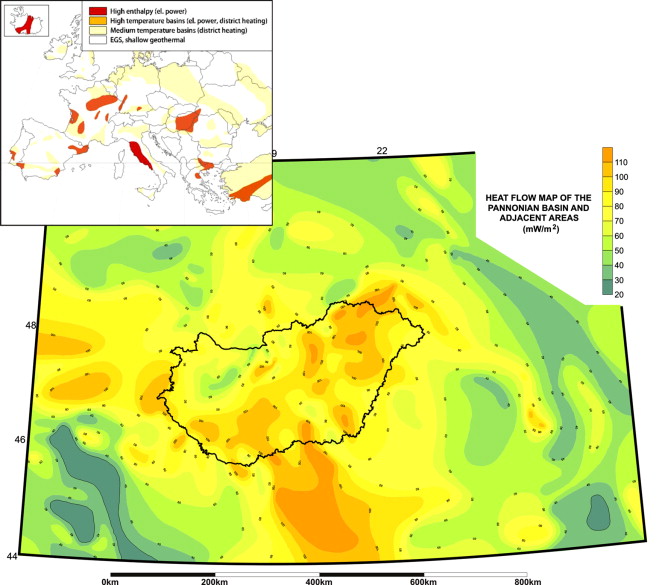
Hungary-Geothermal-Heat-Flow-MapThe EGS technology that lays the foundation of the project has an enormous potential to become an important contributor to the energy portfolio, not only in Hungary, but in the greater part the South Danube Region of central Europe. It represents a source of clean and renewable energy and thereby facilitates the EU goal  that 20% of the energy use is to be from sustainable renewable energy sources by 2020.

The Icelandic engineering firm Mannvit offers wide range of services in the fields of engineering, consulting, management, operations and EPCM contracting. The company was founded in 1963 and is employee-owned (more than 100 shareholders). It has headquarters in Reykjavik and branch offices or affiliates in Hungary, United Kingdom, Germany, Chile and the USA.

Other projects and activities by Mannvit on the European continent include mapping of geothermal potential in Serbia and deep drilling exploration project in Slovenia with the purpose to produce electricity. Also, Mannvit is developing geothermal possibilities in Bosnia and Herzegovina. More information about Mannvit can be found on the company’s website.

Gaining from the European green drivers

Electricity prices in Iceland are substantially lower than anywhere else in Europe. While common wholesale prices for electricity in Iceland are equivalent to 25-30 €/MWh, the wholesale prices in Europe are often double that and even more. This winter, for example, the average wholesale price at the European Power Exchange (EPEX SPOT) has been close to 50 €/MWh.

This means that if Iceland would have an electric cable connection with Europe, electricity could be sold from Iceland at a much higher price than being possible in the small Icelandic market. This  makes the European continent, Scandinavia and the United Kingdom a very interesting market for Icelandic generating firms.

STRONG DRIVERS:

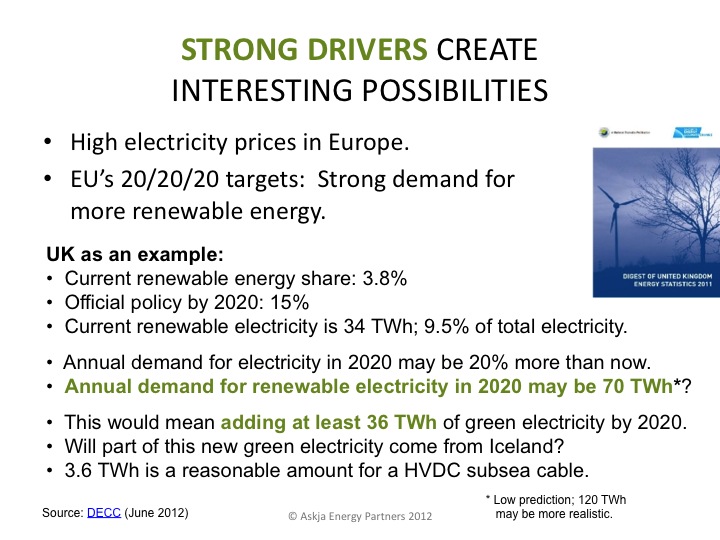
Slide21High electricity prices in Europe are not the only driver, creating more demand for Icelandic electricity. Almost all electricity in Iceland is generated by utilizing renewable sources (hydro- and geothermal power). The European Union (EU) has adopted a binding plan to greatly increase the share of renewable energy. According to EU’s Renewable Energy Directive, the Union is going to reach a  20% renewable energy target for 2020 – more than double the 2010 level of 9.8% – as well as a 10% share of renewable energy in the transport sector. The targets will help to cut greenhouse gas emissions and – what may be even stronger incentive – reduce the EU’s dependence on imported energy.

According to the Directive, the member states have taken on binding national targets for raising the share of renewable energy in their energy consumption by 2020. These targets range from 10% in Malta to 49% in Sweden. The national targets will enable the EU as a whole to reach its 20% renewable energy target for 2020 – more than double the 2010 level of 9.8% – as well as a 10% share of renewable energy in the transport sector.

UK AS EN EXAMPLE:

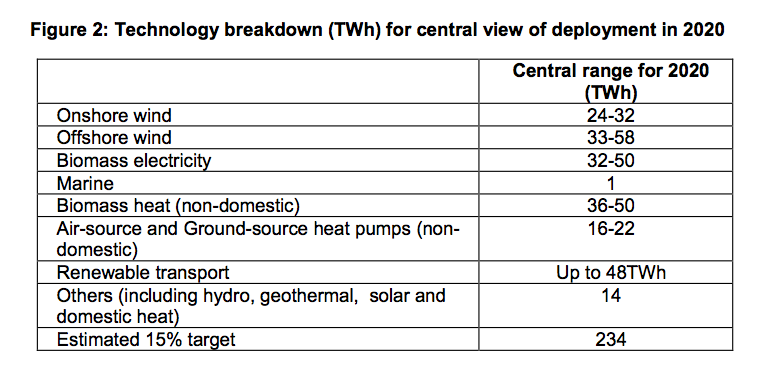
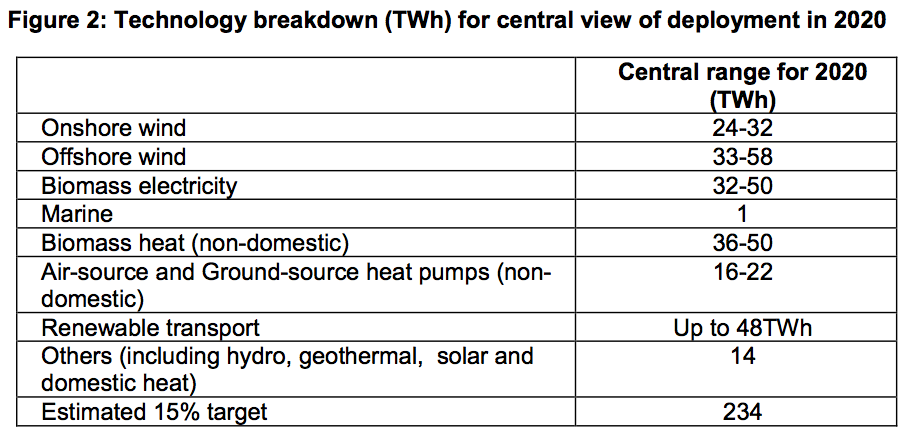
DECC-2011-Figure-2It is noteworthy that to be able to reach the targets, it is expected that for example the United Kingdom needs to add more than 170 TWh of annual renewable energy  by 2020 (UK needs to go from present less than 60 TWh to approximately 230 TWh by 2020). This is according to the 2011 UK Renewable Energy Roadmap (pdf) and the 2012 Update (pdf).

It is not clear how large share new renewable electricity will be of this total renewable energy addition of 170 TWh. However, from the 2011 UK Renewable Energy Roadmap it can be expected that the goal for 2020 may be somewhere between 104-155 TWh of annual renewable electricity generation (as described in a table marked as figure 2 in the Roadmap; shown here above). The current annual renewable electricity generation in the UK is somewhere between 34-38 TWh. Thus, the goal of 104-155 TWh of total electricity from renewable sources by 2020, will call for a new annual renewable electricity production of 66-121 TWh. Possibly, it would be fair to say that the UK needs to add close to 100 TWh to its annual renewable electricity generation. And this is to happen within seven years from now.

HOW ICELAND CAN PLAY A ROLE:

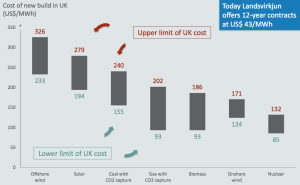
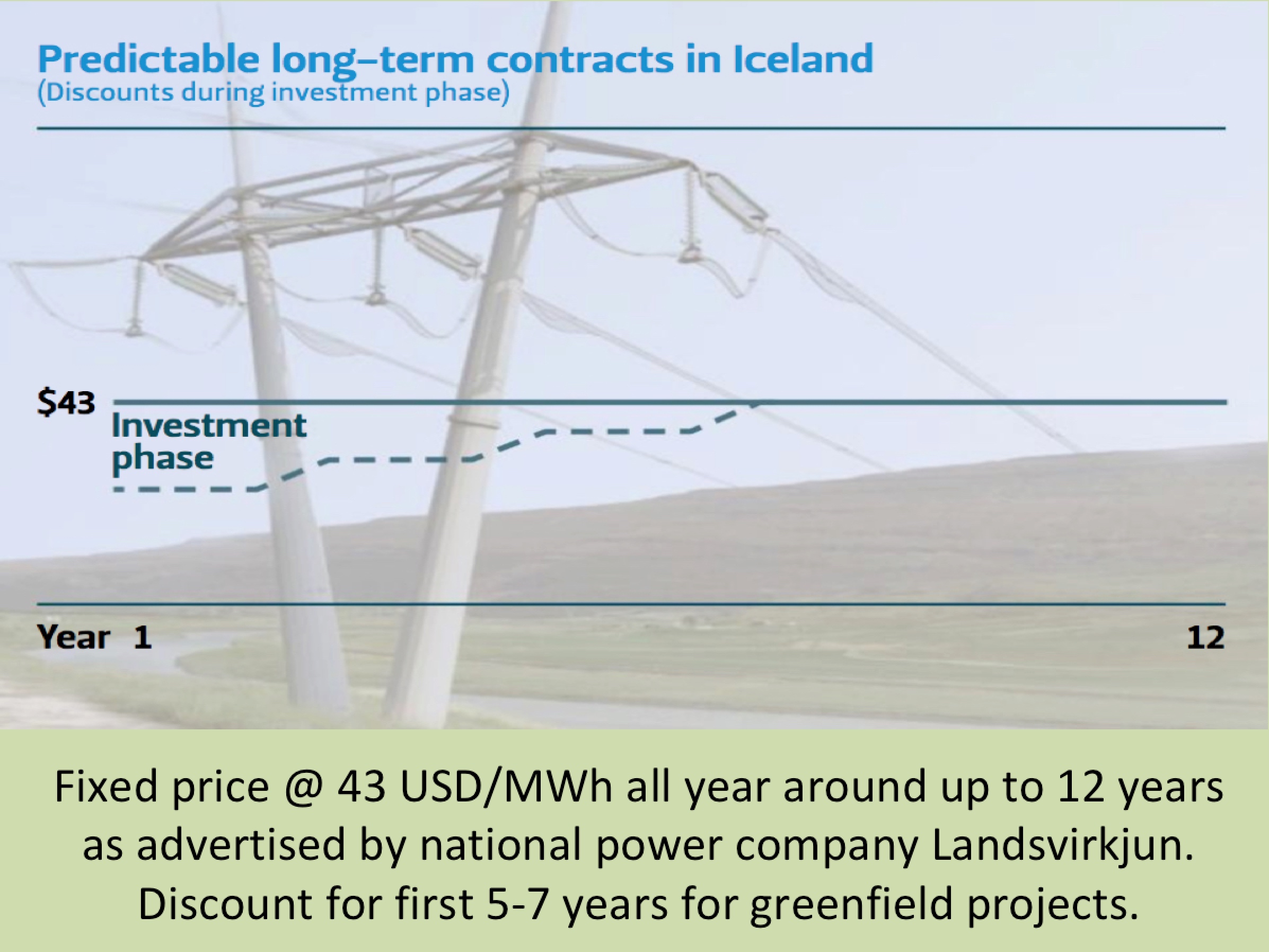
EU’s plan for increasing renewable energy allows the member states to import renewable energy from other countries. Iceland can offer substantial amount of electricity from renewable sources at very competitive prices (currently, the Icelandic power company Landsvirkjun offers new 12 year contracts at 43 USD/MWH, which equals approximately 32 €/MWh). It may be totally realistic that some of UK’s new renewable electricity will come from Iceland.

Slide22Iceland’s hydro- and geothermal power is less costly than for example new wind farms in the UK. In addition, Icelandic hydro- and geothermal power is a stable base-load power, unlike wind and unlike solar.

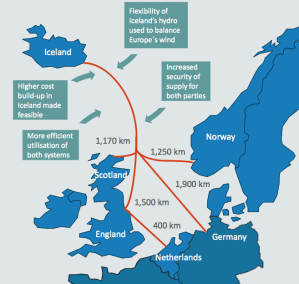
An electric cable between Iceland and the UK might be a win-win project. UK would gain access to reliable base-load renewable electricity. Icelandic power companies would increase their profits and could utilize the cable to import electricity from the UK when prices there are low (for example during the night, when demand is minimal).

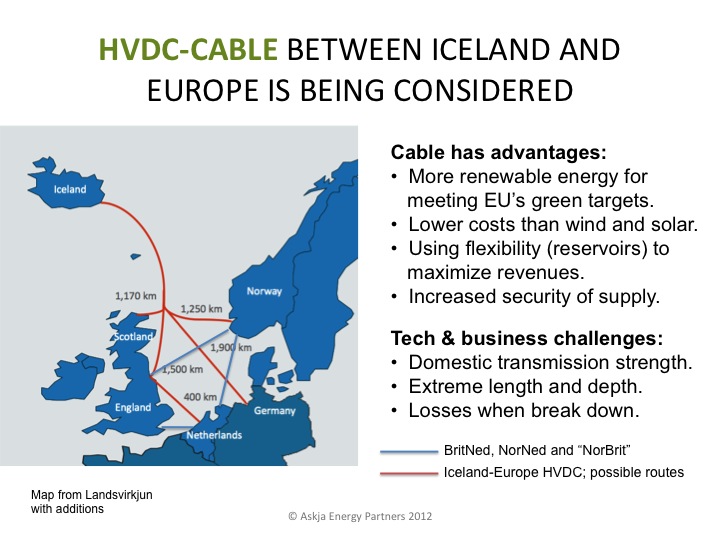
Such a high voltage direct current (HVDC) cable is currently being seriously considered by a group of Icelandic power companies and other stakeholders. This would be a technically and financially complicated project and probably it will take a couple years until any decision will be taken on the matter. For more information you are welcome to contacts us at Askja Energy directly with your inquiries.

Incentives for investing in Iceland

According to Icelandic law and regulations, businesses and industries are generally open to foreign investment. Because of Iceland’s strong legal relationship with Europe, the legal framework of the Icelandic energy industry is very similar to what applies in the European Union (EU). All individuals and other legal residents of Iceland or other member states of the European Economic Area (EEA),  European Union (EU), and European Free Trade Association (EFTA) are permitted to own enterprises which produce or distribute energy, and own energy exploitation rights with regards to water and geothermal energy.

The Icelandic Parliament has adopted a general act on incentives for initial investment in Iceland (law no. 99/2010). Governmental authorities are permitted to grant both general and regional incentives for new investments in Iceland up to a defined ceiling, in line with EU legislation. In addition to certain derogations from taxes and charges, incentives can also come in the form of direct cash grants, training aid and lease of land. Industrial sites are available around Iceland at competitive cost and local communities may offer certain extra incentives.

As a member of the EEA, Iceland has access to research funds of the EU for research and development programs and joint ventures undertaken with companies from at least one other EEA country (including all the countries within the EU). In addition, EU’s energy policy is a strong driver for the Icelandic energy sector. Close to 85% of Iceland’s consumption of primary energy is renewable energy, while renewable energy sources now account for only 12% of the final consumption of energy within the EU (this refers to energy used as electricity, heating, cooling, and transportation). The European Union has a target to increase the share of renewable energy sources in its gross final consumption of energy from 12% to 20% by 2020.

This policy by the EU not only calls for major investment in renewable energy production, but creates great possibilities for countries with unharnessed green energy sources available. With this in mind, it is interesting that only a portion of Iceland’s renewable hydro- and geothermal energy resources have been harnessed (approx. 20–25% of the total and probably around 40-50% when environmental concerns have been taken into account). Iceland may also offer interesting possibilities for large-scale wind power generation. In a nutshell, it is likely that EU’s energy policy will create substantial more interest in Iceland’s green energy industry and more demand for Iceland’s renewable energy sources.

Icelandic energy attracts foreign investment

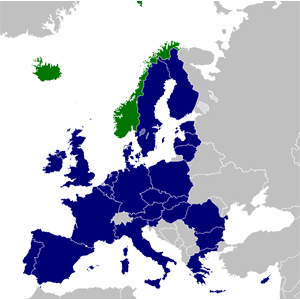
Although Iceland is an independent country with its own currency, the country has a very close economic relationship with its Nordic neighbors as well as the European Union (EU). In this regard, Iceland’s membership in the European Economic Area (EEA) is of special importance.

The EU has adopted an ambitious and binding renewable energy policy, generally referred to as the 20/20/20. The policy requires:

  • a reduction in EU greenhouse gas emissions (by 2020) of at least 20% below 1990 levels,
  • 20% of EU energy consumption to come from renewable resources,
  • and finally a 20% reduction in primary energy use compared with projected levels, to be achieved by improving energy efficiency.

These climate and energy targets will result in a highly increased demand for renewable energy, a demand where Iceland is well-suited to contribute. No less important for the green Icelandic energy sector is the upward-pressure this policy will put on electricity prices. In a nutshell, the EU’s legally binding energy and environmental legislation is making Iceland’s renewable energy more competitive than ever before.

The Icelandic energy and business sectors have been attracting numerous new types of foreign companies to the country in recent years, such as the data-center of Verne Global (a recent benchmarking study by PricewaterhouseCoopers (PwC) in Belgium described Iceland as the most competitive location for the operation of data centers). The latest large energy project in the country is the ongoing construction of the 95 MW Búðarháls Hydropower Station. Several other power projects are being considered and planned, with a total capacity of several hundred MW.

The Icelandic energy industry itself has also gained interest from foreign investors. Recently, Iceland’s third major electricity company (HS Orka) was bought by a Canadian energy investment firm, lead by geologist and resource company entrepreneur Ross Beaty, CEO of American Silver Corp. The electricity industry in Iceland is open to direct investment by all legal entities registered within the European Union (EU) and the European Economic Area (EEA). You can read more about this in our section about Foreign Investment.

The Iceland-Europe interconnector

Iceland is currently a closed electricity market with no cable connections to other markets. This may soon change. Technology advancement, strong demand for more renewable energy, and high electricity prices in Europe are making a submarine high voltage direct current (HVDC) cable between Iceland and Europe more feasible than ever before.

Unharnessed renewable energy

Iceland can substantially increase its green electric power production at a reasonable cost. Iceland is the only country in Western Europe that still has several large unharnessed hydro power options. Also, Iceland’s geophysical conditions offer numerous possibilities for low cost utilization of geothermal power, and Iceland has stronger and more stable winds than most of Europe.

Some of this natural energy will be harnessed for varied domestic industries, such as new data centers, metallurgical-grade silicon production, etc. Iceland also has the possibility to do business with electric power through a submarine cable to Europe. Such a connection would not only be based on Icelandic hydro- and geothermal power, but would open up the possibility of large-scale harnessing of Icelandic wind power.

Choosing the best business model

So far the longest submarine HVDC-cable is the NorNed between Norway and the Netherlands (580 km / 369 miles). The interconnector between Iceland and Europe would be at least double that length, so it will definitely be a challenging project.

Such an  interconnector would not only enable sales of renewable electricity at high prices but also have various other benefits for the Icelandic electricity system, such as more efficient use of the generation capacity and enhance the security of supply. Currently, three scenarios are being studied. The first concerns an interconnector that would be used for export/import only, based on market prices.  The second involves a cable used for export only, and the third assumes an interconnector used in part for export/import and in part for export.

Green AND competitively priced

The main drivers behind an electric cable between Iceland and Europe are high electricity prices in Western Europe and the growing demand in Europe for more renewable energy.

According to engineering and management firm Parsons Brinckerhoff and consultancy firm  Mott MacDonald Group, as presented by Landsvirkjun, Iceland’s electricity prices are much lower than can possible be offered by new electricity generation projects in the United Kingdom (UK). This is especially interesting when having in mind UK’s energy policy, with the goal of increasing its renewable energy consumption from the present 54 TWh to 234 TWh no later than 2020.

This goal, which is based on European Union’s (EU) and UK’s energy policy, will only be achieved with major investments in new green energy projects. Those projects will for example include very expensive and controversial onshore and offshore wind farms in the UK. For example, the minimum cost for offshore wind electricity in the UK is equivalent to 233 USD/MWh.

When comparing this to Icelandic renewable energy cost, it is quite obvious that an electric cable between Iceland and UK is an exciting option (Icelandic Landsvirkjun is currently offering long-term electricity contracts at 43 USD/MWh). Thus, it is not surprising that Mr. Hörður Arnarson, CEO of Landsvirkjun, has described the laying of a submarine cable to Europe, together with vigorous industrial development in Iceland, as probably being “one of the biggest business opportunities Iceland has faced”.

The two charts above are from a presentation by Landsvirkjun, given at an energy seminar in Reykjavik in last May (2012).

The United Kingdom and Icelandic electricity

The British Minister for Energy and Climate Change, Mr. Charles Hendry, was recently in Reykjavik discussing energy issues with Icelandic authorities and people in the industry. Mr. Hendry also gave a speech at an energy-seminar at the headquarters of the Icelandic Arion bank.

One of the main issues discussed were the possibility of connecting Iceland and the United Kingdom (UK) with an electric cable. The cable would transfer green electricity from Iceland’s natural renwable sources to the UK. Such a cable would also offer Iceland access to competitively priced electricity genereted in the UK during night (when demand in the UK is low). Thus, this could be a win-win project.

It is no surprise that the British Government is looking for acess to new sorces of green electricity. The share of renewable energy in the UK is very low. The total annual production of renewable energy in the UK is 54 TWh, which only accounts to approximately 3.5% of the country’s energy consumption.

The UK is determined to increase the share of renewable energy substantially. This is not only a governmental position but also a binding obligation according to the common energy policy of the European Union. Thus, the UK Department of Energy and Climate Change now has published the goal of having 15% of the UK’s energy consumption delivered from renewable sources by 2020.

Let’s look at what this means in numbers. The cost is very uncertain but definitely very high. It is of course hard to foresee exactly how much energy the UK will consume by 2020. According to the Department of Energy and Climate Change it is expected that the UK’s total annual energy consumption in 2020 will be 1,557 TWh. And 15% of 1,557 TWh is 234 TWh.

This means that the UK has to increase its renewable energy consumption from the present 54 TWh to 234 TWh no later than 2020. This is an increase of 180 TWh! 180 TWh of new green energy that needs to beavailable within less than a decade from now. In comparison the whole nuclear industry in the UK produced 69 TWh last year (2011.)

To achieve this goal of adding 180 TWh of renewable energy by 2020, green energy consumption in the UK will need to increase by 22.5 TWh each year over a period of 8 years. Obviously this renewable energy target calls for major investment in all kinds of green energy projects, including for example biomass, geothermal, hydro, solar and wind. Large portion of the new green energy will come from new renewable electricity generation (renewable heat and renewable fuels will have to increase substantially). Renewable electricity will need to maintain a growth rate of approximately 15% per annum from the 2010 baseline.

In addition to more renewable generation at home the UK is also focusing on major imports of electricity from renewable sources in neighbouring countries – like Norway and Iceland. This is why the British Minister for Energy and Climate Change is very positive towards an electric cable between UK and Iceland.

In fact Iceland has been considering such a connection between Iceland and Europe for years and even decades. However, it is probably not until now that such a high voltage direct current cable (HVDC) is becoming both tecnically possible and financially feasable.

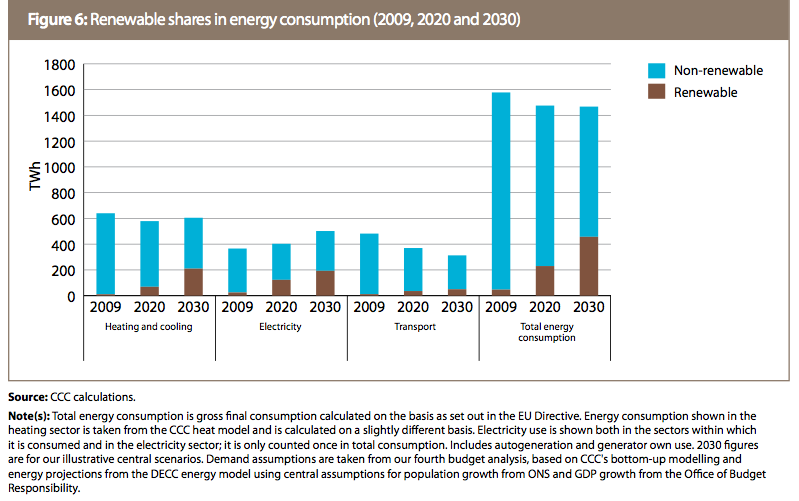
And keep in mind that the British Government is already considering even more ambitious renewable energy targets for 2030 and beyond. Recent independent advice from the British Committee on Climate Change (CCC) has concluded that there is scope for the penetration of renewable energy to reach 30-45% of all energy consumed in the UK by 2030!

At the same time Iceland is in the somewhat unique position to have access to several excellent unharnessed renewable energy opportunities. In the coming weeks we will be presenting more information about the possible Iceland-UK interconnector  and explain Iceland’s potentials for generating more renewable electricity and gaining from Europe’s high electricity prices.

More information about UK’s energy policy and future scenarios:
–  UK Renewable Energy Roadmap
–  UK’s Renewable Energy Review
The charts above are from these two reports.