Skip to content

Posts from the ‘Northern Energy’ Category

Study on cost of IceLink: 2.7 billion USD

The cost of a 1,200 MW HVDC electric submarine cable between Iceland and the United Kingdom (UK) is likely to be GBP 1.58-1.68 billion (USD 2.63-2.80 billion). This includes the cable (with a capacity of 1,200 MW), converters, cable mobilization, and installation. These cost-figures are presented in a research paper from 2010; Proposed Iceland / UK (Peterhead) 1.2 GW HVDC Cable. The authors are three engineers; Thomas J. Hammons from University of Glasgow in Scotland, Egill Benedikt Hreinsson from University of Iceland, and Piotr Kacejko from Lublin University of Technology in Poland.
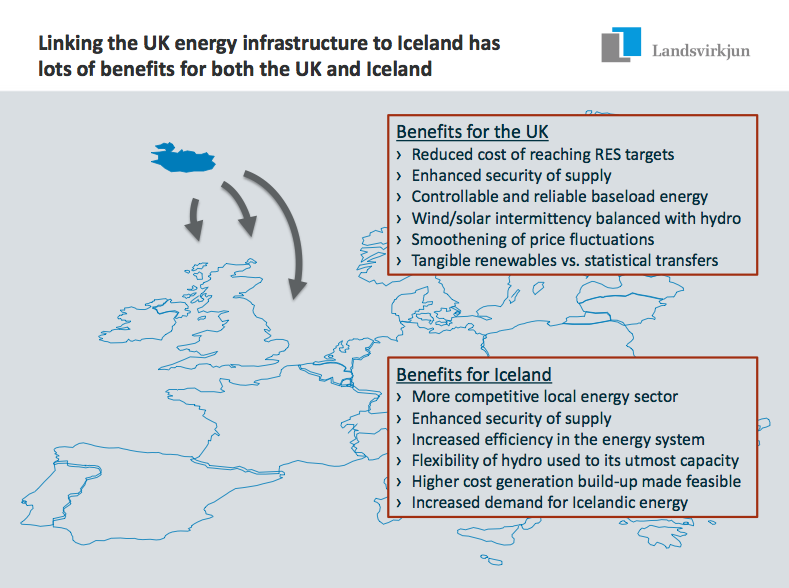
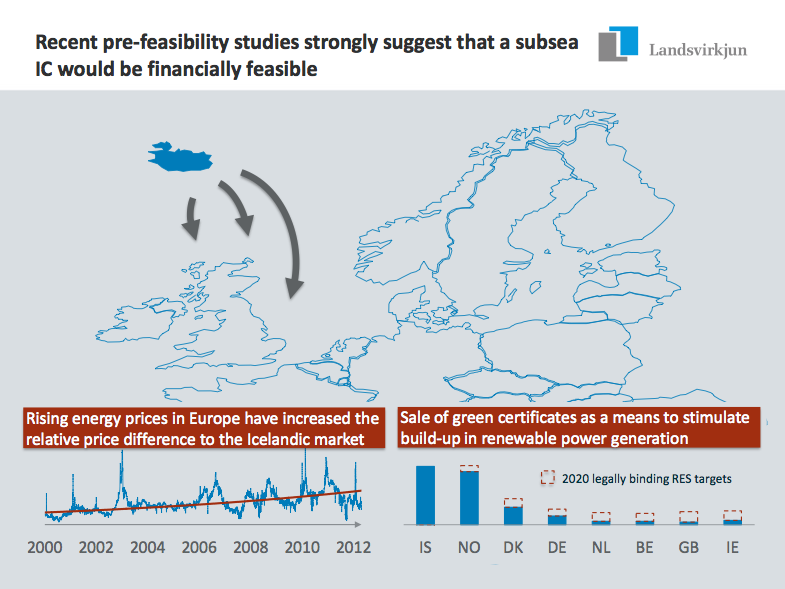
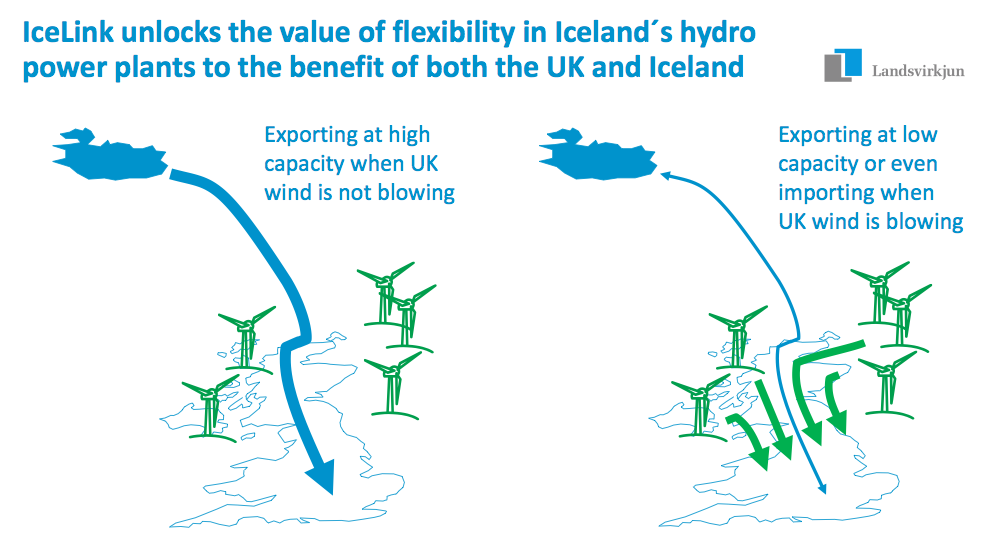
LV-HVDC-Iceland-UK-London-august-2012-2The subject of the paper is a 1,200 MW connector from Iceland to a landing point at Peterhead Scotland (a distance of 1,170km). The paper addresses market considerations with cost of electricity in UK (from new offshore and inland wind power, gas, coal, and nuclear), investments for the development of hydro resources in Iceland, investments for submarine cables and converter plant, and overall capacity of the link. Also reviewed by the authors, is the exploration of deep unconventional geothermal resources in Iceland that could be harnessed in future and developed for the IceLink. The economics, availability, and reliability of geothermal plants are reviewed. [The slide above is from a recent presentation by the Icelandic power company Landsvirkjun}

According to the paper, there should be no major difficulties in the manufacture and laying of submarine cables of length and type necessary for the IceLink connector. What is no less interesting is the finding that the cost of delivered energy would be very competitive with offshore and onshore wind, and of new coal/gas and nuclear plant. Also, the connection would offer high reliability; at least equal to that of new coal/gas and nuclear plant in the UK.

The main conclusions are as follows:

  1. Cost of electricity delivered would be very competitive with that from new wind-farms, nuclear, modern gas/coal fired plant, and tidal barrage / tidal stream power.
  2. Availability of the connection should at least equal that from nuclear, and gas/coal fired plant.
  3. No major difficulties are anticipated in manufacturing, laying and repairing the submarine cables or in construction of hydro schemes for the Link.
  4. Expected life for hydro developments is at least 60 years, submarine cables 50 years, and rectifier/inverter stations 30-40 years.
  5. The link could be considerably expanded in future to utilize deep-well geothermal power when the technology is proven.
  6. The contribution would make a significant contribution towards UK and European targets for renewable energy. The development would benefit the Icelandic economy, rather than demanding huge amounts out of a heavily damaged economy without supporting necessary recovery.
  7. The Icelandic hydroelectric system is likely to be a perfect match for interacting with the UK/North sea wind energy resources in a similar way as the Norwegian hydroelectric power system.
  8. The HVOC UK-Iceland link can serve partly as a one­ way exporter of hydroelectric or geothermal energy from Iceland to the UK or it can be considered as a short term bilateral medium for hourly interaction of hydro with marketslwind based on market signals or short term shadow prices. This dual role should be further defined in a negotiation process between the respective national authorities.
IceLink-Study-University-of-Iceland-2010The study can be downloaded here (pdf) from the website of University of Iceland.

Icelandic electricity would be competitive in the UK

In a recent study, Bloomberg New Energy Finance (BNEF) assessed the political, technological and economic feasibility of an 1,100 km interconnector to bring green Icelandic electricity to the United Kingdom (the project is called IceLink).

BNEF-logoAccording to BNEF, the prospects for implementation of such a project seem quite positive. All the technological and economic barriers regarding the IceLink are believed to be surmountable.

Regarding the economics , BNEF claims that the project is competitive in relation to other zero-carbon options. This for example applies to new offshore wind-farms in the UK and also to the recently agreed Hinkley Point C nuclear project. Electricity produced in Iceland and delivered in the UK, could be lower priced than the confirmed contract-for-difference (CfD) strike prices that have been confirmed for new renewable electricity projects in the UK (as announced by the UK Department of Energy and Climate Change; DECC).

The electricity from the IceLink would have a levelized cost of 86 GBP/MWh (close to 145 USD/MWh) as central estimate by BNEF. This number is based on BNEF’s analysis of the costs of high voltage direct current (HVDC) cable development and geothermal build-out in Iceland. In comparison, DECC’s announced strike price for electricity produced in the UK by hydropower is 100 GBP/MWh (165 USD/MWh), and 140-145 GBP/MWh (235 USD/MWh) for geothermal power.

BNEF-summit-2014What is even more interesting, regarding the competitiveness of the green Icelandic electricity, is the UK strike price for electricity from wind power; 140-155 GBP/MWh (approximately 250 USD/MWh). Wind power is the UK’s major source for increasing renewable electricity. However, this technology is substantially more costly than buying electricity from Iceland via subsea cable. In addition, the wind power is very unstable, while the Icelandic hydro- and geothermal power is a very stable power source. Thus, the cable could be excellent business for the UK. At the same time it could create strong new export revenues for Iceland.

UK will import more power from neighbouring countries in the future

LV-HVDC-Iceland-UK-London-august-2012-1According to the UK National Grid, the UK will import more power from neighbouring countries in the future as the country’s electricity margin continues to tighten. The Financial Times recently wrote about how one of the new subsea electric cables to be constructed is likely to be a cable between UK and Iceland (sometimes referred to as the IceLink):

Swiss engineering group ABB last year commissioned a 262 km interconnector to link Ireland’s grid to the UK’s. National Grid is also working on interconnector projects with Belgium, Denmark, Norway and Iceland. About 5-7 GW of additional capacity could flow from the new interconnectors over the next decade or so, said Mr Bonfield. However, some of the interconnector projects are more feasible than others. A link between UK and Iceland may be the best economic option.

LV-HVDC-Iceland-UK-London-august-2012-2Net electricity imports cost the UK about GBP 365 millions in the past six months of 2013, two and a half times more than two years previously, according to data supplied by ICIS, the price reporting agency. Electricity imports can be cheaper than those produced by UK suppliers and are a small but growing part of the country’s overall power supply. Power is produced in France and the Netherlands and imported via subsea interconnectors. Electricity flows both ways but the UK currently buys more than it sells. And there will be a rise in Uk’s power imports, says Andrew Bonfield, National Grid’s chief finance officer .“[This is] because there is a pricing differential which we believe will be beneficial to the country, and ultimately customers.”

National Grid will invest about GBP 3.5 billion this year, most of which will go towards reinforcing its UK transmission infrastructure. Power imports should help National Grid level out peaks and troughs from renewable energy production and deal with the UK’s diminishing electricity margin, which represents the safety cushion of spare power generating capacity (National Grid previously said that the electricity margin during peak demand in cold weather will be 5 per cent, down from more than 15 per cent in the winter of 2011-12). IceLink could become an important part of this strategy, opening access to Iceland’s 100% renewable power geothermal- and hydro power generation.

The two illustrations above are from a presentation by Mr. Hörður Arnarson, CEO of the Icelandic Power Company Landsvirkjun, presented in August 2012.

UK National Grid: IceLink is feasible, achievable and viable

Economist-Iceland-UK-HVDCAccording to a recent article in the Schumpeter column of the Economist, the proposed IceLink power cable between Iceland and Britain seems to be getting a deservedly serious hearing.

The IceLink would be the longest undersea cable in the world, at at least 1,000 km, costing on current estimates billions of EUR.  According to the Economist It would take four years to construct the cable and would have a capacity of 1,000 MW. And the Economist is very positive about the project:

Iceland is in a unique position with regard to energy: it has in effect unlimited power, from both geothermal and hydro-electric. Apart from keeping the hardy Icelanders warm, it also runs aluminum smelters. But exporting electricty would give the small island economy a new source of income (the main other ones, since the collapse of the financial bubble, are fish and tourism).

HVDC-Cable-Iceland-Europe-map-slideThe Economist goes on by pointing out that the attraction of the IcLink for Britain is flexibility. The increasing dependence on wind energy, which produced a record ten percent of Britain’s power in last December (2013), may be questionable from an economic point of view. And it creates a technical difficulty too: if the wind drops, you need a speedy alternative source of power. When it blows strongly, you need somewhere to store it. Iceland’s stable geothermal- and hydro-electric generation is ideal for both purposes. But Britain has rather little hydro and close to none geothermal.

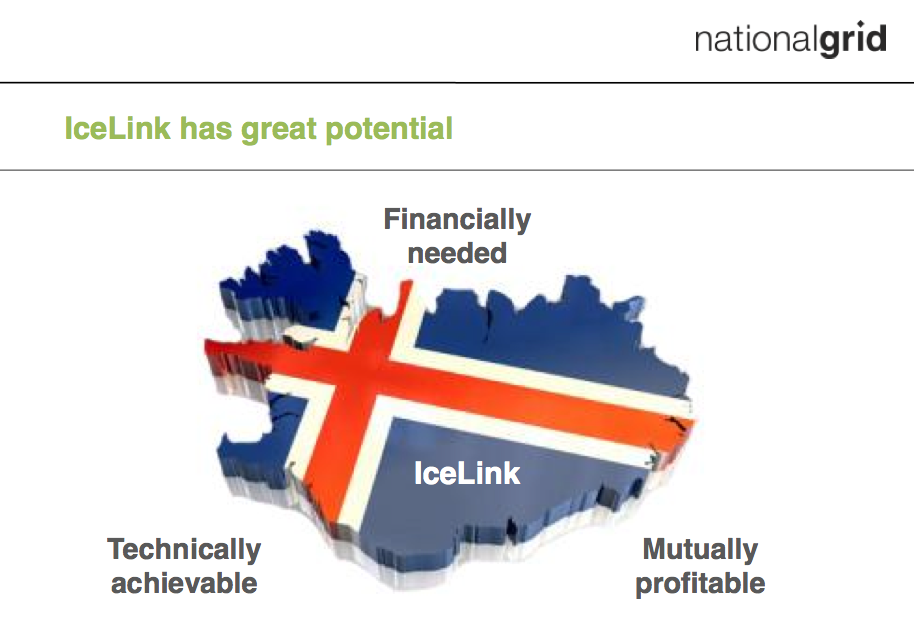
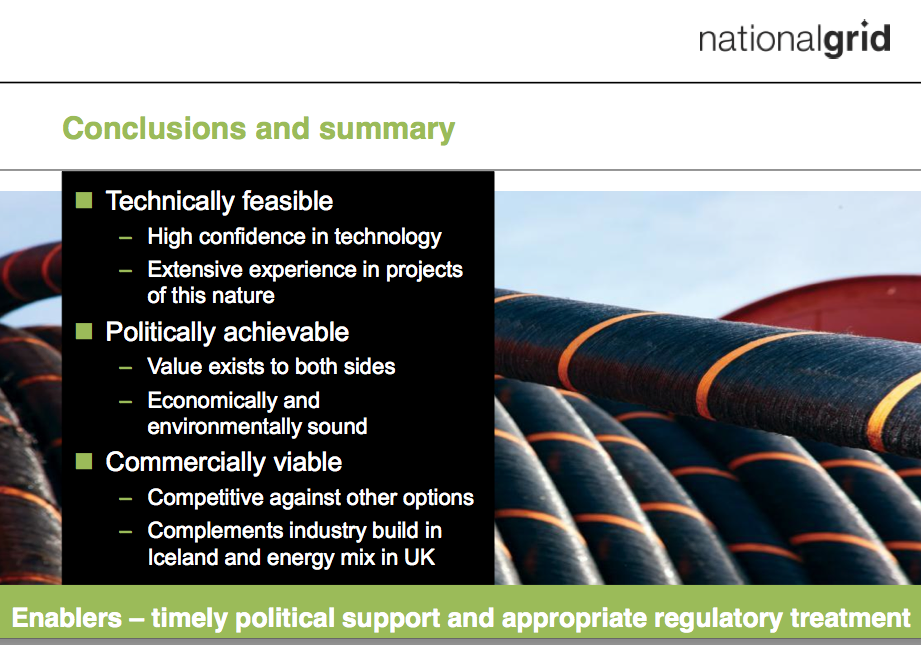
According to the Economist, the UK National Grid (the transmission operator for electricity and gas) likes the project, describing it as “Technically feasible…Politically achievable…Commercially viable”. Britain and Iceland signed an intergovernmental memorandum of understanding on the project in 2012. In June last year, the project won backing from an UK cross-party government advisory committee. Now the British government is waiting for the Icelandic side to come out with a firm proposal.

UK National Grid showing interest in IceLink

According to news from Norwegian energy information provider Montel, the cost of electric power from the potential subsea interconnector linking the UK with Iceland  will be around GBP 100/MWh (164 USD/MWh). This new subsea cable, which is sometimes referred to as the IceLink, would thus offer electric power at substantiall lower prices than for example from offshore wind.

Icelink-HVDC-UK-NG-nov-2013-5The IceLink would be a high voltage direct current (HVDC) cable, with a power capacacity of 700-1,000 MW.  It would be 1,000-1,500 km long, making it qute a bit longer than any existing subsea cable of this kind today. The longest subsea electric cable is currently the 580 km NorNed cable between Holland and Norway. Longer cables of this type are being planned, such as a cable between Norway and the United Kingdom that will be more than 700  km long, and even longer cables in the Mediterranean.

Mr Hörður Arnarsson, CEO of the Icelandic  state owned power company Landsvirkjun has expressed that the Icelink cable could add “very valuable” flexibility to offset intermittent renewables production in the UK. Landsvirkjun generates 75% of all electricity used in Iceland.

Icelink-HVDC-UK-NG-nov-2013-4In May 2012, Icelandic and UK ministers signed a memorandum of understanding over a new interconnector between the countries. The UK TSO National Grid has been showing interest in the Icelink, focusing on issues such as supply diversification, and gaining access to the reliable hydro- and geothermal energy resources of Iceland.

In the last few months,Mr. Paul Johnson, Project Director and Head of Cables at National Grid, has at numerous occasions expressed that the need for such an interconnector between Iceland and the UK has come to the fore. According to Mr. Johnson, the IceLink is a realizable goal and there is political will for the connector. Mr. Charles Hendry, MP and former UK Energy Minister has been of the same opinion, as the IceLink project offers low-risk, predictable returns attractive to investors, such as pension and infrastructure funds.

Icelink-HVDC-UK-NG-nov-2013-7

According to Montel, the costs of the IceLink are estimated at GBP 4 billion, with it being possibly completed by 2022. The project could supply up to 5 TWh of power annually to Britain from hydro, geothermal and wind sources in Iceland.

While Icelanders still need to engage in national discussions about the costs and benefits of a subsea power cable to the UK, policy makers in the UK seems to agree on the project. In addition, the President of Iceland, Mr. Ólafur Ragnar Grímsson, has addressed leaders and people in the energy business, expressing his view that the Icelanders and the Brits should jointly examine the options of an interconnector.

Iceland-UK-BICC-meeting-Nov-2013-ORG-2At an energy conference in London in last November (2013), Mr. Grímsson said the proposed IceLink should be hard-headed analysis driven by engineers and energy specialists. “We should listen to the government in Britain…then in two to three years we can come back to the table and make the real decision.”

Grimsson said popular support was necessary before a project to bring geothermal power from Iceland to the UK could get off the ground. “As we move forward we need to bring all segments of Icelandic society into this discussion,” he said. “Then we will take a decision based not only on the business sense and the technical feasibility [of the project] but on the national will,” Grimsson said, adding that unless “there is a broad national will behind this, you will never get the necessary players on board”.

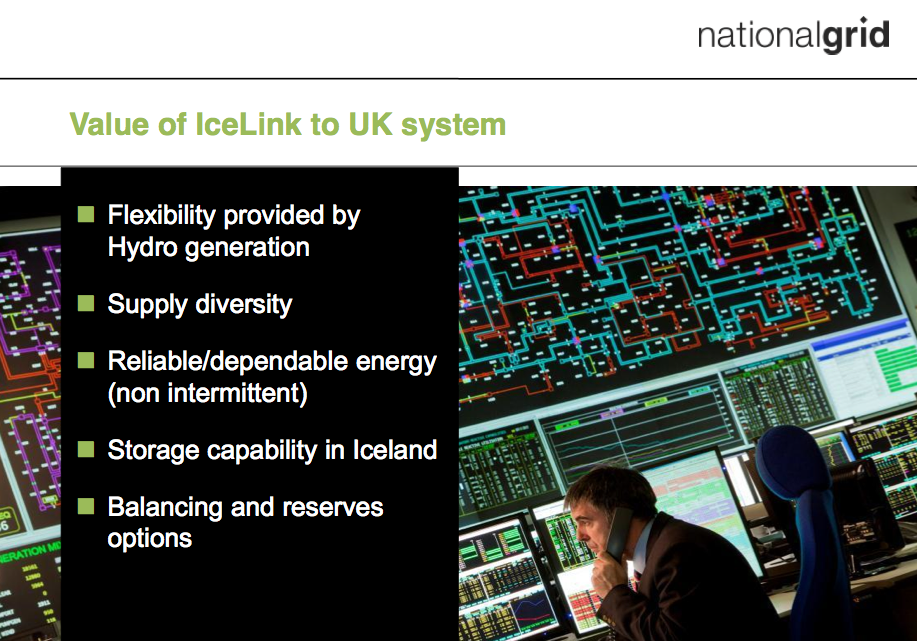
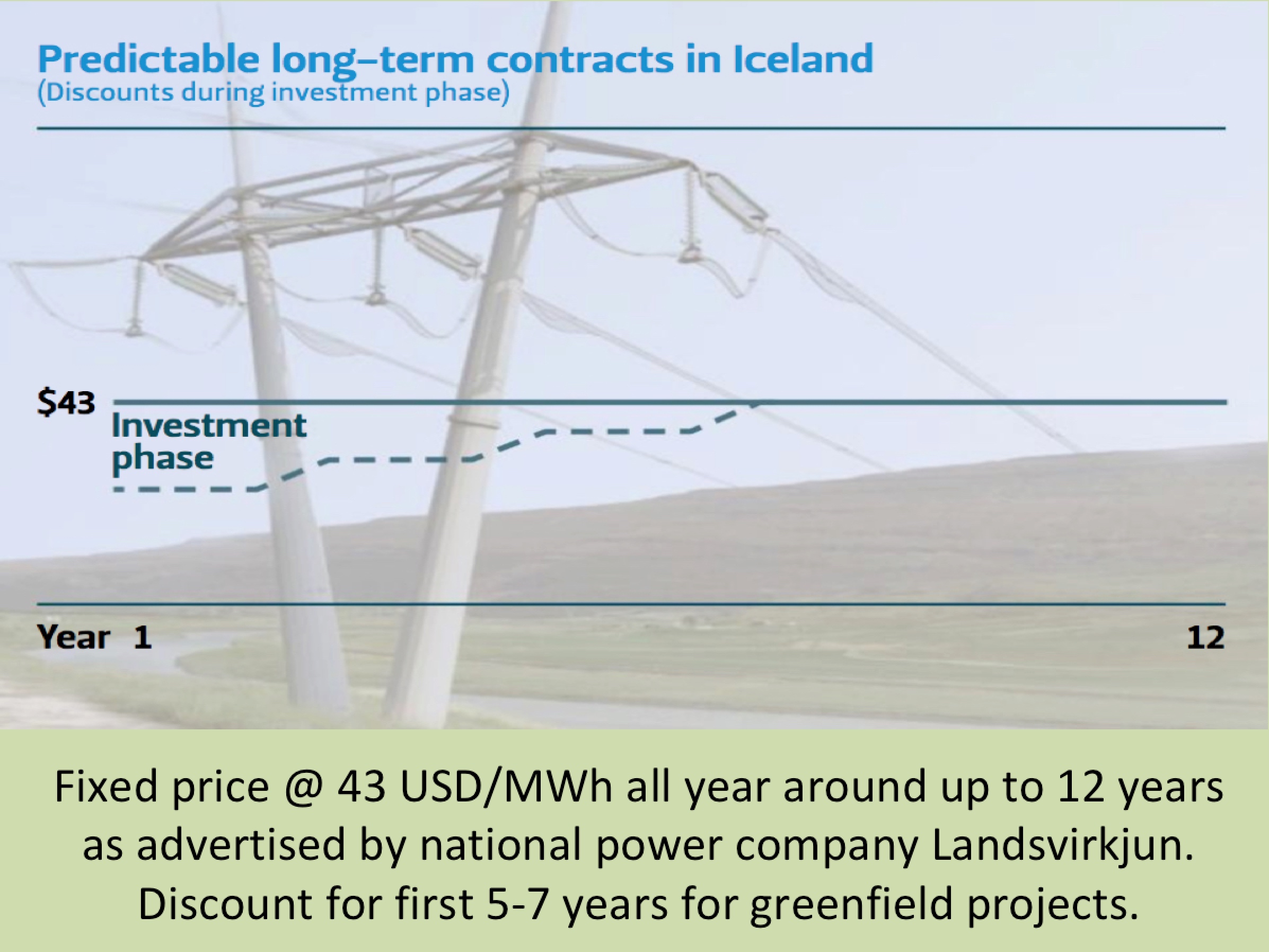
The three slides above are from a presentation given by Mr. Paul Johnson from UK National Grid, at the Bloomberg Icelandic Energy Summit. It took place in London on November 1st 2013.

Interesting development in UK electricity strike prices

Earlier this month (December 2013), the British Department of Energy and Climate Change (DECC) introduced the strike prices that will be on offer to energy developers in the coming years.

UK_DECC_Final_Document_-_Investing_in_renewable_technologies_-_CfD_contract_terms_and_strike_prices_UPDATED_6_DEC-coverThis new regime especially focuses on increasing investment in new renewable energy projects. According to Ed Davey, UK’s Energy and Climate Change Secretary, the new levels of support are designed to provide certainty to investors and will ensure the UK meets its 30 percent renewable electricity target in 2020 (doubling the current percentage of electricity generated from renewable sources, which now is 15 percent). The package will deliver record levels of investment in green energy by the end of the decade (GBP 40 billion) and is expected to attract investors from around the world so Britain can replace its ageing power stations, ensure access to sufficient electricity, reduce greenhouse gas emissions, and create green jobs.

The geothermal industry is  likely to welcome the plan by the UK Government to increase geothermal strike price by extra 20 GBP/MWh each year, meaning geothermal developers can expect at least 140-145 GBP/MWh in the coming years. It is also interesting, that hydropower schemes have been allocated a boost of extra 5 GBP/MWh, with strike prices to be 100 GBP/MWh. However, most of the new green electricity will come from offshore wind power, where the strike prices will be 140-155 GBP/MWh.

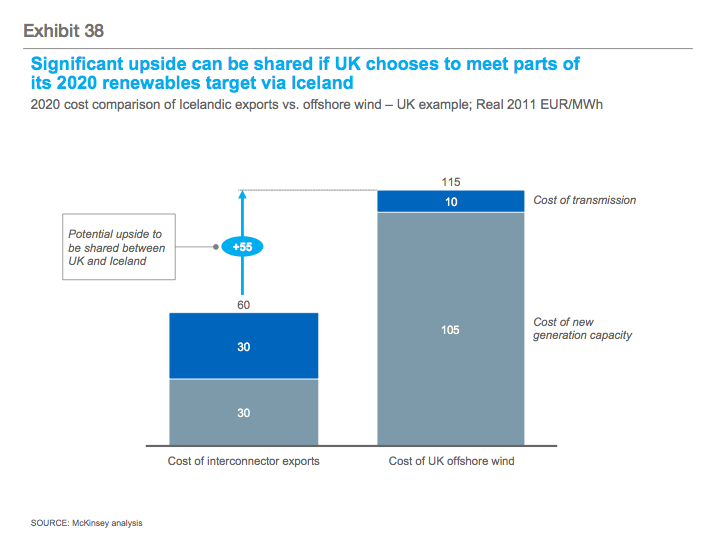
Iceland-Electricity-HVDC-Cable-to-Europe-at-competitive-prices-McKinsey-2012It is worth having in mind that Iceland could most likely offer the UK base-load green electricity (from geothermal- and hydropower sources) at substantially lower prices than the average strike prices. A recent independent report by the well known management and consulting firm  McKinsey, introduced a positive view towards constructing an interconnector (HVCD cable) between Iceland and Europe. According to McKinsey, such an interconnector could offer substantial cost savings for the buyer of the Icelandic electricity.

McKinsey puts forward the idea that price for the Icelandic electricity might be somewhere between 50-95 GBP/MWh (60-115 EUR/MWh). This is a much lower price than the UK strike price for offshore wind power.  By sharing the benefits, offered by the cheaper Icelandic electricity, between Iceland and the UK the strike price for the Icelandic electricity could possibly be as low as 75 GBP/MWh (which is equivalent to 90 EUR/MWh and approximately 125 USD/MWh). And even if the strike price for the Icelandic electricity would be close to 95-100 GBP/MWh (115 EUR/MWh or 155 USD/MWh), this would be lower than the British strike price for geothermal-, hydro- and wind power.  Therefore it is quite clear that an electric interconnector between Iceland and UK is a very interesting business opportunity.

The Nordic energy infrastructure is gaining interest

Public ownership is widespread in the energy sector of the Nordic countries. This especially applies to the transmission system operators (TSO’s). Strong state ownership is also the norm regarding all the main electricity producing companies and oil exploration companies in the Nordic countries. However, private investment has been increasing in the Nordic energy sector, especially in energy infrastructure projects and renewable energy production.

Nordic-Energy-Perspectives-CoverThe Norwegian electricity company Statkraft and the Norwegian TSO Statnett are both 100% owned by the Norwegian state. Norwegian oil giant Statoil is 70.9% owned by the Norwegian state.

The Swedish electricity company Vattenfall is 100% owned by the Swedish state and so is the Swedish TSO Svenska Kraftnät. Finnish electricity company Fortum is 50.76% owned by the Finnish state. And the Finnish TSO Fingrid is 53.1 % owned by the Finnish state.

Icelandic electricity company Landsvirkjun is 100% owned by the Icelandic state. And the Icelandic state owns  87.24% in the Icelandic TSO Landsnet (through 100% state owned Landsvirkjun and Rarik). In Denmark, the Danish state has owned 76,49% in the energy company Dong Energy. And the Danish TSO Energinet.dk is 100% owned by the Danish state.

Thus, all the major Nordic electricity companies and the TSO’s are controlled by the relevant Nordic state, and also the main Nordic oil exploration companies. Although this ownership structure of the Nordic energy sector will probably not change much in the near future, we may be experiencing increased private investments in certain parts of the Nordic energy sector. This seems especially to apply to infrastructure and renewable energy.

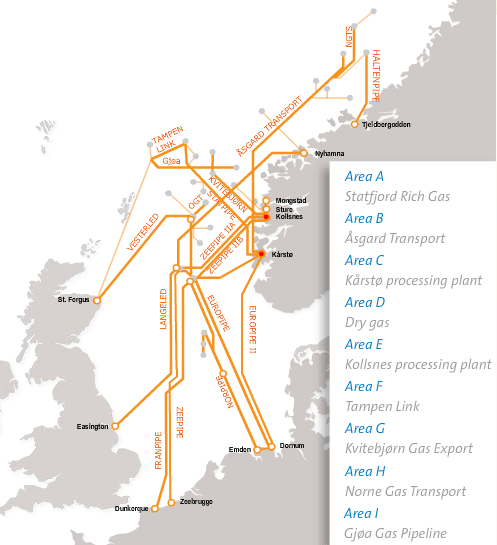
Norway-Gassco-PipesSubstantial private investment is already to be found in Statoil (oil & gas), Fortum (electricity), Fingrid (TSO), and in Dong Energy (oil, gas, heating & electricity). In addition, the Norwegian state has sold large share of the natural gas transportation infrastructure system that links the gas resources of the Norwegian continental shelf with the neighbouring countries. Today, the Norwegian state owns only 45.8% stake in Gassled (through the state owned oil license investing company Petoro), plus its stake through Statoil, which owns 5% in Gassled. The major private investors in Gassled are Abu Dhabi Investment AuthorityCanada Pension Plan Investment Board, and the German insurance and financial services group Allianz (together they own 24.75% in Gassled).

The most recent private investment in the typically state owned Nordic energy sector took place earlier this year (2013). When two funds (managed by Goldman Sachs) and two Danish pension funds (Arbejdsmarkedets Tillægspension; ATP, and Pension Forsikringsaktieselskab; PFA) agreed to buy 26% stake in the Danish Dong Energy. When this 2 billion USD deal will be finalized (probably within a few weeks) it is expected that Goldman Sachs will own approximately 19% in Dong Energy, ATP approximately 5% and PFA approximately 2%. The Danish state will still be owner of more than half of the shares in the company.

It is expected that this deal will allow Dong to strengthen its balance sheet (hit by falling electricity demand due to the economic crisis and competition from coal) and to pursue its ambition to become a leading player in offshore wind energy. Thus, the deal has a strong renewable energy aspect. Dong Energy is already European market leader with almost 2 GW of offshore wind power installed in Denmark, Britain and Germany. And the company wants to more than triple that to 6.5 GW by 2020.

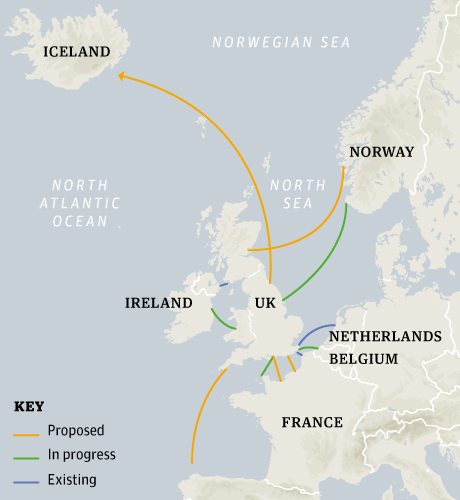
UK-Electric-Subsea-Cables-MapThe investments by the Goldman Sachs funds, Abu Dhabi Investment Authority, the Canadian pension fund, and Allianz are good examples of increased interest in the Nordic energy infrastructure and renewable energy. This may be a positive development, having regard to financing of the IceLink (an electric cable between Iceland and the UK). Financing projects like that could be perfect fit for large pension funds and investment vehicles.

Upcoming new world-record subsea electric cables

An electric subsea cable between Iceland and Europe is currently being considered.

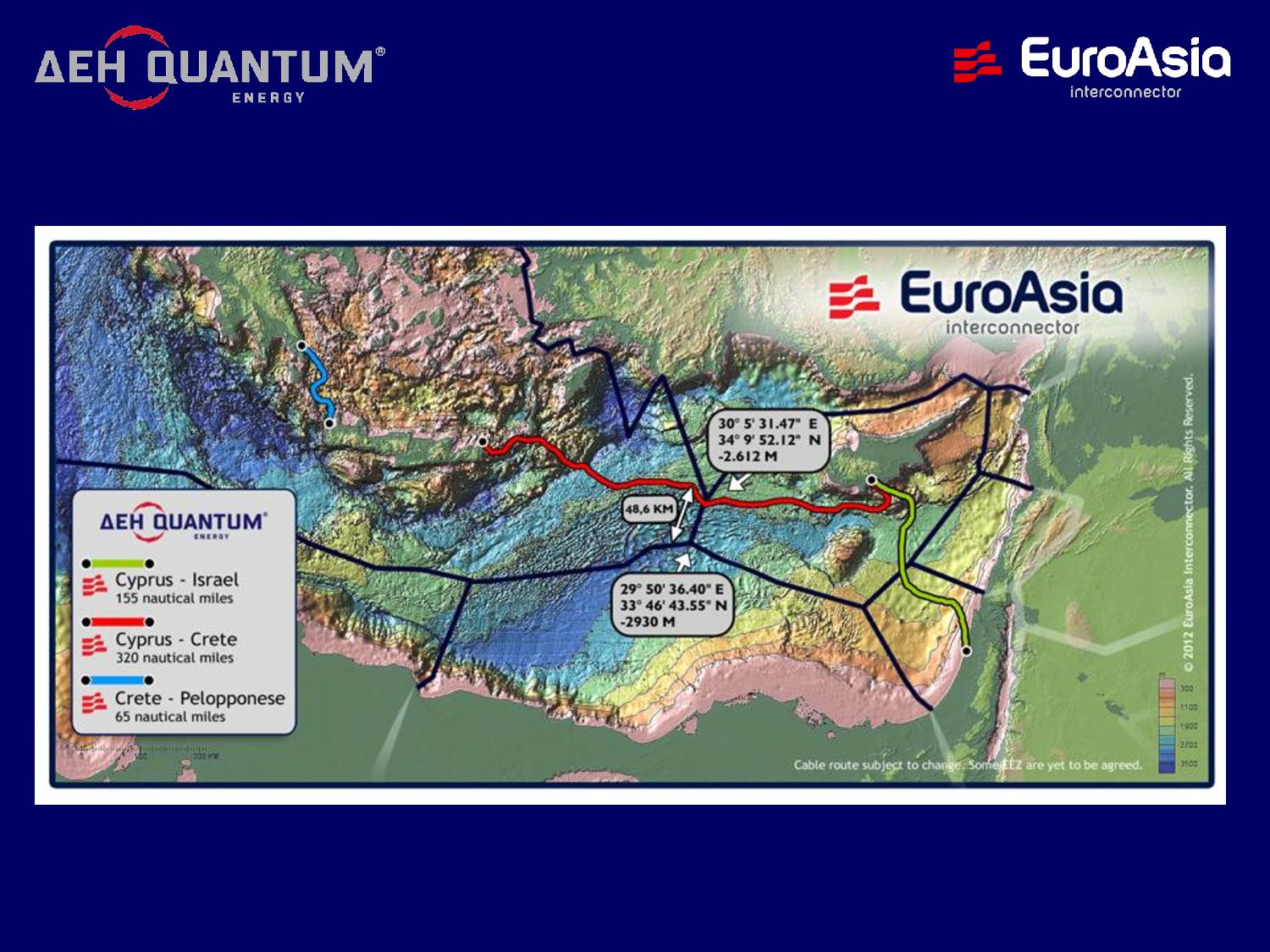
HVDC-Euroasia-Interconnector-map-2The cable, sometimes referred to as IceLink, will be approximately twice as long as the longest subsea electric cable today, which is the NorNed cable between Holland and Norway (NorNed is 580 km, with a capacity of 700 MW). It seems likely that we will soon see a substantially longer cable than the NorNed, which will be a new cable between Norway and the United Kingdom (this new cable will be more than 700 km long, with a capacity of 1,400 MW). However, an even more ambitious project is being planned in the Mediterranean; the EuroAsia Interconnector.

The EuroAsia Interconnector project aims to link the power grids of Cyprus, Greece (including both Crete and the Greek mainland) and Israel. The total length of the cable will probably be between 1,000 and 1,500 km, and have a capacity of 2,000 MW. It will travel through an enormous depth of more than 2,500 m.

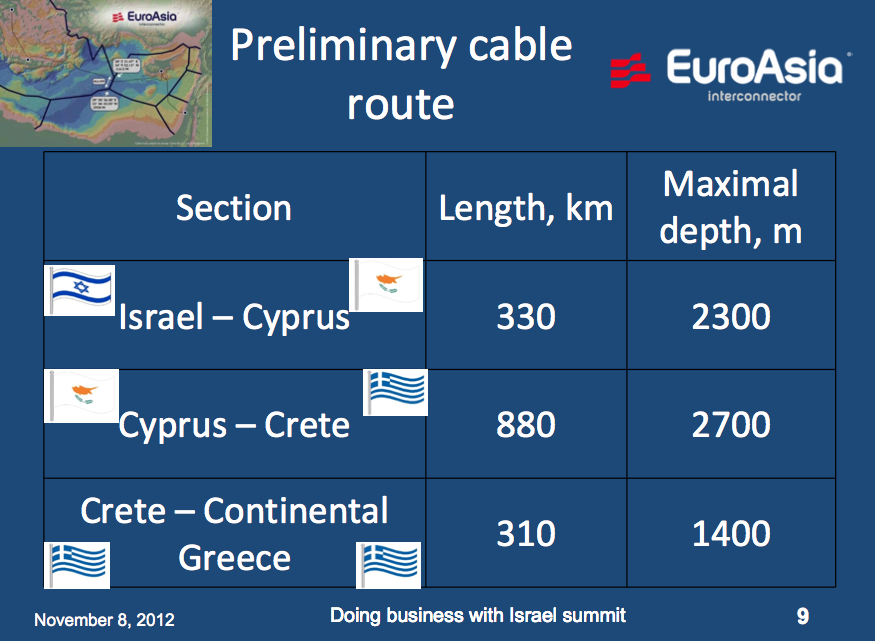
HVDC-Euroasia-Interconnector-2Firstly, a 330 km cable will link Israel with Cyprus. Further, Cyprus will be connected with the Greek island of Crete via an 880 km long cable. From there Crete will be connected to Greece via a 310 km long cable, providing a connection to the pan-European electricity grid.

In March 2012, Cyprus and Israel initiated a feasibility study to explore the possibility of the EuroAsia Interconector connecting the grids of the two countries. The project is expected to be completed in 36 months from the start of construction. The interconnector will be funded and developed by DEH Quantum Energy, a joint venture consisting of Greece’s DEH and Cyprus’ Quantum Energy, with the Bank of Cyprus as a minority shareholder.

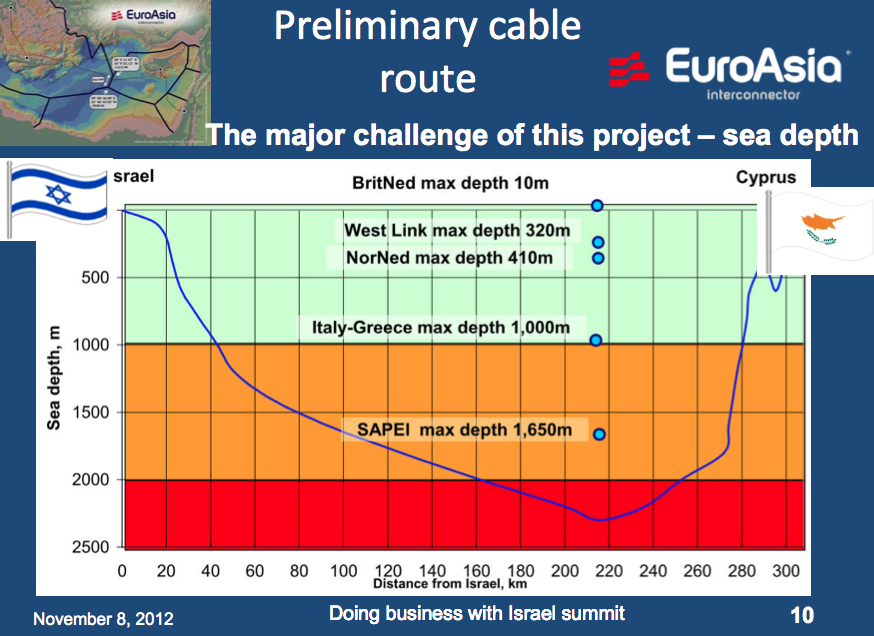
HVDC-Euroasia-Interconnector-1In comparison with the EuroAsia Interconnector, the IceLink between Iceland and Europe seems to be a very positive and even a simple project. While the EuroAsia Interconnector will mainly transfer electricity generated by burning natural gas, the IceLink is based on renewable hydro- and geothermal power. The IceLink is likely to be close to 1,200 km (if connecting Iceland and UK) and the maximum depth of the route is close to 1,000 m. As the depth is one of the main challenges for subsea electric cables, it is interesting that the EuroAsia Interconnector will be at more than twice as much depth as the IceLink.

The EuroAsia project has recently been added to the European Commission’s list of Projects of Common Interest (PCI). This recent list of 248 key energy infrastructure projects was adopted by the European Commission on 14 October 2013. These projects will benefit from faster and more efficient permit granting procedures and improved regulatory treatment, and may also have access to financial support from the Connecting Europe Facility (CEF). The CEF has a budget of EUR 5.85 billion that has been allocated to trans-European energy infrastructure for the period 2014-20. The current plan is to have the EuroAsia Interconnector up and running as soon as 2017.

UK’s electricity strike prices positive for IceLink

In last October, the Government of the United Kingdom (UK) gave the go-ahead for a new nuclear plant. This will be the first nuclear power station to be be constructed in the UK for numerous decades. The agreement regarding this nuclear plant shows well how competitive Icelandic electricity is, and makes it clear that an electric cable between Iceland and the UK could be very positive for both countries.

The nuclear strike price will be 92.50 GBP/MWh (close to 150 USD/MWh)

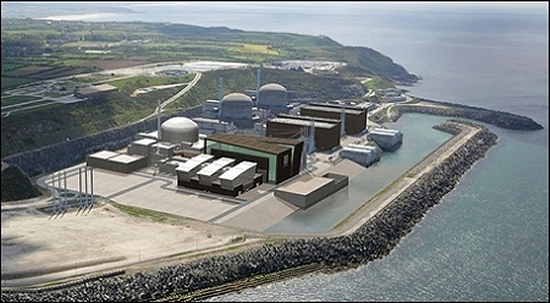
The above mentioned agreement on the nuclear energy involves an enlargement of the Hinkley Point Nuclear Plant in Somerset (Hinkley Point C). The new reactors are scheduled to be completed ten years from now (2023). The plant will be built and operated by the French energy firm EDF (Électricité de France) in cooperation with Chinese investors.

UK-Hinkley-Point-C-new-Nuclear-Plant-diagramEDF has negotiated a guaranteed fixed price – a strike price – for the nuclear electricity at 92.50 GBP/MWh (equivalent to approximately 150 USD/MWh). This strike price is in 2012 prices. The price will be adjusted according to inflation during the construction period and over a subsequent period of 35 years. According to the BBC, the existing nuclear plant at Hinkley produces about 1 per cent of the UK’s total electricity. This is expected to rise to 7 per cent once the construction of Hinkley Point C will be completed in 2023.

Strike Prices effectively remove price volatility risk for electricity generated from low-carbon sources. This ensures greater certainty to generators and minimizes their risk. The goal is to bring forward investment in affordable low-carbon electricity generation, including renewables and new nuclear. In total, renewable energy is expected to make up more than 30 per cent of the UK’s electricity mix in 2020, helping to significantly decarbonize the power sector by 2030. This means that the UK has very ambitious plans in expanding the production of renewable power.

Strike price for renewable power will be even higher

Earlier this year (2013), the British Government introduced the strike price which renewable energy technologies can expect in the coming years (2014-2019). The proposals are expected to become legislation in early 2014. According to a publication by the UK Department of Energy and Climate Change (DECC) the new regime will make the UK market one of the most attractive for developers of most renewables technologies, whilst minimising the costs to consumers. The proposed renewable electricity technologies eligible for the strike prices for example include hydro, geothermal, onshore and offshore wind, tidal and solar projects.

UK-Renewable-Energy-Strike-Price_2014-2019-The strike price for geothermal power will be 120-125 GBP/MWh (approximately 190-200 USD/MWh) and strike price for hydro will be 95 GBP/MWh (approximately 150 USD/MWh). The lowest strike price is for sewage gas; 85 GBP/MWh (close to 135 USD/MWh).

However, what is probably most important and interesting is the strike price for wind power. The British Government expects the overwhelming majority of the new renewable-capacity will be new wind farms, both onshore and offshore. This is understandable, because the utilization of wind power for electricity production is a well known and mature technology. In fact the strike price for wind power can be said to be the base price for new renewable generation. And the strike price introduced for onshore and offshore wind is 95-100 GBP/MWh and 135-155 GBP/MWh, respectively.  This is equivalent to approximately for 150-180 USD/MWh for onshore wind, and 215-250 USD/MWh for offshore wind.

IceLink could be an important part of the solution

In comparison, Iceland could most likely offer the UK electricity from renewable sources at prices similar or even substantially lower than the strike price for new offshore- or even onshore wind capacity in the UK. And actually the Icelandic electricity can be seen as a better product and thus a better option than massive wind power in the UK. Both hydro- and geothermal power offer stable base load electricity, which is very different from the unstable wind power.

Iceland-UK-BICC-meeting-Nov-2013-Landsvrkjun-Hordur-Arnarson-slide-7With an electric cable between Britain and Iceland (IceLink), the Icelandic energy sector could provide the UK with stable and reliable power from the Icelandic hydro- and geothermal power plants, at very competitive prices. Iceland could also import some of the unstable wind power from the UK; especially during the night. This would give an option to “store” even more of the controllable hydro power in the dams in Iceland during the night. When demand in UK rises during the day this power can then be transferred through the cable to the electricity markets in UK.

The UK wants to be able to move away from fossil fuels towards low-carbon power. What is even more important for the UK is to gain more energy independence and be able to rely on energy from politically stable neighbours (rather than for example importing more LNG from Algeria). Both the nuclear plant at Hinkley Point and plans for more renewable energy in the UK’s energy mix, are important in this context. In addition, a fifth of Britains’ aging power plants are due to close over the coming decade (with further closures in the 2020’s). Thus, the UK needs not only huge investment in energy production and -infrastructure, but also need to secure it self access to numerous reliable energy sources. Therefore the IceLink is a project that undoubtedly will interest the British energy sector and investors.

Successful energy summit in London

The Iceland Energy Summit was held in London on November 1, 2013. The event was organized by the British-Icelandic Chamber of Commerce (BICC) and hosted by Bloomberg.

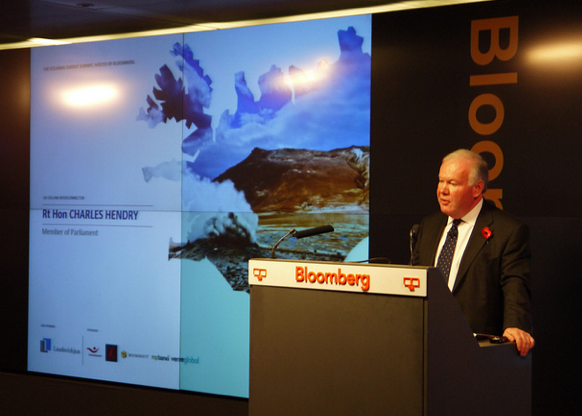
Iceland-UK-BICC-meeting-Nov-2013-CHThe event provided insight into Iceland’s renewable energy resources, the birth and growth of the data storage industry in the country, as well as the search for offshore oil on the Icelandic continental shelf. Strong focus was on a plan for an undersea power cable to connect the British and Icelandic grids. This plan or proposal is attracting strong investor interest, according to Mr. Charles Hendry, the former Energy Minister of the United Kingdom and current Member of Parliament.

Mr. Hendry, who promoted the project, said that there’s “no doubt that in Britain the political will is there, so if there is a political will in Iceland, we want to work together”. According to Mr. Hendry the project offers low-risk, predictable returns attractive to institutional investors including pension funds. The UK is preparing to change policies needed for the cable, Mr. Hendry said.

In May last year (2012), Mr. Hendry helped spur an agreement between Iceland and the UK to explore proposals regarding the cable (sometimes referred to as the IceLink). The cost of the link is still not clear, but if it will go ahead it could probably be completed within 7-10 years.. It would extend more than 1,000 kilometers,  thus be longer than any of the subsea electrical cables currently in operation.

Iceland-UK-BICC-meeting-Nov-2013-Landsvrkjun-Hordur-Arnarson-slide-7Electric cables like that already connect the grids of Norway and Britain to the Netherlands. The Dutch grid operator (TenneT) is planning links between Germany and Norway and the Netherlands and Denmark. There are already connections of this type between Britain and France, between Vancouver island and Canada, between Sardinia and Italy, and between Tasmania and Australia, to name a few well known examples .

According to Bloomberg, Mr. Andrew Perkins, a partner in energy and environmental finance at Ernst & Young, stresses that these assets are attractive to financiers, suggesting that the capital costs to build the IceLink should be financed by the private sector. As close to 100 percent of all electricity generated in Iceland comes from natural renewable sources, and several promising renewable energy options are still unharnessed, the IceLink offers great opportunity for the UK to access substantial green power at a very competitive cost.

Here, at the Icelandic Energy Portal, we will soon be covering the Energy Summit in more details. Note that the slides (and videos) from the event can be downloaded from the website of the BICC.