Skip to content

Posts by Askja Energy

Verne Global in Iceland scores high

Iceland’s green data centers are receiving growing interest. They run 100% on renewable energy and offer the lowest carbon footprint in the industry.

LV-Renewable-banner-2

It does indeed matter if a data center is green or not. According to a report by UBM Tech and InformationWeek, 22 percent of 100 executives said they regularly track energy usage in their data centers, and close to 60 percent of IT decision makers say the state of their data center is fair, serious or urgent, and at the brink of running out of capacity in 2014. For many of those executives and IT people, Iceland may be the perfect location for their data.

Small and large companies alike are looking for greener options. Adobe, eBay, Facebook, Hewlett-Packard, Salesforce and Symantec have joined the Future of Internet Power initiative to showcase low-carbon power. IBM is heavily into promoting green data center design; the European Union Commission honored 27 of them in January 2012. EBay also has raised the bar by with its Digital Service Efficiency (DSE) methodology, which links how many “buy” or “sell” business transactions are completed per kilowatt-hour.

Recently, the GreenBizGroup listed 12 green data centers and co-location facilities that stand out for innovative cooling, green energy or head-turning designs. One of them is the data centre of Verne Global in Iceland. According to GreenBiz, the geothermal and hydroelectric-powered campus of Verne Global in Southwest Iceland calls itself the first zero-carbon data center. Among its customers are automaker BMW Group and the Climate Action organization.

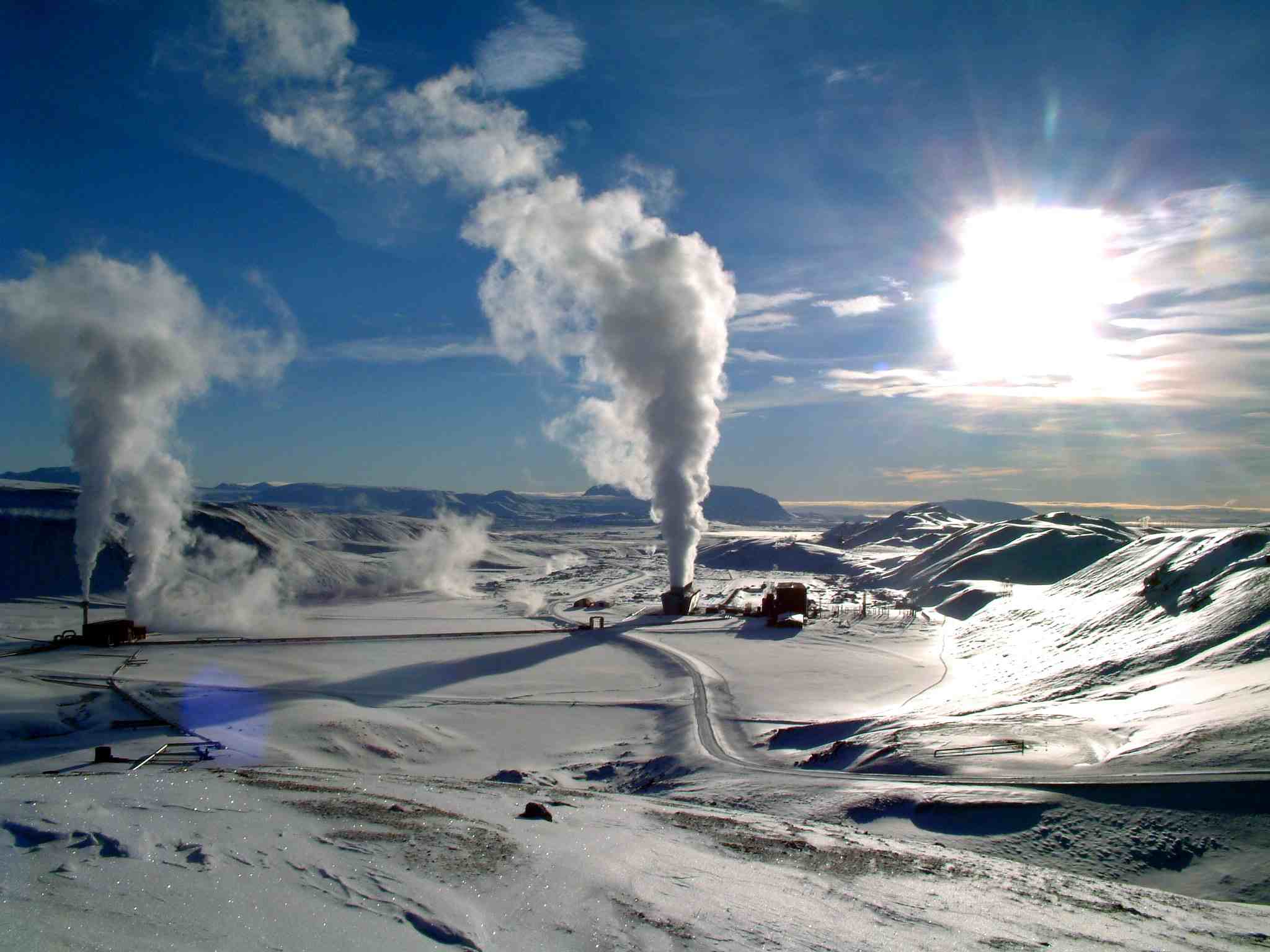
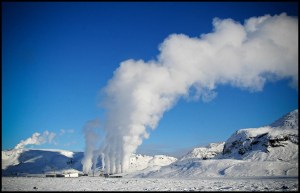
Krafla_geothermal_power_station_winter_LandsvirkjunBMW is using the campus of Verne Global for crash simulations, aerodynamic calculations and other computer-aided design (CAD) purposes. This requires plenty of electricity, both for the transactions and to keep the infrastructure cool. By moving ten of its  high-performance computing clusters (HPC) to Iceland from Germany, BMW hopes to reduce annual carbon emissions by 3,570 metric tons.

What is no less interesting for BMW and other companies considering where to host their data, Iceland not only offers green electricity and natural cooling, but also electricity prices that are lower than anywhere else in Europe. Therefore, it is quite obvious that Iceland has excellent possibilities for becoming a leading data centre hub.

Green methanol produced in Iceland

In Iceland renewable geothermal energy is utilized to produce Green Renewable Methanol; a synthetic liquid fuel which can be used as a fuel blend for normal gasoline combustion engines. The company behind this innovation is Carbon Recycling International (CRI).

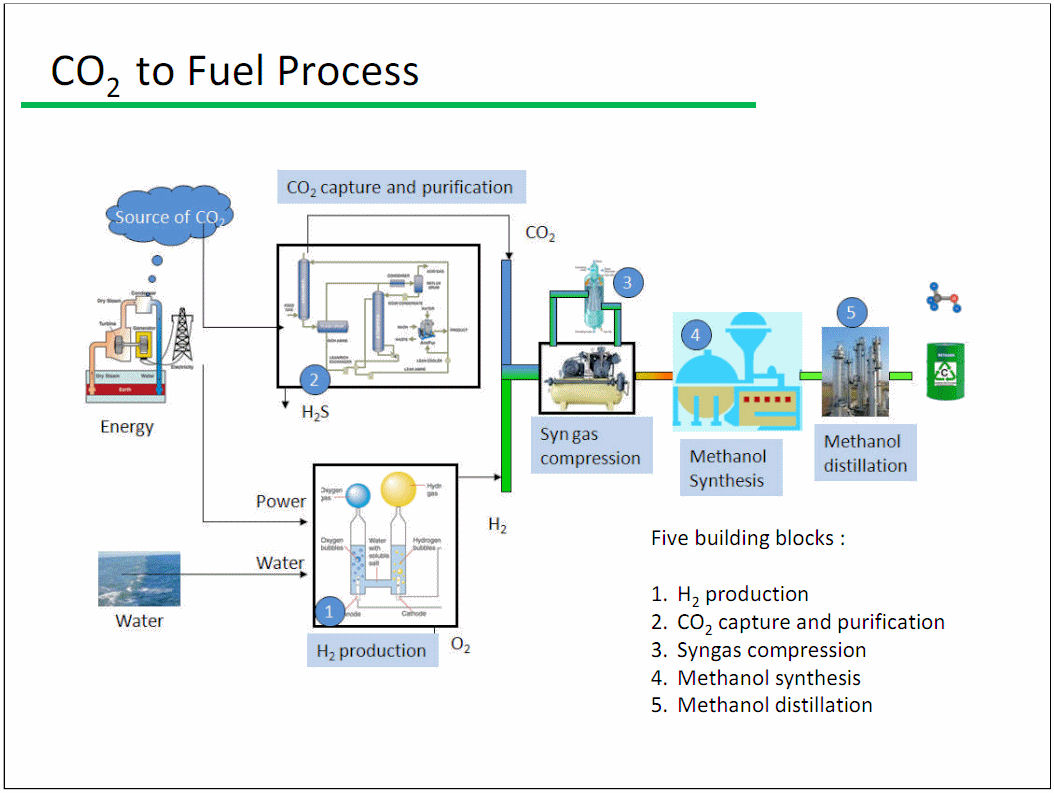
Methanol-CRI-process-explainedMethanol is one type of alcohol fuel that can be used as alternative fuel in gasoline combustion engines, either directly or in combination with gasoline. If it is used as low blend in gasoline, very little or even no modifications of the engine are needed.

Methanol is produced from hydrogen and carbon monoxide. Normally the feedstock is petroleum based, such as natural gas or coal. However, it is possible to obtain the hydrogen portion of the synthesis gas via electrolysis, as well as the carbon monoxide by collecting it from a a biomass, factory emissions or a geothermal borehole.

The Green Renewable Methanol produced by CRI is made from water and carbon dioxide from a geothermal power plant. The electricity used in the process comes from the same geothermal power plant (the Svartsengi Geothermal Plant in Southwest Iceland). One might wonder why power from geothermal power plants in Iceland is categorized as renewable energy, since they emit carbon dioxide. The fact is that the amount is tiny compared to fossil fuel tendencies – yet enough for CRI to utilize it for methanol production. And CRI refers to its product as Green Renewable Methanol because it captures carbon dioxide that would otherwise escape to the atmosphere.

Methanol-CRI-George Olah-plant-Svartsengi

The methanol from CRI’s plant is blended with regular gasoline to meet the fuel standards of the European Union (EU). According to the European regulations, the maximum volume of methanol in the gasoline can be three percent). In the world about 20 million tons (25 billion liters) of methanol are consumed as fuel annually. However, only a fraction of it is from renewable sources.

It is expected that the market for renewable automobile fuels in Europe will more than double before 2020. Large share of that will be in the form biofuels from food sources. The market for renewable transport fuels which are of non-biological origin or from waste is expected to show the fastest growth in coming years. CRI may be in a unique position having brought a renewable fuel to the market from non-biological sources (as opposed to oil seeds, corn or sugar cane). The Green Renewable Methanol proves that carbon dioxide can provide alternative renewable fuel and it is not necessary to use scarce agricultural resources or destroy forests and wetlands to grow fuel crops. And, unlike hydrogen, methanol can be transported and distributed via existing gasoline infrastructure.

argos-energiesEarlier this year (2013), CRI announced that the first shipment of renewable transport fuel from its production plant in Iceland had been shipped to Dutch oil company Argos in Rotterdam, signaling the entrance of transport fuel from geothermal sources to the European market. Argos is the largest independent player in the downstream oil market in Western Europe and distributes over 17.5 billion liters of fuels each year. The company has a leading position in the Netherlands and also operates a distribution network in Belgium, France, Germany and Switzerland. Argos has been ambitious in providing renewable fuel and it will be interesting to see how the Green Renewable Methanol from Iceland will fit into their fuel mix.

Experiencing Earth’s underground steam

Power plants are becoming a popular attraction for foreign visitors in Iceland. According to Samorka, which is a federation of the Icelandic electricity industry, district heatings, waterworks and sewage utilities in Iceland, tens of thousands of tourists visit the largest power plants every summer. This both applies to hydro- and geothermal power plants.

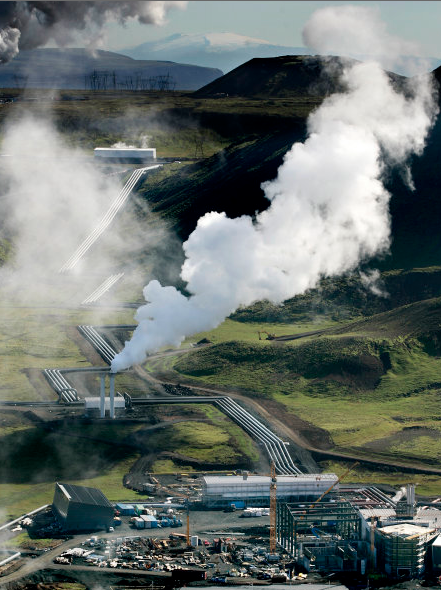
Hellisheidi-Geothermal-Plant-Steam-Winter

The power plants are therefore among the most popular tourist attractions in Iceland. Some of the plants are open all year around.

The most popular power plant to visit is Hellisheiðarvirkjun Geothermal Power Plant. Around 50,000 guests are forecast to visit the Geothermal Energy Exhibition at Hellisheiðarvirjun this year. Around 95 percent of guests are foreign, the largest number from the United Kingdom. The exhibition includes multimedia presentations about the harnessing of geothermal energy in Iceland. You can read more about Iceland’s geothermal diversity here.

The GEOthermal Research Group

The cooperative project Deep Roots of Geothermal Systems (DRG) aims at understanding the relationship of water and magma in the roots of volcanoes and how heat is transferred into geothermal systems to maintain their energy. Furthermore, the project focuses on the design of wells and well heads for high temperatures, as well as methods for utilizing superheated steam from greater depths.

PrintThe project is managed within a cluster cooperation called GEORG. This Icelandic entity is financially supported by the National Energy Authority (Orkustofnun), Icelandic power companies Landsvirkjun, Orkuveita Reykjavíkur (Reykjavik Energy), and HS Orka, and the Iceland Deep Drilling Project (IDDP). The IDDP has several partners from Europe and USA, making both IDDP and GEPRG leading international players in geothermal research.

By enhancing research and development of geothermal resources in a sustainable way, geothermal energy will constitute an important part of reducing the world dependence on carbon-based energy sources.  Hence, the foundation of GEORG can be vital. It is based on the principles of creating a critical mass of joint resources and efforts to break through existing scientific and technical barriers to innovation in the field. This may lead to increasing the number of qualified experts in geothermal research, engineering, design and technical exploitation of the resource.

OR-Hellisheidi-Power-Plant-SteamThe research within GEORG is performed by three groups made up of representatives from universities, research institutes, engineering companies and energy companies. The latest technology is be applied in surveying, resistance measurements and seismic measurements, petrology and geochemistry. In addition, new simulation models will be developed. These models will be used to simulate heat transfer and operation of geothermal boreholes for high temperature steam. Training young scientists to work in this field will be an area of heavy focus for this project.

The project will be ongoing over the next three years and the partners have pledged direct financial support amounting close to 100 million ISK. In addition, they will provide support through other similar projects the partners are working on. More information about geothermal energy in Iceland can be found here.

Landsvirkjun promotes university research and education

The Icelandic power company LandsvirkjunReykjavík University (RU), and the University of Iceland have joined forces to support and encourage the development of expertise within the field of renewable energy. The cooperation will strive to create a source of shared value for Landsvirkjun, the universities and Icelandic society by supporting those disciplines where more education and research are vital.

Landsvirkjun-university-cooperation-2013In total, Landsvirkjun has pledged 80 million ISK to the universities over a five year period, to promote education and research in geochemistry, electric power engineering and other academic disciplines within the universities. The cooperation agreement with the University of Iceland has the main objective of promoting and supporting teaching and research in the disciplines of geochemistry, geology, mechanical and industrial engineering. An emphasis will be placed on developing expertise in the field of renewable energy sources. Landsvirkjun and Reykjavík University will also cooperate in promoting research and university education in the field of renewable energy.

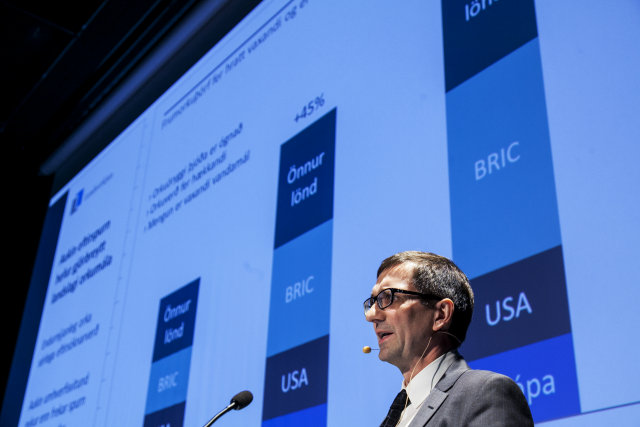
Hordur-Arnarson-Landsvirkjun-CEO-presentingWhen signing the Agreement Mr. Hörður Arnarson, CEO of Landsvirkjun, stated that in building a dynamic cooperation between Landsvirkjun and the universities will create shared value for the economy and for society, by sharing expertise and supporting innovation and development in renewable energy sources. The University of Iceland has a long established history in building upon its expertise in these fields and the contract is an extension of decades of cooperation between the university and Landsvirkjun in the disciplines of engineering and the natural sciences. In recent years the Reykjavik University has also been actively developing dynamic courses and expertise in technical subjects, including the utilisation and distribution of renewable energy sources. The financial support from Landsvirkjun will substantially strengthen education, research and the development of projects related to renewable energy within the universities, and increase opportunities for expertise and creativity.

Green high performance computing cloud node opens in Iceland

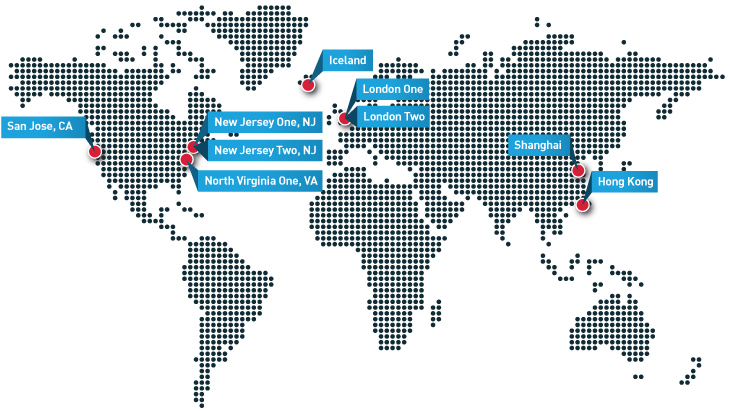
Managed hosting provider Datapipe has launched a green cloud node in Iceland. The company has made its high performance computing (HPC) cloud platform available out of Verne Global’s facility in Southwestern Iceland, which uses 100 percent renewable energy.

Datapipe-Data-Center-World-MapDatapipe is an existing tenant, but its expansion is a reflection of increased data center activity in Iceland. Low cost, renewable energy, improved connectivity, and a location between North America and Europe add up to an enticing proposition. Datapipe clients have immediate access to the new Iceland node. It’s available through the same portal as its other locations in Silicon Valley, the New York Metro area, Ashburn Virginia, London, Hong Kong, and Shanghai. “Iceland is a great in-between point with our U.S. and UK infrastructure, it’s great for disaster recovery., says Ed  Laczynski, Datapipe’s VP of Cloud Strategy.

The Statosphere HPC cloud platform is a high performance solution targeted at Big Data wokloads. Typical verticals that the company attracts are manufacturing, financial service, and research and development. The platform is API driven and utilizes all SSD storage with guaranteed IOPS (input/output per second) . Stratosphere can be configured with public or private resources, with up to 32 physical core equivalents per instance, a half terabyte (TB) of RAM, and tens of thousands of IOPS per volume, all residing on a 10GE network. It’s known as the most widely deployed Apache CloudStack environment on the market.

datapipe-logoDatapipe has been committed to using as much renewable energy as it can, and is finding that customers are increasingly asking for it as well. “As we grow new solutions, we’re seeing more and more green qualifications as a requirement to do business,” says Laczynski. “The kind of customers we’re talking about really do care about this; these are multinational corporations looking for sustainable solutions.” Recognized as a Green Power Partner by the U.S. Environmental Protection Agency (EPA) since 2010, Datapipe achieved EPA Leadership Club status in 2011 and is currently ranked #9 on the EPA Green Power Partner Top Tech & Telecom list.

Iceland-waterfall-1Verne Global offers a 100 percent renewably powered data center solution, which features access to geothermal and hydroelectric power sources, free-cooling provided by Iceland’s ambient air temperature and lower power prices that can be locked in over a 20 year period. “Power availability and costs are becoming two of the leading constraints for HPC clouds and clusters,” says Jeff Monroe, CEO of Verne Global. “Together, Verne Global and Datapipe are meeting these challenges with the first truly green HPC Cloud for the European and North American markets.”

Iceland as a leading data centre hub

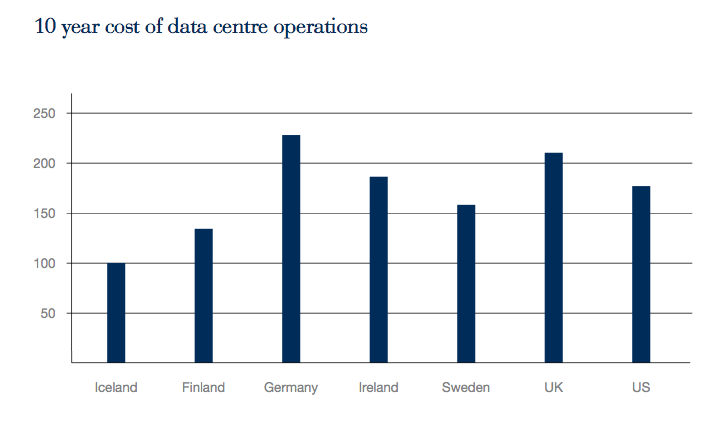
Data-Centre-Operation-Cost-comparedIceland is a highly attractive place to locate a data centre and is positioned to become an international data centre hub, according to an independent study conducted by BroadGroup Consulting. On the key issue of power, encompassing everything from costs to quality to regulation, Iceland scores higher than leading global data centre locations, such as the USA, UK, Sweden, Singapore and Hong Kong. When all the issues are taken together, Iceland has truly become an extremely attractive location in which to site a data centre. Reasons include:

1.  All the basic factors in place

The reality for most data centre users is that they need all basic issues to be in place. This includes cheap energy and strong connectivity, and also areas as telecoms, power, reliability, taxation and business environment, and the legal/regulatory framework. According to BroadGroup, Iceland has these factors in place.

2.  Low-cost power

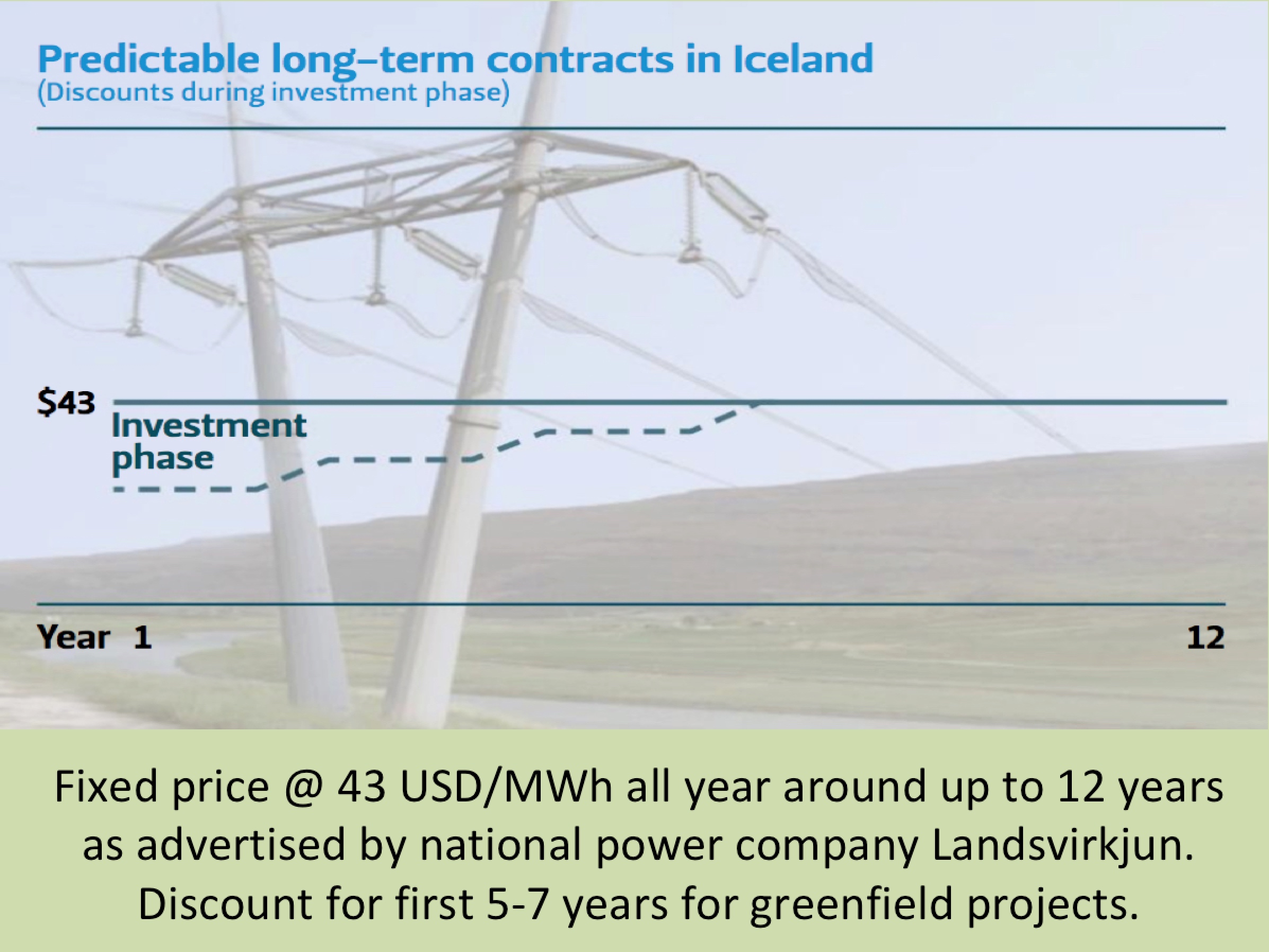
Iceland is also highly attractive in terms of differentiating factors such as power costs and availability, government support and incentives, and operating costs. Power is the biggest operating cost item for data centre users. Iceland is highly competitive on power pricing today, and can provide commitments for ten years or potentially more. Iceland power costs can be halve those in Scandinavia, and significantly more competitive than other European countries. Iceland’s power costs remain very likely to stay much lower than other countries, particularly given the opportunity to cap such prices for ten years or even longer for greenfield projects. Factoring in all data centre cost factors over a ten year period, shows the significant savings available in choosing Iceland (as per chart).

3.  Excellent reliability

Power reliability and quality are extremely high. Iceland has a long history with a key group of power-intensive users already (such as the aluminum smelters). Such users, including global leaders such as Rio Tinto and Alcoa, can have requirements of >400MW and have expanded their sites in Iceland due to the strong reliability and availability. These are users for whom an outage of more than an hour would cause serious damage, and have selected Iceland and expanded in Iceland due to its power reliability. For these businesses, there have no disruptions due to natural disasters since the first smelter started operating in Iceland in over 40 years ago.

4.  Base-load renewable energy

Icelandic power is 100% green. Iceland is one of few countries in Western Europe with large quantities of competitively priced, renewable carbon neutral electricity. Setting Iceland apart from most countries, it produces electricity using exclusively hydropower, geothermal energy and onshore wind. These are sustainable, environmentally “green” resources with zero carbon trade-offs. This makes it an ideal location for addressing corporate responsibility considerations.

5.  Good connections

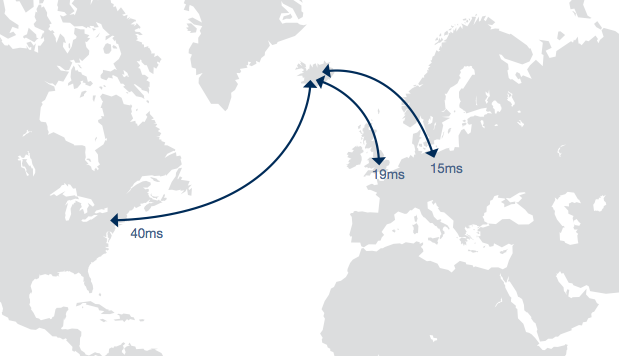
Iceland-Telecom-Network-Latencies-MapOn telecoms, existing connectivity, Greenland Connect, FARICE and DANICE are being substantially upgraded, while significant new capacity is planned to be added over the next several years, enabling up to 30 Tbit/s of full capacity. In terms of telecoms pricing, large international users are able to negotiate prices which are comparable with transatlantic prices into mainland Europe. For example, Icelandic prices are close to the Telegeography Median 10G transatlantic prices reported in Q4 2012. The telecoms pricing attractiveness is illustrated by existing users in Iceland, such as Opera Software, which uses >50 Gbit/s of capacity. Furthermore, Iceland is ideally situated between the US and Europe, and is highly accessible with 20+ airlines landing on the island. Many of the Iceland data centers are also within a short drive of Reykjavik airport.

6.  High educational skills and modern European business environment

There is a high education level in Iceland and strong availability of highly skilled technical staff. A major issue for data centre users is how a location will evolve over the 15+ years of the facility. Some of the large, existing data centre locations are facing key challenges such as lack of land, power availability and the threat from natural disasters. By contrast, Iceland is rapidly developing as a global data centre location, with a highly committed, stable and democratic government and clear focus on the sector, and a legal system in line with the European Union.. 

7.  Positive political support

The Icelandic economy is strongly supportive of IT investment, and has particularly looked to ensure it is attractive to those looking to site data centers in the country. This has attracted an impressive range of global companies who already have data centers in the country, including Opera Software, COLT Telecom, BMW, Datapipe and the Joint Nordic Supercomputer. It has also attracted data centre outsourcing companies such as Advania and Verne Global. The Iceland government has also developed specific incentives for the industry.

8.  Low natural risk

Iceland does have earthquakes, but most are tiny (<2 on Richter scale). They also tend to be well away from the best data centre sites, and the electricity production and distribution infrastructure has been developed in such a way that it is not vulnerable to earthquakes or strong winds. Indeed, earthquakes and volcanic eruptions of the last decades have caused no real damage and had no disrupting effect on the services of electric power transmission, power production or telecommunication in the country as a whole and no effect on local services for the potential sites. A detailed independent study has shown that estimated risk from earthquakes and volcanoes is still relatively low, especially compared with places like California. Indeed, even New York State had 400 earthquakes with Richter magnitude greater than 2.0 recorded between 1700 and 1986. Iceland also has negligible risks from other natural disasters such as hurricanes, heat waves, droughts, wildfires and tsunamis.

9.  Plenty of space available

Iceland also offers two of the other key requirements of many data centre users – space and flexibility. There is plenty of space to build data centers of different designs, rather than being forced to use refurbished buildings or multi-storey sites. For example, land is available at suitable locations close to both the capital Reykjavik and the Keflavik International Airport. And there is flexibility to provide different solutions, from high-connectivity, purpose-built technology parks to sites that are close to energy sources and offer a green and low-cost option.

From colocation facilities to major internet giants

In the last few years, Iceland has been seeing new investments in the form of colocation facilities.

Iceland-green-renewable-askja-energyLong term contracts for fixed price low cost power, free cooling promoting a year-round power usage effectiveness, well-educated workforce, and several high-speed telecom subsea cables make Iceland a perfect location for data centers with a minimum of cost and complexity.

Verne Global opened its data centre in 2012 and has taken on BMW on as a major and expanding client. The Advania-owned highly effective Thor Data Centre hosts search engine Opera’s environment and the supercomputer used by the National High Performance Computing organizations of Norway, Denmark, Sweden and Iceland.

Gullfoss-eveningIceland is likely to attract increasingly more colocation facilities, offering equipment space and bandwidth for rental to retail customers. With plenty of renewable energy to spare, Iceland may soon also lure a major internet-giant to host its data in Iceland. Companies like Yahoo!, Facebook and Google have all been looking towards Iceland in this respect.

In next post we will be introducing an independent analysis of Iceland as a global data centre hub. This new study was undertaken by BroadGroup, which made a comparison using a wide variety of criteria with today’s leading data centre locations from around the world. The results were strongly in Iceland’s favor.

CNOOC on the Icelandic continental shelf

China is showing interest in oil exploration on the Icelandic continental shelf.

CNOOC_Logo

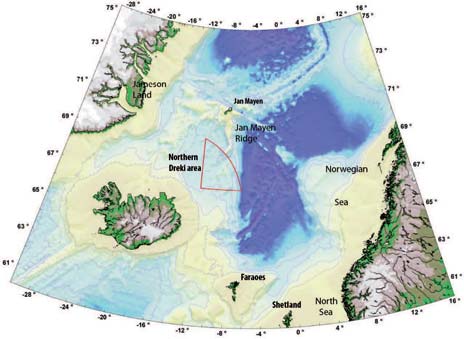
According to reports, China National Offshore Oil Corporation (CNOOC)  is partnering with the Icelandic firm Eykon Energy in an application for a license to explore and produce oil and gas in deep waters offshore Iceland. The area is called Dreki (Dragon Area) and is part of a micro-continent located between Iceland and the Norwegian island of Jan Mayen. Seabed samples from the area have indicated the presence of sedimentary rocks and an active hydrocarbon system.

Eykon Energy had earlier applied for an exploration and production license, but without an operating partner. Now, the Icelandic National Energy Agency (NEA) has announced that CNOOC has decided to participate in the application of Eykon Energy as an operator and potential licensee. The NEA will now evaluate further the financial and technical capacity of the applicants and their ability to undertake the exploration and production as described in the application. The NEA estimates that the processing of the application will be finalized within a few months.

Dreki-Area-Map-2013Norwegian Petoro may also become a partner in the license with Eykon Energy and CNOOC. According to an agreement between Iceland and Norway from 1981, Norway has a right to up to 25% participation in any licence granted within the area of the agreement. Petoro is already participating in two other oil exploration and production licenses on the Icelandic continental shelf.

CNOOC’s participation in the project with Eykon Energy would mark the first entry of a major oil company into Iceland’s nascent oil sector (the only foreign oil companies that have been awarded exploration and production licenses in the Icelandic jurisdiction so far, are Faroe Petroleum and Ithaca Energy). If the application by Eykon Energy and CNOOC will be successful and a license will be awarded, it would mark the Chinese company’s first foray into offshore Arctic oil drilling; a new area the industry’s biggest players are scrambling to enter in efforts to replenish reserves.

Eykon-logoThe size of Eykon Energy’s  and CNOOC’s stakes in the partnership and the exact location of the offshore Arctic license area will be announced later (probably next autumn). Big oil companies are keen to tap some of the 90 billion barrels of oil the U.S. Geological Survey estimates the entire Arctic region may hold, but progress has been slow and exploration is still at a very early stage. The entrance of CNOOC may become an important step in speeding this process up.

Aluminum and Icelandic GDP

According to recent research at the University of Iceland, direct contribution of the aluminum industry in Iceland has been around 2.9 percent of gross domestic production (GDP). This is the average percentage for the period 2007-2010. In this period, the contribution reached its maximum in the year of 2010, when it was 4.6% of GDP.

Anna-Gudrun-Ragnardottir

In her theses towards a MS degree in Economics at the University, Ms. Anna Guðrún Ragnarsdóttir describes how the aluminium industry has had a major influence on Iceland’s economy. The author explains how the aluminum industry can be divided into three different categories, regarding its contribution to the Icelandic GDP; direct contribution, indirect contribution and demand effects. The industry’s total contribution to the Icelandic GDP was calculated as the sum of direct and indirect contribution. The demand effects were not estimated in the thesis.

The direct contribution of the aluminum industry is estimated using a data set from Statistics Iceland. Estimating the industry’s indirect contribution was more complex. The aluminum sector now consumes almost 75 per cent of electricity generated in Iceland. When taking this part of the Icelandic energy industry into account, the total contribution of the aluminum industry to the Icelandic GDP is somewhat larger than the direct contribution, and the total contribution can be said to be 5.4-6.3 per cent annually (on average in the period 2007-2010). In 2010 this number was approximately 7.7-8.6 per cent.

Straumsvik-nature-aluminumum-smelter

In her thesis, Ms. Ragnarsdóttir explains how aluminum production first began in Iceland in the year 1969, with an output of barely 11 thousand tons annually. In the early 1990s the rate of production grew rapidly and today it is around 820 thousand tons annually. Two of the largest hydroelectric power stations in Iceland were constructed mainly to serve the aluminium industry. According to the thesis, the industry generates in total around 4,000 jobs in the country. However, almost all the aluminum products manufactured in Iceland are exported. Today, the aluminum products have approximately a 40 percent  share in the total export of goods from Iceland (which is more or less the same proportion as that of fish products).