Skip to content

Posts from the ‘Electricity Market’ Category

Upcoming new world-record subsea electric cables

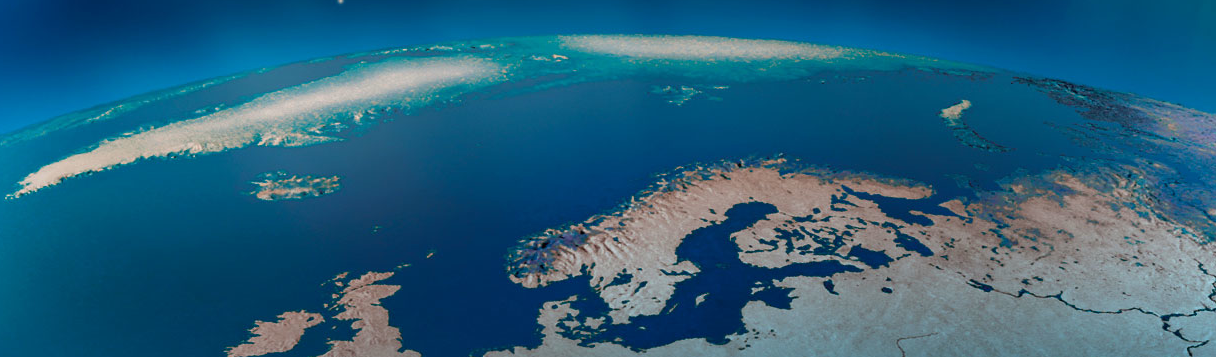
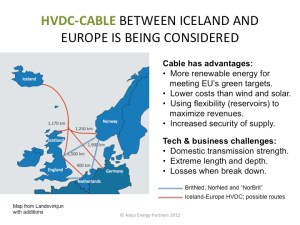
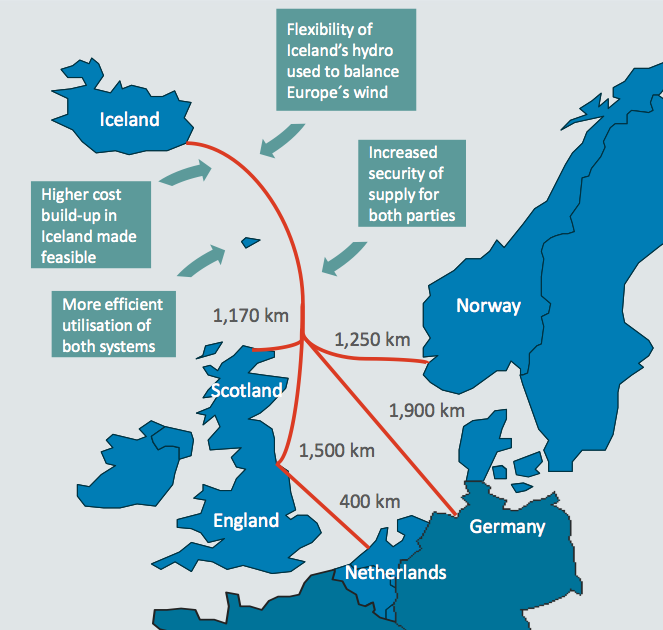
An electric subsea cable between Iceland and Europe is currently being considered.
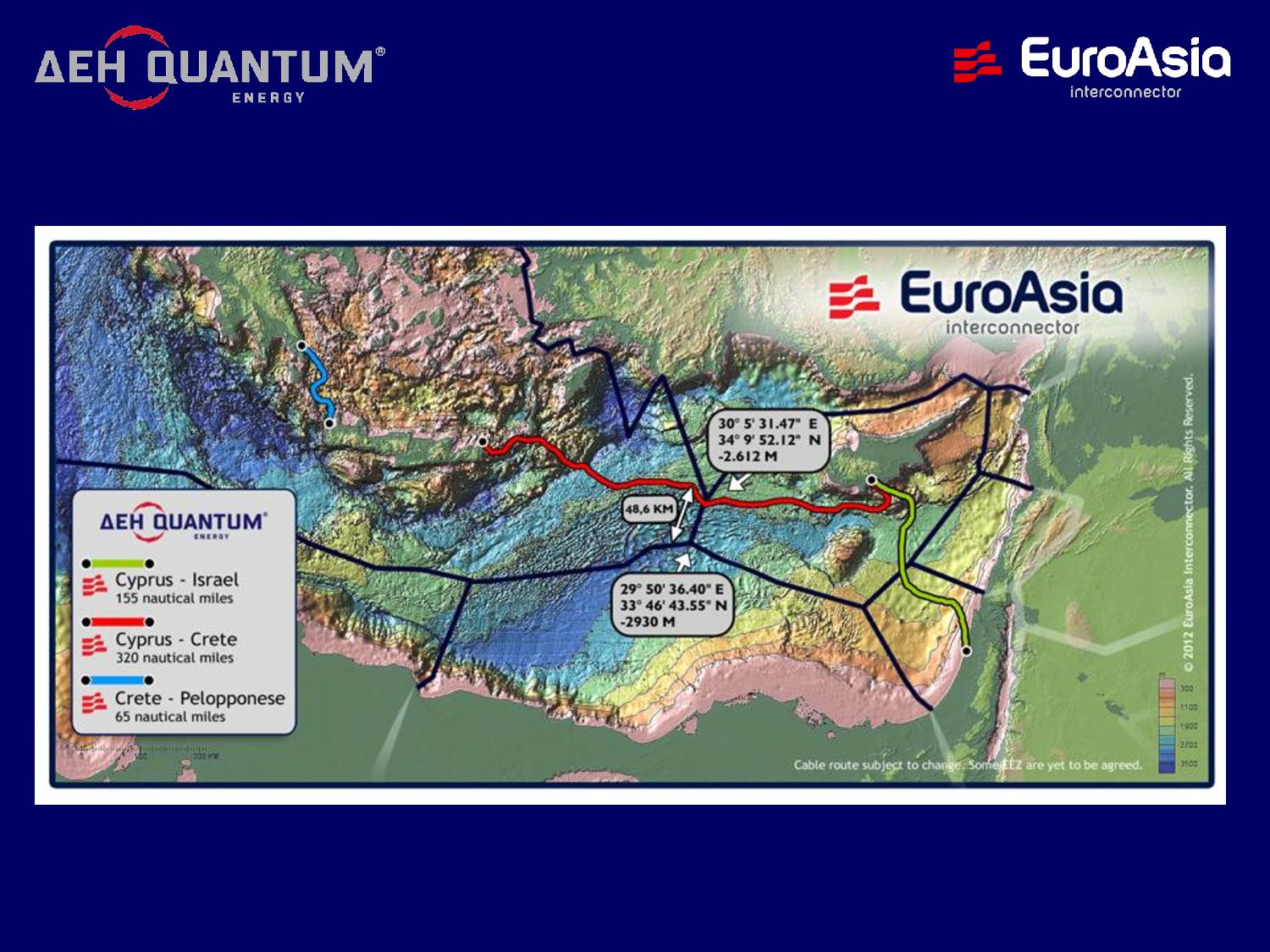
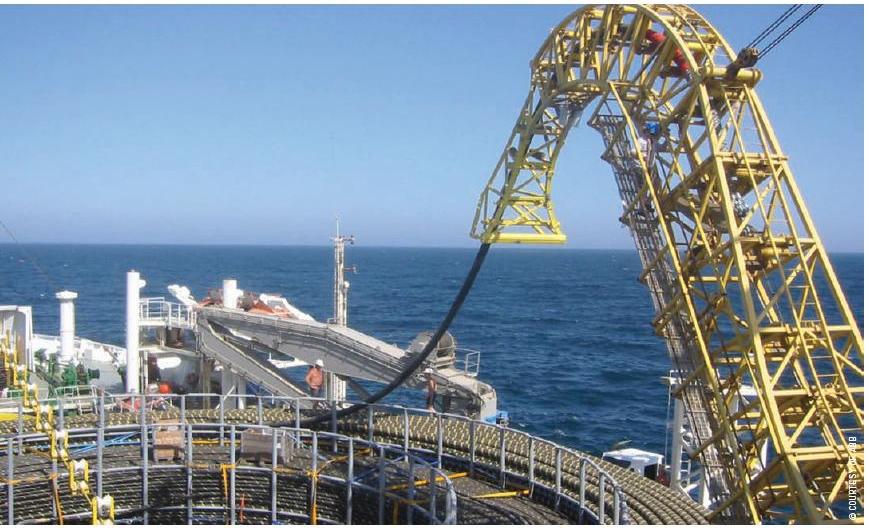
HVDC-Euroasia-Interconnector-map-2The cable, sometimes referred to as IceLink, will be approximately twice as long as the longest subsea electric cable today, which is the NorNed cable between Holland and Norway (NorNed is 580 km, with a capacity of 700 MW). It seems likely that we will soon see a substantially longer cable than the NorNed, which will be a new cable between Norway and the United Kingdom (this new cable will be more than 700 km long, with a capacity of 1,400 MW). However, an even more ambitious project is being planned in the Mediterranean; the EuroAsia Interconnector.

The EuroAsia Interconnector project aims to link the power grids of Cyprus, Greece (including both Crete and the Greek mainland) and Israel. The total length of the cable will probably be between 1,000 and 1,500 km, and have a capacity of 2,000 MW. It will travel through an enormous depth of more than 2,500 m.
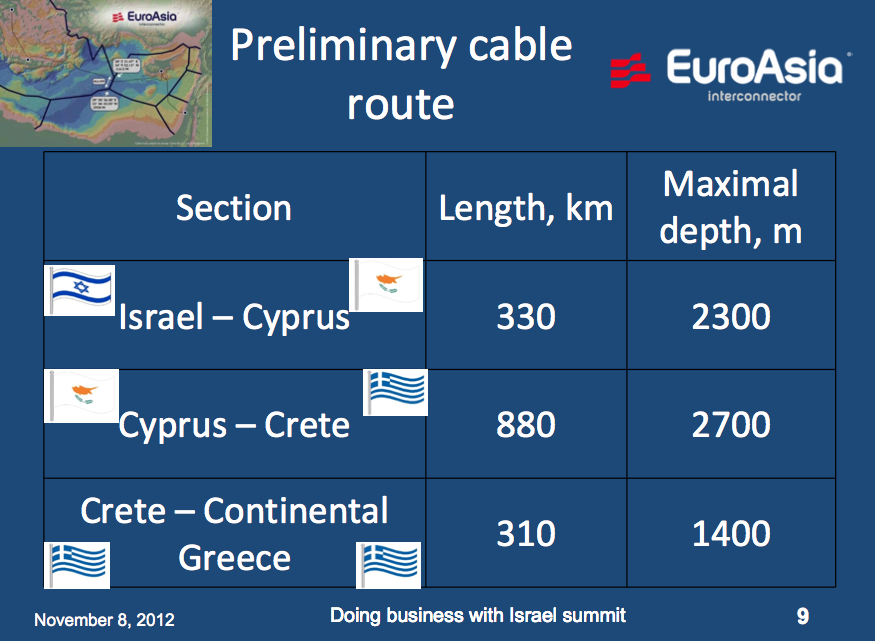
HVDC-Euroasia-Interconnector-2Firstly, a 330 km cable will link Israel with Cyprus. Further, Cyprus will be connected with the Greek island of Crete via an 880 km long cable. From there Crete will be connected to Greece via a 310 km long cable, providing a connection to the pan-European electricity grid.

In March 2012, Cyprus and Israel initiated a feasibility study to explore the possibility of the EuroAsia Interconector connecting the grids of the two countries. The project is expected to be completed in 36 months from the start of construction. The interconnector will be funded and developed by DEH Quantum Energy, a joint venture consisting of Greece’s DEH and Cyprus’ Quantum Energy, with the Bank of Cyprus as a minority shareholder.
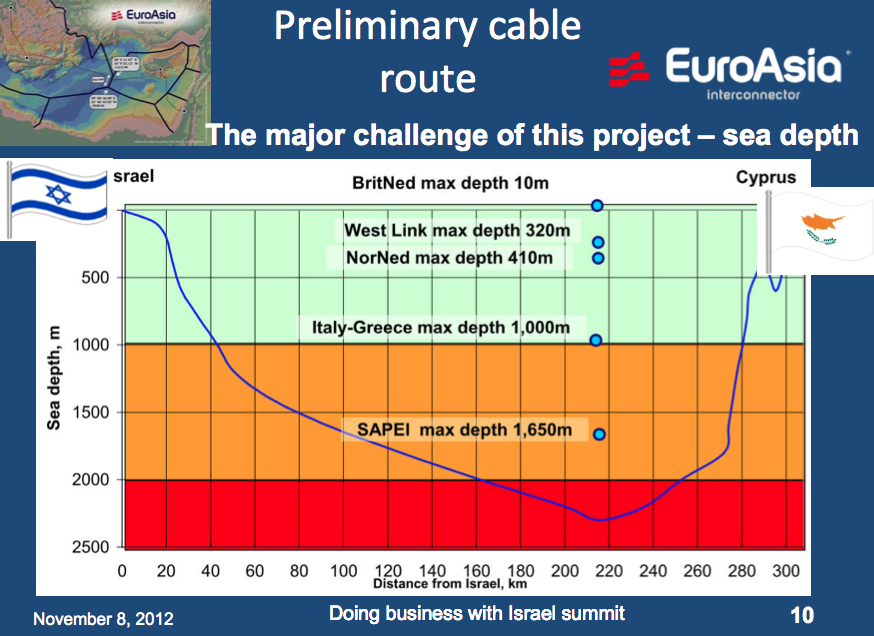
HVDC-Euroasia-Interconnector-1In comparison with the EuroAsia Interconnector, the IceLink between Iceland and Europe seems to be a very positive and even a simple project. While the EuroAsia Interconnector will mainly transfer electricity generated by burning natural gas, the IceLink is based on renewable hydro- and geothermal power. The IceLink is likely to be close to 1,200 km (if connecting Iceland and UK) and the maximum depth of the route is close to 1,000 m. As the depth is one of the main challenges for subsea electric cables, it is interesting that the EuroAsia Interconnector will be at more than twice as much depth as the IceLink.

The EuroAsia project has recently been added to the European Commission’s list of Projects of Common Interest (PCI). This recent list of 248 key energy infrastructure projects was adopted by the European Commission on 14 October 2013. These projects will benefit from faster and more efficient permit granting procedures and improved regulatory treatment, and may also have access to financial support from the Connecting Europe Facility (CEF). The CEF has a budget of EUR 5.85 billion that has been allocated to trans-European energy infrastructure for the period 2014-20. The current plan is to have the EuroAsia Interconnector up and running as soon as 2017.
UK’s electricity strike prices positive for IceLink

In last October, the Government of the United Kingdom (UK) gave the go-ahead for a new nuclear plant. This will be the first nuclear power station to be be constructed in the UK for numerous decades. The agreement regarding this nuclear plant shows well how competitive Icelandic electricity is, and makes it clear that an electric cable between Iceland and the UK could be very positive for both countries.

The nuclear strike price will be 92.50 GBP/MWh (close to 150 USD/MWh)

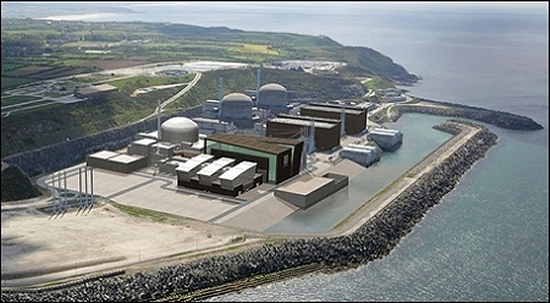
The above mentioned agreement on the nuclear energy involves an enlargement of the Hinkley Point Nuclear Plant in Somerset (Hinkley Point C). The new reactors are scheduled to be completed ten years from now (2023). The plant will be built and operated by the French energy firm EDF (Électricité de France) in cooperation with Chinese investors.

UK-Hinkley-Point-C-new-Nuclear-Plant-diagramEDF has negotiated a guaranteed fixed price – a strike price – for the nuclear electricity at 92.50 GBP/MWh (equivalent to approximately 150 USD/MWh). This strike price is in 2012 prices. The price will be adjusted according to inflation during the construction period and over a subsequent period of 35 years. According to the BBC, the existing nuclear plant at Hinkley produces about 1 per cent of the UK’s total electricity. This is expected to rise to 7 per cent once the construction of Hinkley Point C will be completed in 2023.

Strike Prices effectively remove price volatility risk for electricity generated from low-carbon sources. This ensures greater certainty to generators and minimizes their risk. The goal is to bring forward investment in affordable low-carbon electricity generation, including renewables and new nuclear. In total, renewable energy is expected to make up more than 30 per cent of the UK’s electricity mix in 2020, helping to significantly decarbonize the power sector by 2030. This means that the UK has very ambitious plans in expanding the production of renewable power.

Strike price for renewable power will be even higher

Earlier this year (2013), the British Government introduced the strike price which renewable energy technologies can expect in the coming years (2014-2019). The proposals are expected to become legislation in early 2014. According to a publication by the UK Department of Energy and Climate Change (DECC) the new regime will make the UK market one of the most attractive for developers of most renewables technologies, whilst minimising the costs to consumers. The proposed renewable electricity technologies eligible for the strike prices for example include hydro, geothermal, onshore and offshore wind, tidal and solar projects.

UK-Renewable-Energy-Strike-Price_2014-2019-The strike price for geothermal power will be 120-125 GBP/MWh (approximately 190-200 USD/MWh) and strike price for hydro will be 95 GBP/MWh (approximately 150 USD/MWh). The lowest strike price is for sewage gas; 85 GBP/MWh (close to 135 USD/MWh).

However, what is probably most important and interesting is the strike price for wind power. The British Government expects the overwhelming majority of the new renewable-capacity will be new wind farms, both onshore and offshore. This is understandable, because the utilization of wind power for electricity production is a well known and mature technology. In fact the strike price for wind power can be said to be the base price for new renewable generation. And the strike price introduced for onshore and offshore wind is 95-100 GBP/MWh and 135-155 GBP/MWh, respectively.  This is equivalent to approximately for 150-180 USD/MWh for onshore wind, and 215-250 USD/MWh for offshore wind.

IceLink could be an important part of the solution

In comparison, Iceland could most likely offer the UK electricity from renewable sources at prices similar or even substantially lower than the strike price for new offshore- or even onshore wind capacity in the UK. And actually the Icelandic electricity can be seen as a better product and thus a better option than massive wind power in the UK. Both hydro- and geothermal power offer stable base load electricity, which is very different from the unstable wind power.

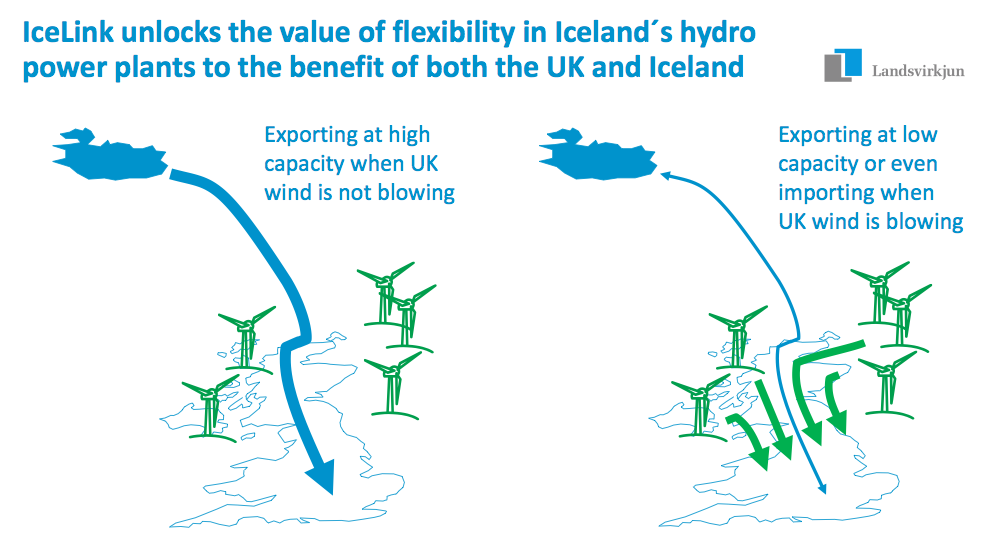
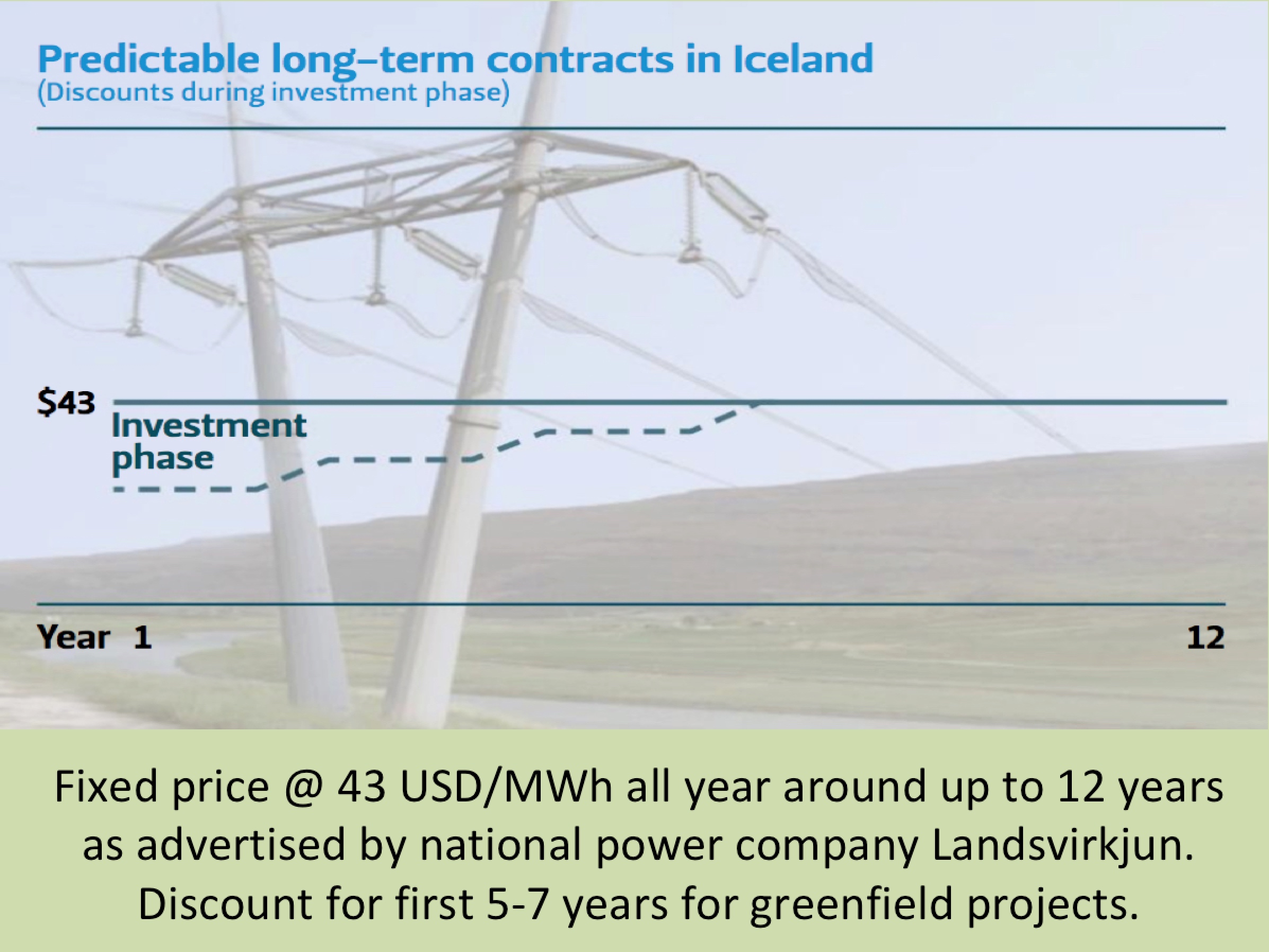
Iceland-UK-BICC-meeting-Nov-2013-Landsvrkjun-Hordur-Arnarson-slide-7With an electric cable between Britain and Iceland (IceLink), the Icelandic energy sector could provide the UK with stable and reliable power from the Icelandic hydro- and geothermal power plants, at very competitive prices. Iceland could also import some of the unstable wind power from the UK; especially during the night. This would give an option to “store” even more of the controllable hydro power in the dams in Iceland during the night. When demand in UK rises during the day this power can then be transferred through the cable to the electricity markets in UK.

The UK wants to be able to move away from fossil fuels towards low-carbon power. What is even more important for the UK is to gain more energy independence and be able to rely on energy from politically stable neighbours (rather than for example importing more LNG from Algeria). Both the nuclear plant at Hinkley Point and plans for more renewable energy in the UK’s energy mix, are important in this context. In addition, a fifth of Britains’ aging power plants are due to close over the coming decade (with further closures in the 2020’s). Thus, the UK needs not only huge investment in energy production and -infrastructure, but also need to secure it self access to numerous reliable energy sources. Therefore the IceLink is a project that undoubtedly will interest the British energy sector and investors.

Iceland offers unique renewable opportunities

Iceland and Norway are the world’s largest electricity producers (per capita). The reason for this huge electricity production is simple. Compared to the low population, both countries are rich in natural renewable resources that offer good opportunities to produce green electricity at a very competitive price.

Iceland-Renewable-Opportunities-10

Well-Known Business Concept

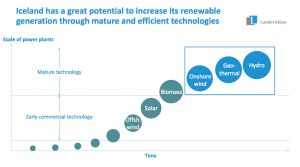
Like Norway, Iceland has extensive renewable hydropower. Iceland’s geothermal sources are also harnessed for electricity production. In addition, the windy conditions in Iceland may offer interesting possibilities to generate electricity at substantially lower costs than at wind-farms in other European countries.

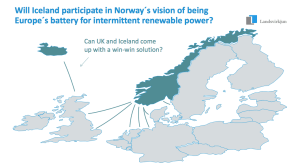
Norway has numerous electric cable connections with other countries and is a net-exporter of electricity. An important part of the business concept of the cable connections is to be able to use the flexibility of the hydropower to maximize revenues. The Norwegian power companies have the possibility to  “save” the hydropower in the dams during night (when electricity prices tend to be low) and produce electricity at full capacity when prices are high (normally during the day).

This not only maximizes the revenues of the Norwegian hydropower firms, but also opens up the possibility for European power companies to export electricity to Norway during the night. Such exports are especially interesting for European power plants that have high fixed cost and low flexible cost, like wind farms (and nuclear power stations that are operated at a stable capacity).

Iceland-Renewable-Opportunities-12

Win-Win Situation

Iceland has no electrical cable connection with markets outside of Iceland. The country is a closed electric system, but with abundant hydro- and geothermal sources. Thus, heavy industries like aluminum smelters, have been able to access very low priced electricity in Iceland. If Iceland would be connected to a European electricity market, by an electric cable, this would offer European markets access to new sources of reliable renewable energy. At the same time the cable (sometimes referred to as the IceLink) would offer Iceland access to  a market willing to pay substantially higher price for the electricity than the heavy industries are. Thus, an electric cable between Iceland and Europe would create a win-win situation.

Actually, the heavy industries in Iceland would not necessarily close down if there came an electric cable between Iceland and Europe. First of all they have long-term energy contracts (up to 40 years). Secondly, there are numerous unharnessed hydro- and geothermal power options in Iceland. An electric cable to Europe would be like adding a new large consumer that is willing to pay higher price but can only receive a fixed amount of electricity (the capacity of IceLink would possibly be close to 1,000 MW).

Iceland-Renewable-Opportunities-13

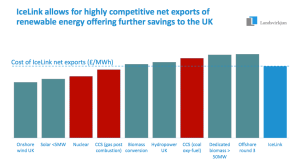
The IceLink would mean that new hydro- and geothermal power stations in Iceland would be more profitable than they would be today (by selling the electricity to heavy industries). At the same time the green Icelandic electricity could be offered in Europe at prices that are very competitive. Even despite the long transmission, the Icelandic green  electricity could be a better choice (economically) for the European markets than offshore wind, biomass, coal and/or nuclear. In a nutshell, Iceland is in the position to be the best economic option for other European countries to access more renewable energy.

The illustrations above are from a presentation by Mr. Hörður Arnarson, CEO of Landsvirkjun, presented at the Iceland Energy Summit in London on November 1, 2013.

Successful energy summit in London

The Iceland Energy Summit was held in London on November 1, 2013. The event was organized by the British-Icelandic Chamber of Commerce (BICC) and hosted by Bloomberg.

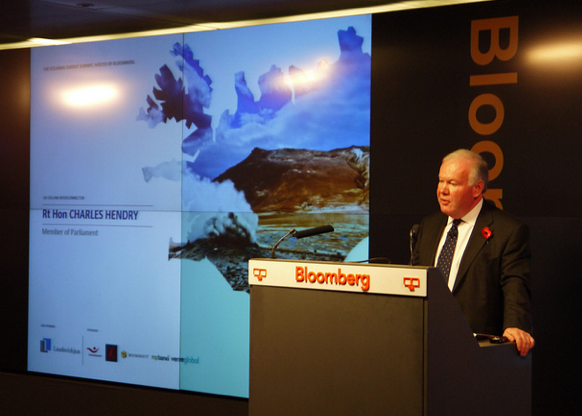
Iceland-UK-BICC-meeting-Nov-2013-CHThe event provided insight into Iceland’s renewable energy resources, the birth and growth of the data storage industry in the country, as well as the search for offshore oil on the Icelandic continental shelf. Strong focus was on a plan for an undersea power cable to connect the British and Icelandic grids. This plan or proposal is attracting strong investor interest, according to Mr. Charles Hendry, the former Energy Minister of the United Kingdom and current Member of Parliament.

Mr. Hendry, who promoted the project, said that there’s “no doubt that in Britain the political will is there, so if there is a political will in Iceland, we want to work together”. According to Mr. Hendry the project offers low-risk, predictable returns attractive to institutional investors including pension funds. The UK is preparing to change policies needed for the cable, Mr. Hendry said.

In May last year (2012), Mr. Hendry helped spur an agreement between Iceland and the UK to explore proposals regarding the cable (sometimes referred to as the IceLink). The cost of the link is still not clear, but if it will go ahead it could probably be completed within 7-10 years.. It would extend more than 1,000 kilometers,  thus be longer than any of the subsea electrical cables currently in operation.

Iceland-UK-BICC-meeting-Nov-2013-Landsvrkjun-Hordur-Arnarson-slide-7Electric cables like that already connect the grids of Norway and Britain to the Netherlands. The Dutch grid operator (TenneT) is planning links between Germany and Norway and the Netherlands and Denmark. There are already connections of this type between Britain and France, between Vancouver island and Canada, between Sardinia and Italy, and between Tasmania and Australia, to name a few well known examples .

According to Bloomberg, Mr. Andrew Perkins, a partner in energy and environmental finance at Ernst & Young, stresses that these assets are attractive to financiers, suggesting that the capital costs to build the IceLink should be financed by the private sector. As close to 100 percent of all electricity generated in Iceland comes from natural renewable sources, and several promising renewable energy options are still unharnessed, the IceLink offers great opportunity for the UK to access substantial green power at a very competitive cost.

Here, at the Icelandic Energy Portal, we will soon be covering the Energy Summit in more details. Note that the slides (and videos) from the event can be downloaded from the website of the BICC.

Icelandic Energy Summit, London, November 1st 2013

The British Icelandic Chamber of Commerce is introducing the Icelandic Energy Summit, hosted by Bloomberg, in London on Friday, 1 November 2013.

Iceland-Europe-mapAccording to the website of the British Icelandic Chamber of Commerce the event “will provide participants an insight into Iceland´s renewable energy resources, the birth and growth of the data storage industry in the country, the search for offshore oil – and what all this means for the country and its neighbours. The BICC is proud to have assembled some of the most dynamic voices in the developing story of Iceland and its energy potential.” The event, which is free, is said to be of interest “to finance professionals who conduct business with Iceland, or would like to, renewable energy specialists, academics and all those who take an interest in the future development of the Arctic. Feel free to pass on this invitation to colleagues, but  we expect this event to be well attended.”

The Agenda is as following:

10:30 Registration & Coffee
11:00 Welcome
William Symington, BICC
Keynote speech
Olafur Ragnar Grimsson, President of Iceland
11:45 UK-Iceland Interconnector
Charles Hendry, MP
Hörður Arnason, CEO Landsvirkjun
Paul Johnson, National Grid
Mike Lawn, Bloomberg New Energy Finance
13:00 Buffet Lunch
13:45 Data Centres in Iceland
Verne Global – Isaac Kato, CFO
Risk Management Solutions Inc, Robert Muir-Woood, Chief Research Officer
14:45 Geothermal
Sigurður St Arnalds, Senior Energy Advisor, Mannvit
Mark Taylor, Bloomberg New Energy Finance
15:45 Icelandic Oil exploration and the development of Arctic Resources
Michael Evans, Chief Operating Officer, Iceland Petroleum
Heiðar Guðjónsson, author “The Push for the Arctic”
16:30 Closing & Drinks

Here is a link to the registration.

1 GW Iceland-UK electric subsea cable may be close

The governments of United Kingdom (UK) and Iceland may both be interested in a subsea electric connection between the countries.

HVDC-Cable-Iceland-Europe-map-slide

The main purpose of the cable would be to bring electricity from Iceland’s renewable sources to the UK. The UK has ambitious plans to substantially increase renewable energy in UK’s energy mix. According to legally binding goals, set by the member states of the European Union (EU), the UK needs to dramatically increase production and imports of renewable energy. Iceland could become an important player in that green transformation.

Renewable electricity could be provided by Iceland to the UK even at a cheaper cost than offshore wind. In addition the Icelandic hydro- an geothermal power is a very reliable power source. The plans being discussed concern a 1,100-1,200 km subsea cable with a capacity of 1GW. The package might be worth an estimated GBP 4 billion, with the inclusion of related generation and onshore transmission investments and could be operational by within a decade.

bjorgvin-sigurdsson-landsvirkjunMr. Bjorgvin Sigurdsson, executive vice president of Iceland’s main power company (Landsvirkjun), has expressed that the company is now looking at this much more seriously than ever before.  “The technology seems to be there to make it work… the issue is whether this makes sense economically.”

At present, Iceland benefits from some of the most competitive electricity prices in Europe. All the electricity in Iceland comes from renewable hydro- and geothermal sources, which offer the possibility of a very low cost generation. The director general of the National Energy Authority of Iceland (NEA), Mr. Guðni Jóhannesson, has said that the interconnector could provide power to the UK at around 60 to 70 percent of the price of offshore wind.

hvdc-cable-nornedAs Iceland still has numerous options of unharnessed hydro- and geothermal energy, an electrical cable might create a win-win situation for Iceland and the UK. The idea of exporting energy from Iceland to the UK is not a new one, as it was first mentioned decades ago. However, it is not until recently that technological advancement and rising electricity prices in Europe made the idea feasible.

Significant milestone reached on HVDC cable

Connecting with another electricity market in Europe could provide Iceland with a unique opportunity to maximise the return from the country’s natural resources:

  • Surplus energy already within the system and presently unutilised by industry could be sold.
  • Further energy generation methods could be introduced.
  • The flexibility of hydropower could be better utilized.
  • Risk distribution could be increased.
  • Iceland’s energy supply security could be increased by opening up the presently isolated system.
  • A number of new and exciting employment opportunities could become a reality and the value created by such a project could be significant.

Iceland-Europe-HVDC-cable-map-LandsvirkjunEarlier this summer an advisory group on a subsea HVDC electricity cable between Iceland and Europe handed over its recommendations to the Icelandic Minister of Industries and Innovation. The report shows that there are indications that such a HVDC cable between Iceland and the United Kingdom could prove macro-economically profitable if certain conditions were to be fulfilled; i.e. if negotiations with the counterparties should prove successful, procuring favourable energy prices and secure long term contracts.

The recommendations of the advisory group are a significant milestone in assessing the feasibility of connecting Iceland with the European electricity market. The advisory group was unanimous in its opinion that work should continue on mapping out the various aspects of the project domestically whilst concurrently seeking out answers on potential operational and ownership models from the counterparties in the UK.

The risk of domestic electricity prices multiplying, with a connection with European markets, seems to be minimal. The Norwegians have set a successful precedent for achieving the consensus of stakeholders whilst utilising the opportunity to sell electricity to the European market. This has been done without threatening the existence of industry within Norway.

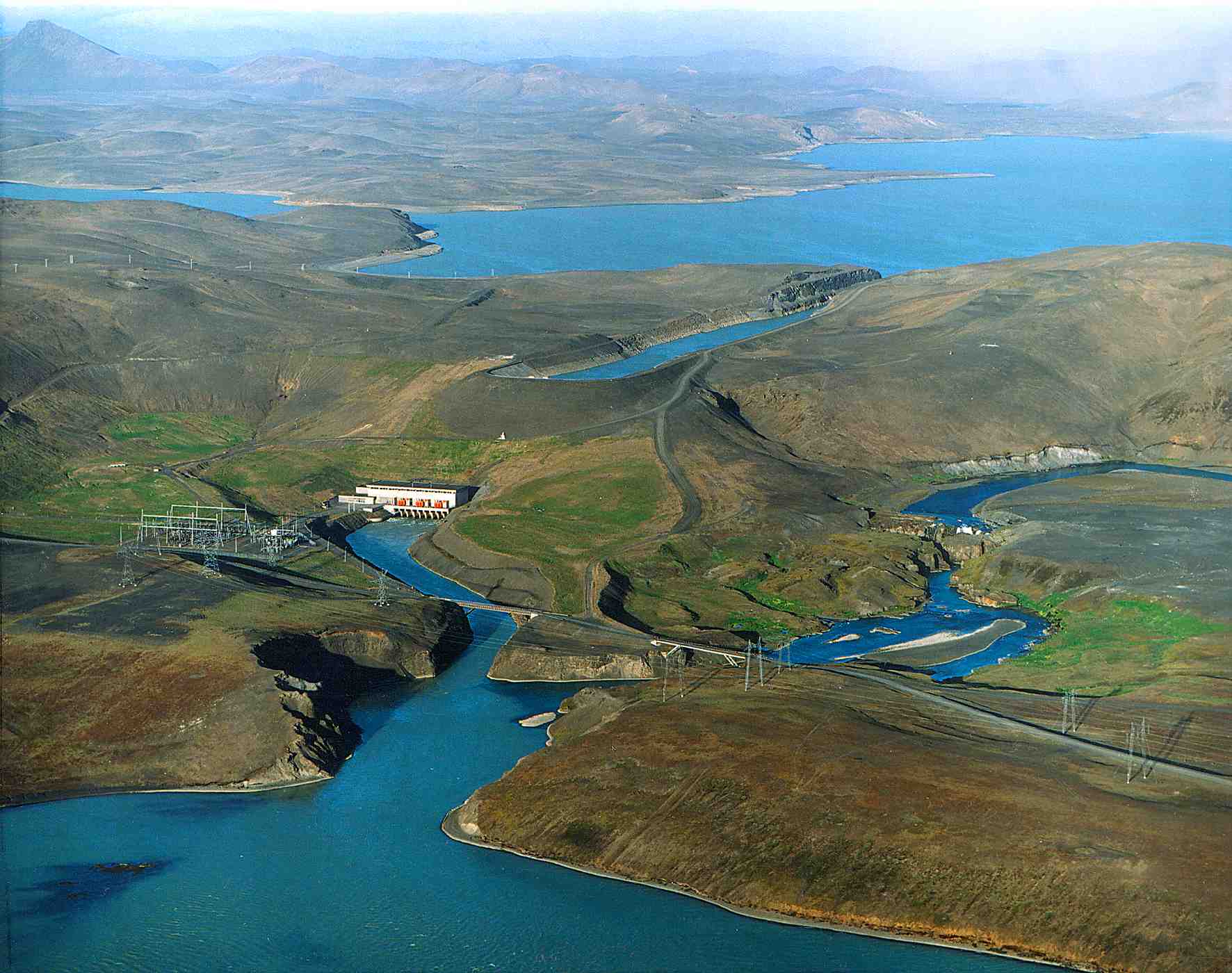
Iceland-Landsvirkjun-Sigalda-HydroThe Minister of Industries and Innovation will assess the recommendations of the advisory group and come to a decision as to the next step. It is estimated that the preliminary findings will be released by the end of this year (2013). This will include a decision on if and when expensive and extensive detailed research on the project will begin.

What explains the high energy intensity in Iceland?

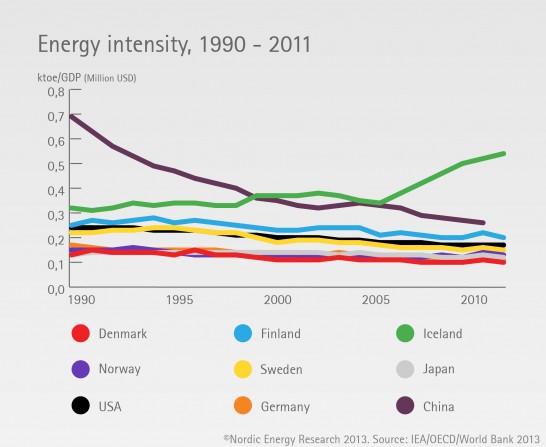
The worlds major economies have gradually been reducing their energy intensities (using less energy to produce one unit of GDP). This, for example, applies to all the Scandinavian countries. However, this does not apply to Iceland; Iceland has been increasing its energy intensity.

Nordic-Energy-intensity-1990-2011-with-China-Germany-Japan-USA

Reducing energy intensity means increasing the energy efficiency in the economy. China is an example of a country where the trend towards more energy efficiency has been evident. As the Chinese economy has increased productivity and moved towards higher value products, GDP has increased much faster than energy consumption.

Industry is often classified into three sectors;  primary, secondary, and services (tertiary sector). The primary sector involves the retrieval and production of raw materials, while the secondary sector involves the transformation of raw or intermediate materials into goods. The services- or tertiary sector involves the supplying of services to consumers and businesses.

Economies previously dominated by primary and secondary sectors, such as in Denmark, have steadily decreased their energy intensities since 1990. The economies in Sweden and Finland also follow this trend – although their energy intensity increased in the early 1990s due to an economic recession.

The reason for the present high energy intensity in Iceland, is the recent expansion of energy-intensive industries in the country. It is especially the aluminum industry that has expanded at a much faster rate than the general economy in Iceland has grown.

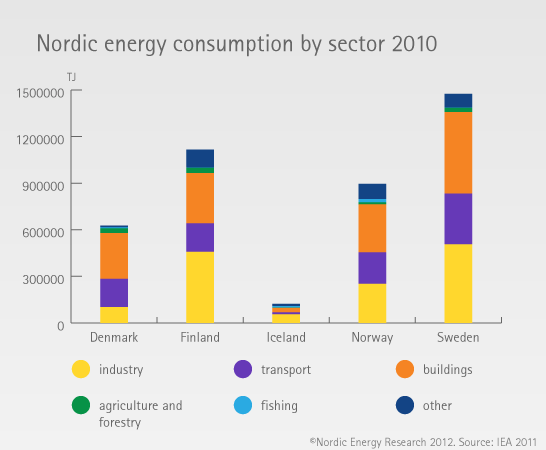
On average, industry accounts for about a third of the energy use in the Nordic countries. This is considerably higher than in most other developing countries.

Nordic-Energy-Consumption-by-Sector-20101

Both Iceland and Norway have significant metal manufacturing. This is due to historically cheap and plentiful hydroelectricity (and geothermal energy in Iceland). Because of the electricity consumption by the aluminium industry and other energy-intensive industries, Iceland and Norway actually have the world’s highest electricity consumption (and production) per capita!

10 TWh of green energy available

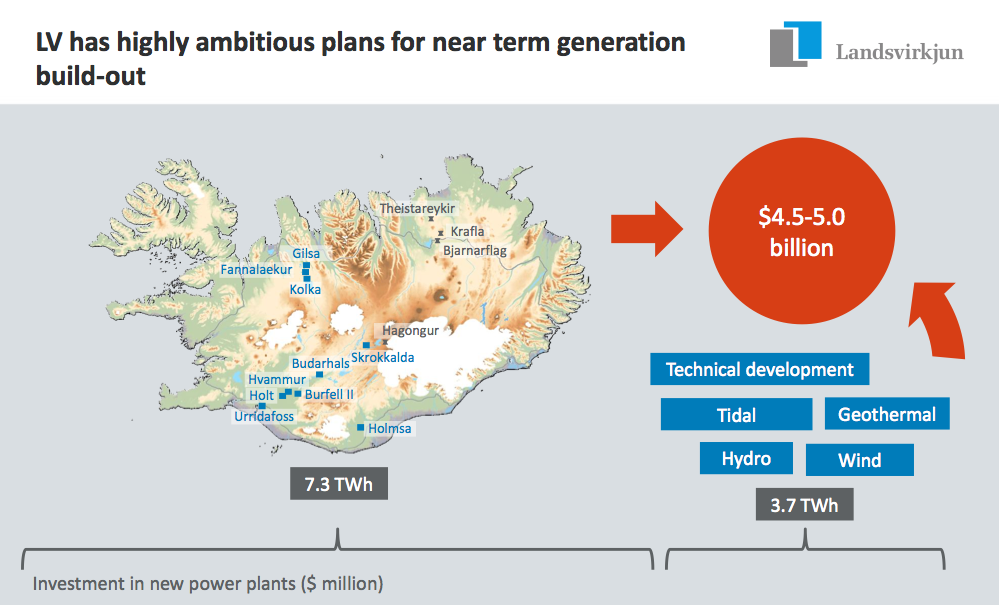
Iceland-Landsvirkjun-New-Renewable-Electricity-GenerationThe Icelandic power company Landsvirkjun has introduced plans for several new renewable energy projects.

If all these projects will be realized, they will add close to 7 TWh of annual generation from natural hydro- and geothermal sources. All the projects have been identified. As Landsvirkjun is owned by the Icelandic government, formal decisions about which of the projects will be realized first depends on the Icelandic parliament.

In addition, Landsvirkjun has put a figure on several other possible new power projects, that could be generating electricity within a decade or so. In total, Iceland may within near future be producing 9-10 TWh more electricity than today. This is not an exact figure; the new additional capacity could be somewhat less or even more. This will depend on the interest of new users of electricity, such as data centers, silicon industry etc. However, the most interesting option may be selling part of the new electricity production to markets in Europe.

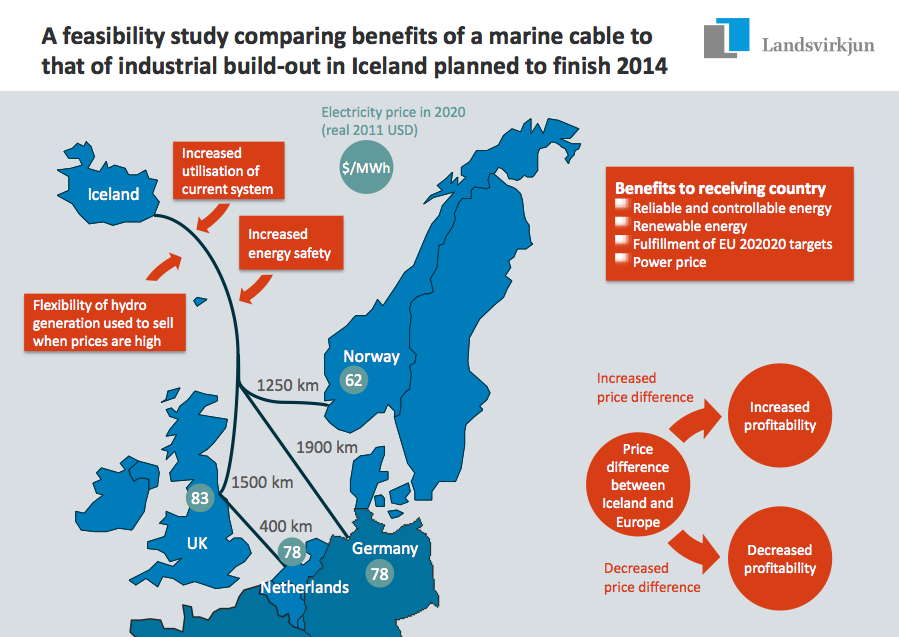
Iceland-Landsvirkjun-HVDC-Feasabilty-StudyA feasibility study on a possible electrical cable (high voltage direct current cable; HVDC) between Iceland and Europe is currently being carried out by a special working group. The group includes people from the Icelandic power sector and other stakeholders, appointed by the Icelandic Minister of Industries and Innovation. It is expected that the working group will deliver its report  during next year (2014).

The high electricity prices in Europe make a cable to Europe an especially interesting option for the Icelandic power generating firms. During the last few years, wholesale electricity prices in Western Europe have often been around three times higher than in Iceland. Thus, an electric cable between Iceland and Europe could increase the profits of Icelandic power companies  substantially.

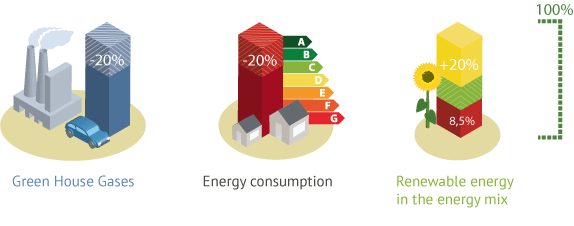
EU-energy-policy-20-20-20There would be numerous other positive gains from such a cable, as presented on the slide at left (the slide is from a presentation by Landsvirkjun). For example, the Icelandic power companies would be able to maximize the current capacity, resulting in more production. Europe would enjoy access to new green electricity generation, which would help the member states of the European Union (EU) in achieving climate- and energy goals (the EU aims at raising the share of EU energy consumption produced from renewable resources to 20% no later than 2020). The issues of such a connection between Iceland and Europe was described in more details in one of our earlier posts.

In the forthcoming months it will hopefully become clearer if Europe may gain access to the geothermal- and hydropower of Iceland.

Icelandic energy in the New York Times

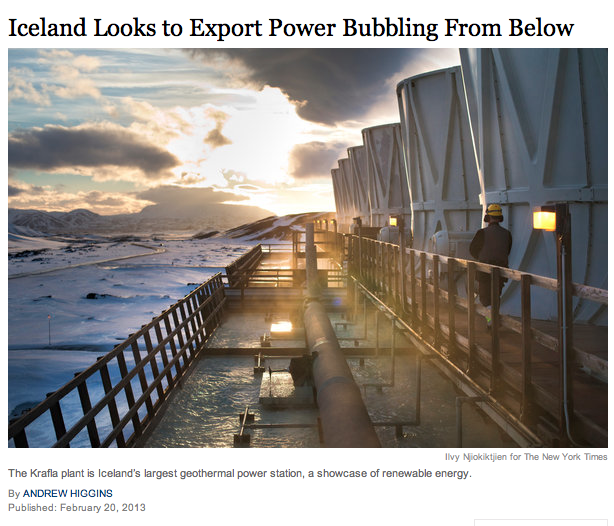
“In a nation with only 320,000 people, the state-owned power company, Landsvirkjun, which operates the Krafla facility, sells just 17 percent of its electricity to households and local industry. The rest goes mostly to aluminum smelters owned by the American giant Alcoa and other foreign companies that have been lured to this remote North Atlantic nation by its abundant supply of cheap energy.”

NYT-Iceland-electric-cable-feb-2013These words are from an article published by the New York Times (NYT) a few days ago. The article describes how electricity generated by harnessing Iceland’s extensive renewable energy sources may possibly be exported to consumers in the European Union (EU). Such an export could result in a very substantial increase in profits for the generating companies in Iceland. The aluminum smelters are paying prices believed to be less than 30 USD per MWh. Which is, according to the NYT, less than half the going rate in the EU and barely a quarter of what, according to the Renewable Energies Federation, a Brussels-based research unit, is the average tariff, once tax breaks and subsidies are factored in, for renewable electricity in the EU.

Currently, Landsvirkjun is conducting a research into the possibility of a submarine electric cable (a High Voltage Direct Current cable or HVDC) to connect the electricity markets of Iceland with the European market. The cable would be approximately three times longer than the link between Norway and the Netherlands, which is currently the world’s longest submarine electricity cable. It is to early to say what would be the preferable connecting point in the EU; it could be Scotland, the Netherlands, Germany, or even Norway.

A connector between Iceland and Europe would not only offer the Icelandic electricity generating companies the possibility of substantially higher price for their product. Such a cable would also make it possible to import electricity to Iceland in periods of low electricity prices at the other end of the cable (such as during the night). The connector would also increase the energy security in Iceland, as the country would be less dependent on keeping large emergency reserves, as it does now. For the EU this would also be an attractive project – not least as the Union’s 27 member states agreed in 2009 to a mandatory target of deriving at least 20 percent of its energy from renewable sources by 2020.

Hordur-Arnarson-Landsvirkjun-CEOLandsvirkjun’s CEO, Mr. Hörður Arnarson, has described the possible cable as a very promising project.  “We have a lot of electricity for the very few people who live here.” Compared with the rest of the world, he said to the NUT, Iceland produces “more energy per capita by far, and it is very natural to consider connecting ourselves to other markets.”

It is expected that final decision on the cable will be taken within two years or so. For more information about the cable and the importance of EU’s energy policy for Iceland, please check out our earlier post on the issue.