Skip to content

Posts from the ‘Electricity Market’ Category

Data centers in Iceland

In 2007, a benchmarking study by PricewaterhouseCoopers  (PWC) showed Iceland to be a favorable location for new data centre activity. The report concluded with Iceland being supportive and welcoming in the respect of issues as governmental legislation, immigration and permits.

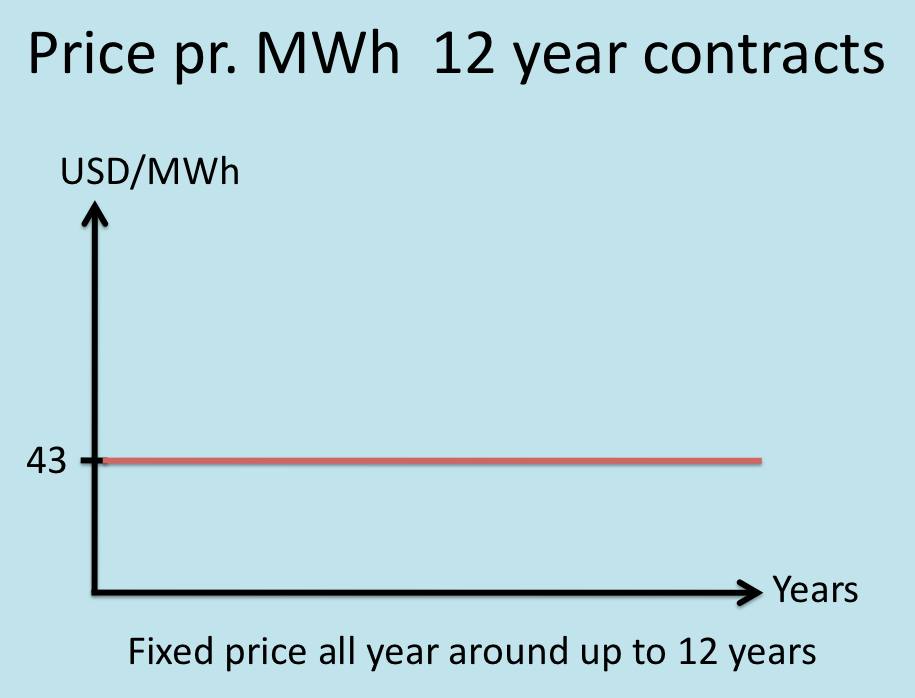
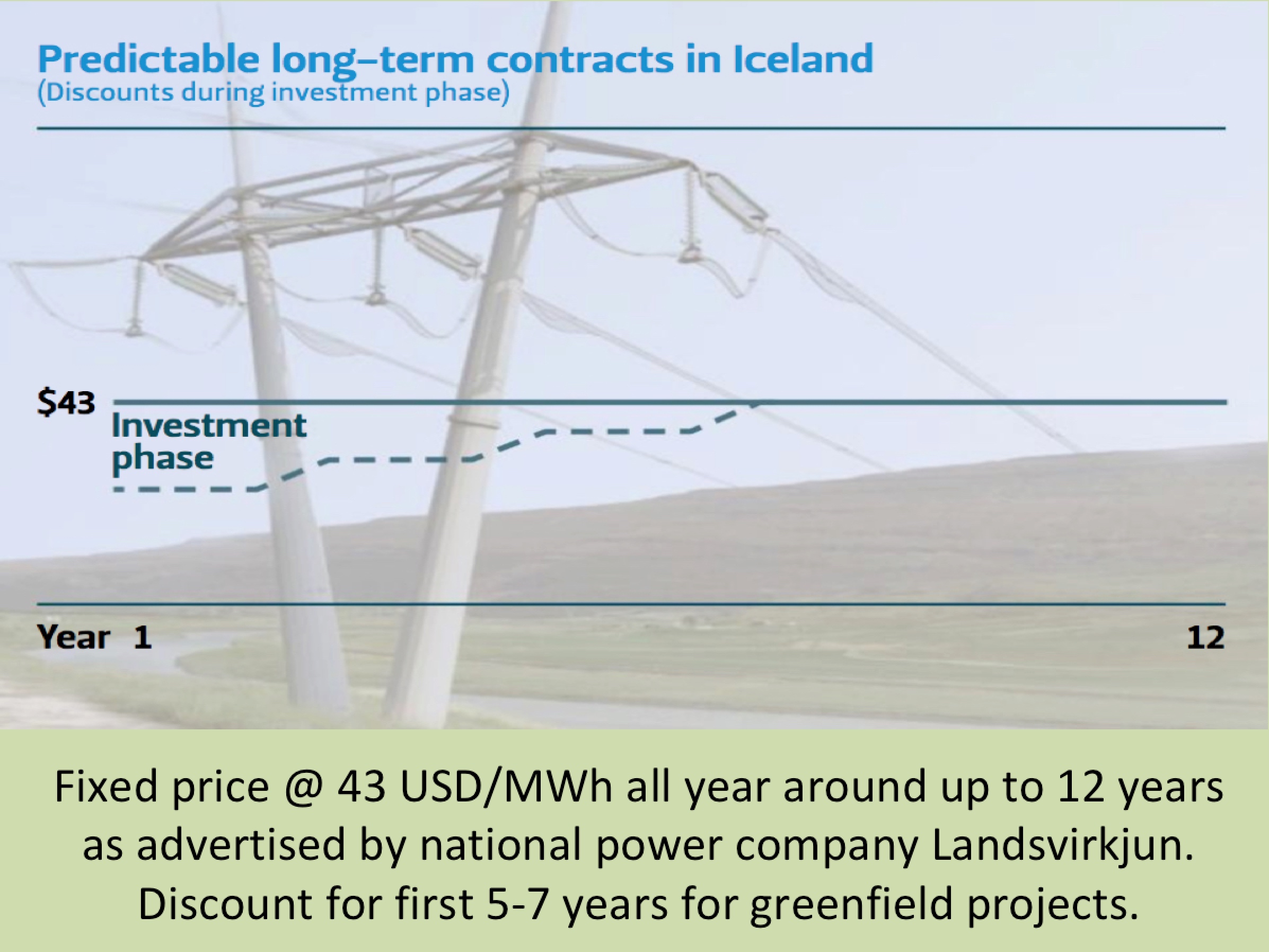
Operational cost for data centres in Iceland is minimum due to the low cost cooling and electricity. Presently, the Icelandic power company Landsvirkjun is offering electricity contracts at the price of 43 USD/MWh. Those competitive rates are available as fixed for up to 12 years. Furthermore, Iceland has significantly less of a security risk than almost any other Western or emerging countries. Its geographic location, low population density and lowered post-Cold War strategic value make it an unlikely target for either external or internal forces.
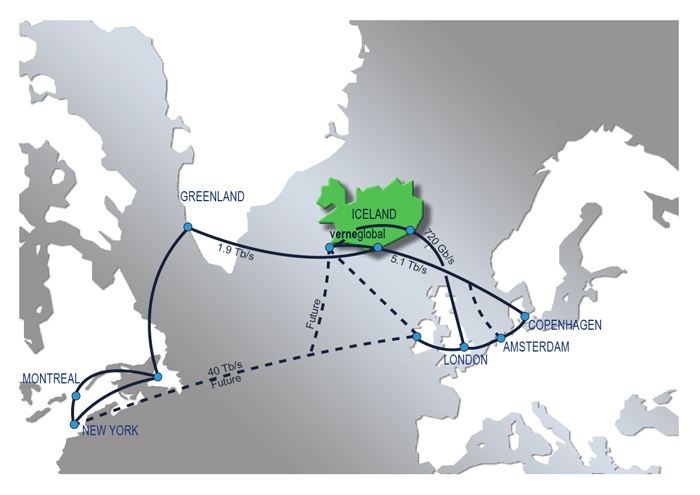
Iceland-Telecom-Cable-MapThe Icelandic infrastructure for telecommunications networks and services is highly advanced. Mobile phone and Internet penetration in Iceland are among the highest in the world. Iceland is linked with Europe and North America via number of fiber-optic submarine systems. They are Farice-1 to the UK (with a capacity of 0.72 terabits per second and was originally installation in 2003), the Danice cable to Denmark and the Netherlands (with a capacity of 5.1 terabits per second), and Greenland Connect which connects Iceland to Canada and the Northeast United States (with a total capacity of 1.9 terabits per second). Additionally, the new Emerald Express trans-Atlantic cable (with a connection to Iceland) is scheduled to be ready for service before end of this year (2013).

Verne Global and Thor Data Center are examples of new data-centres that have started operation in Iceland in recent years. Besides running on low-cost 100% renewable energy, the growing data-center industry in Iceland is also enjoying a major upgrade of the international submarine telecom capacity between Iceland and mainland Europe

Verne-Global-logo-taglineVerne Global is a company that owns and operates a data center campus in Keflavik in Southwest Iceland. The 18-hectare (approximately 45-acre) Verne Global data centre complex is just west of Reykjavik, the capital of Iceland, minutes from Keflavík International Airport. Verne Global’s facility has been designed to fully utilise Iceland’s unique environmental power advantages: 100% powered by renewable energy resources and 100% cooled by the natural environment of Iceland, without the use of chillers or compressors.

The largest investor in Verne is the UK investment foundation Wellcome Trust. Verne Global offers data centre decision makers a 100% carbon neutral and affordable power solution with a very precise pricing predictability, a range of server density options and efficiency without extra expense, using natural cooling. The customers of Verne Global customers range in size from those requiring multi-kilowatts to multi-megawatts. With its headquarters in the United Kingdom, Verne Global is led by an experienced team with proven success in the data centre industry.

Thor-Data-Center-Advania-logoThor Data Center (THORDC) in Hafnarfjordur is owned by the Nordic IT company Advania. The Thor Data Center facility is located 10 minutes from  Reykjavik, and a 30 minute drive from Keflavik International Airport. Due to the physical and natural elements in Iceland and the specific datacenter design, Thor Data Center is claimed to be one of the most energy efficient data centers in the world. It is powered by clean renewable hydro- and geothermal energy sources and offers unique value proposition for companies demanding a reliant and cost effective hosting service in a 100% green, zero carbon footprint  environment.
Gaining from the European green drivers

Electricity prices in Iceland are substantially lower than anywhere else in Europe. While common wholesale prices for electricity in Iceland are equivalent to 25-30 €/MWh, the wholesale prices in Europe are often double that and even more. This winter, for example, the average wholesale price at the European Power Exchange (EPEX SPOT) has been close to 50 €/MWh.

This means that if Iceland would have an electric cable connection with Europe, electricity could be sold from Iceland at a much higher price than being possible in the small Icelandic market. This  makes the European continent, Scandinavia and the United Kingdom a very interesting market for Icelandic generating firms.

STRONG DRIVERS:

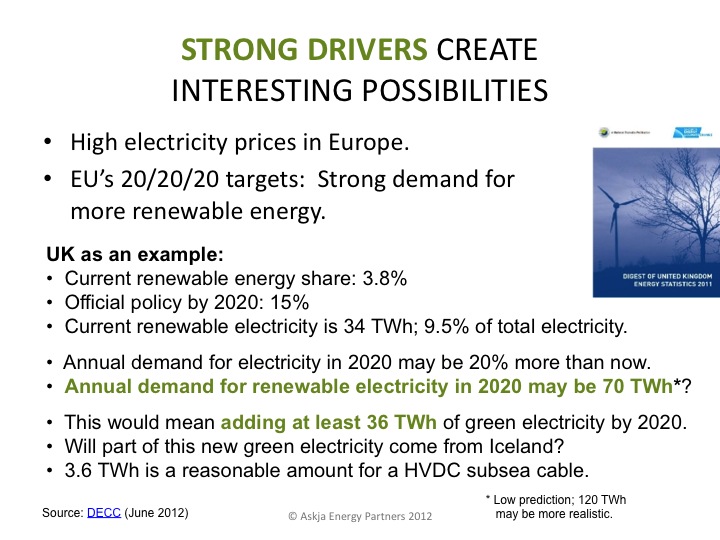
Slide21High electricity prices in Europe are not the only driver, creating more demand for Icelandic electricity. Almost all electricity in Iceland is generated by utilizing renewable sources (hydro- and geothermal power). The European Union (EU) has adopted a binding plan to greatly increase the share of renewable energy. According to EU’s Renewable Energy Directive, the Union is going to reach a  20% renewable energy target for 2020 – more than double the 2010 level of 9.8% – as well as a 10% share of renewable energy in the transport sector. The targets will help to cut greenhouse gas emissions and – what may be even stronger incentive – reduce the EU’s dependence on imported energy.

According to the Directive, the member states have taken on binding national targets for raising the share of renewable energy in their energy consumption by 2020. These targets range from 10% in Malta to 49% in Sweden. The national targets will enable the EU as a whole to reach its 20% renewable energy target for 2020 – more than double the 2010 level of 9.8% – as well as a 10% share of renewable energy in the transport sector.

UK AS EN EXAMPLE:

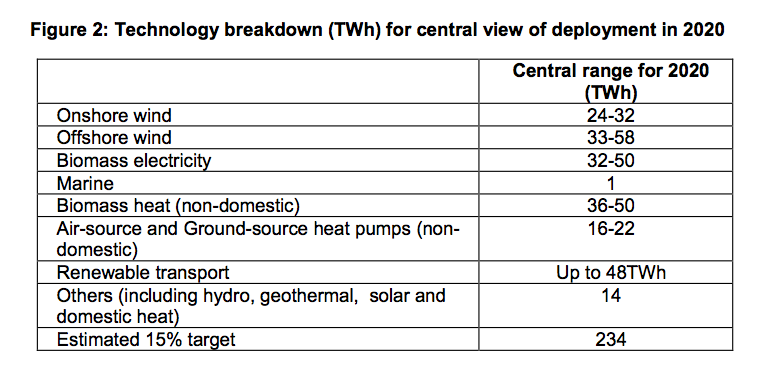
DECC-2011-Figure-2It is noteworthy that to be able to reach the targets, it is expected that for example the United Kingdom needs to add more than 170 TWh of annual renewable energy  by 2020 (UK needs to go from present less than 60 TWh to approximately 230 TWh by 2020). This is according to the 2011 UK Renewable Energy Roadmap (pdf) and the 2012 Update (pdf).

It is not clear how large share new renewable electricity will be of this total renewable energy addition of 170 TWh. However, from the 2011 UK Renewable Energy Roadmap it can be expected that the goal for 2020 may be somewhere between 104-155 TWh of annual renewable electricity generation (as described in a table marked as figure 2 in the Roadmap; shown here above). The current annual renewable electricity generation in the UK is somewhere between 34-38 TWh. Thus, the goal of 104-155 TWh of total electricity from renewable sources by 2020, will call for a new annual renewable electricity production of 66-121 TWh. Possibly, it would be fair to say that the UK needs to add close to 100 TWh to its annual renewable electricity generation. And this is to happen within seven years from now.

HOW ICELAND CAN PLAY A ROLE:

EU’s plan for increasing renewable energy allows the member states to import renewable energy from other countries. Iceland can offer substantial amount of electricity from renewable sources at very competitive prices (currently, the Icelandic power company Landsvirkjun offers new 12 year contracts at 43 USD/MWH, which equals approximately 32 €/MWh). It may be totally realistic that some of UK’s new renewable electricity will come from Iceland.

Slide22Iceland’s hydro- and geothermal power is less costly than for example new wind farms in the UK. In addition, Icelandic hydro- and geothermal power is a stable base-load power, unlike wind and unlike solar.

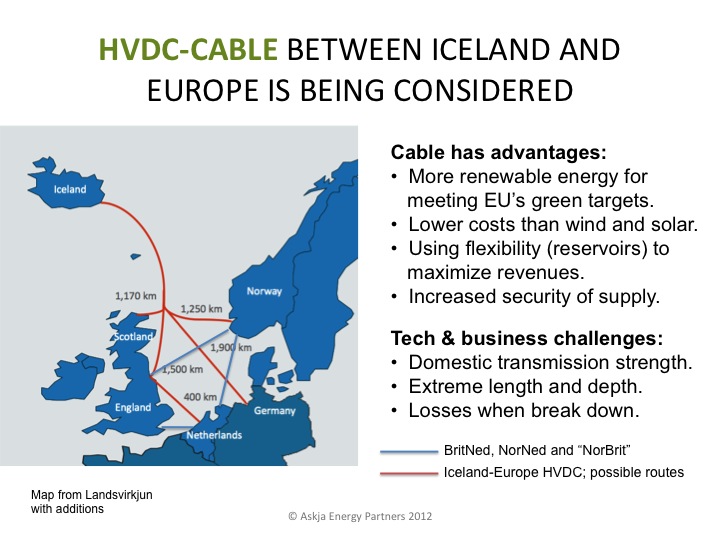
An electric cable between Iceland and the UK might be a win-win project. UK would gain access to reliable base-load renewable electricity. Icelandic power companies would increase their profits and could utilize the cable to import electricity from the UK when prices there are low (for example during the night, when demand is minimal).

Such a high voltage direct current (HVDC) cable is currently being seriously considered by a group of Icelandic power companies and other stakeholders. This would be a technically and financially complicated project and probably it will take a couple years until any decision will be taken on the matter. For more information you are welcome to contacts us at Askja Energy directly with your inquiries.

Future growth of the Icelandic energy industry

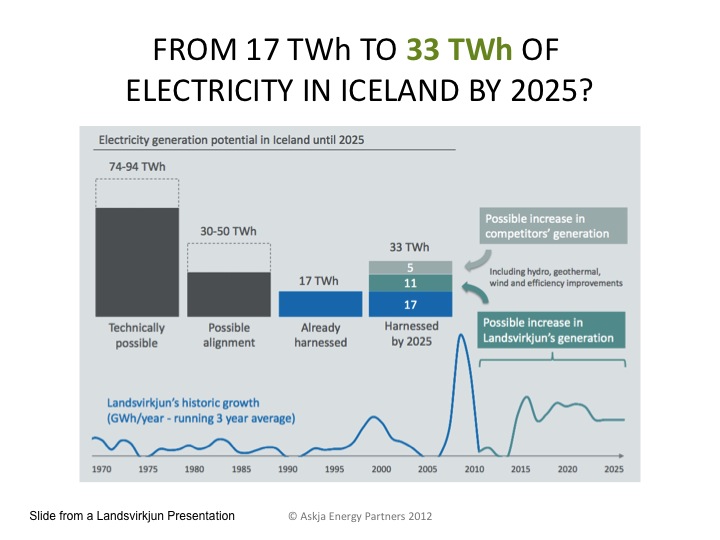
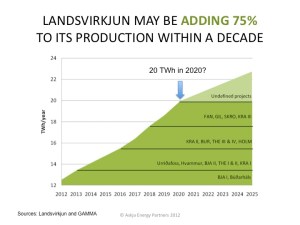
Slide20Iceland has substantial renewable and economically attractive options to increase its electricity generation. The National Power Company, Landsvirkjun, has introduced a vision for possible upcoming projects, that could increase the total annual generation from the present 17 TWh to 33 TWh by the year of 2025.

Almost all of this additional generation of  16 TWh would come from new geothermal- and hydro power projects, but a small share might come from wind power. Almost doubling the electricity production in Iceland in a period of less than 15 years would call for massive investment. However, this investment could be fairly stable over the period, as most of the suggested power projects would be medium scale (and, for example, not as large as the 690 MW Kárahnjúkar / Fljótsdalsstöð Hydropower Plant, that was constructed in the first years of the 21st century).

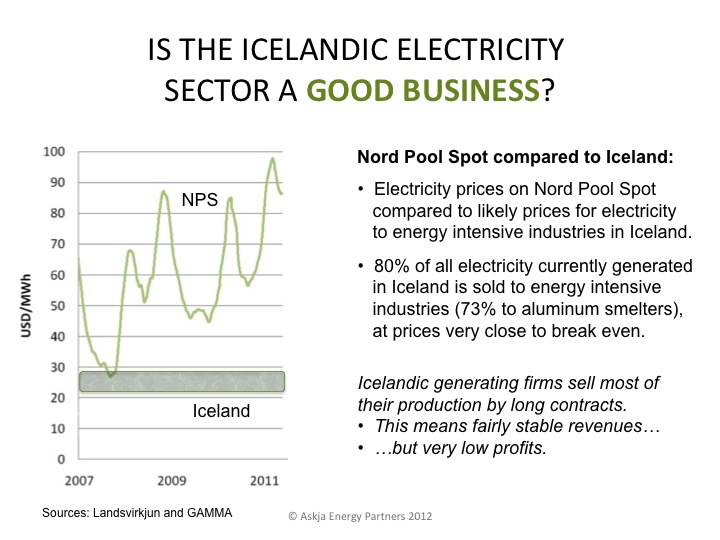
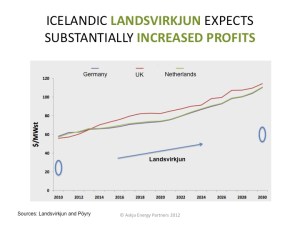
Slide17Electricity prices in Iceland have been much lower than, for example, in most of Europe. This price gap has been increasing, offering the Icelandic power industry the possibility to raise the electricity price and still be very competitive.

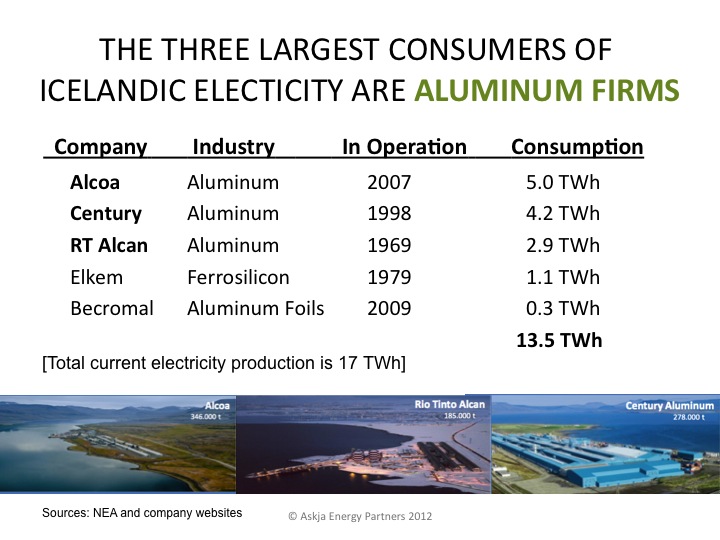
Today, most of the electricity generated in iceland is consumed by the aluminum industry and other energy intensive industries. The long term contracts offer the electricity companies fairly stable revenues, but low profits. The increased price difference between Iceland and Europe may change this situation for the better. Today, Landsvirkjun is offering electricity contracts over a 12 year period, where the price is 43 USD/MWh. This is a very good option for small and medium sized companies, where electricity cost is a substantial share of their production costs.

Several new contacts have already been signed. Two new data-centers are already in operation; Verne Global and Thor Data Center, offering services that run on 100% renewable energy. This growing data-center industry is also enjoying  a major upgrade of the international submarine telecom capacity between Iceland and mainland Europe .

Slide18

Another example of new power contract is an agreement between Landsvirkjun and GMR (Geothermal Metal Recycling), where clean, renewable energy will be supplied to power a new steel and scrap metal recycling plant at Grundartangi in Southwest Iceland. Also, the German industrial holding company PCC and the French construction-materials giant Saint Gobain are considering Iceland as a location for their production.

It is too early to say how fast the Icelandic electricity industry will grow in the forthcoming years. If the electricity prices in Europe will continue to rise, as the consulting and engineering firm Pöyry has been forecasting, Iceland’s competitiveness will increase even further. For more information about these possibilities we recommend a recent analysis by Gam Management; Landsvirkjun’s Renewable Energy Potential and its Impact on Iceland’s Economy.

The largest consumers of electricity in Iceland

Iceland-12-year-electricity-contractsVery few countries in the world offer as competitively priced electricity as Iceland does. Companies that need substantial quantity of electricity (or hot water) and wish to operate within Europe, North America or elsewhere in the OECD, will hardly find better business environment as available in Icelandic. For example, the Icelandic power company Landsvirkjun offers 12 year contracts where the electricity is priced at 43 USD/MWh.

Another fact that makes Icelandic electricity a very attractive option, is that almost 100% of all electricity generated in Iceland comes from renewable sources (hydro- and geothermal power). In addition, the Icelandic power stations and transmission system rank among the world’s best in terms of secure and reliable electricity supply.

The low-cost and reliable Icelandic electricity has led to a strong power-intensive industry in Iceland. Industrial manufacturing products have become the largest part of Icelandic exports, accounting for close to 55% of the total exports (in fob-value). The largest proportion of these exports is aluminum (40% of total exports), which is produced in large smelters by harnessing Icelandic renewable energy.

Slide15

Today, the aluminum industry and other power intensive industries consume approximately 80% of all the electricity in Iceland. Although the aluminum industry is a dominating consumer of Icelandic electricity, new energy related industries and services have started to see Iceland as an attractive location. Examples are foils production for electrolytic capacitors and data centers.

This new interest is understandable, especially when having in mind the high electricity prices in many European countries. And Iceland’s cool weather, good capacity in overseas telecom cable connections, and very competitive electricity prices make the country an ideal location for data storage services. Another example of a new industry is aquaculture, utilizing warm wastewater from the Icelandic geothermal stations. This, and other new upcoming projects harnessing Icelandic energy, will be further described here at the Icelandic Energy Portal in next week.

Overview of the Icelandic energy business

There are three main energy companies in Iceland:

Landsvirkjun (owned by the Icelandic state).
Orkuveita Reykjavíkur (owned by municipalities).
HS Orka (owned by Canadian firm Alterra Power and a group of Icelandic pension funds).

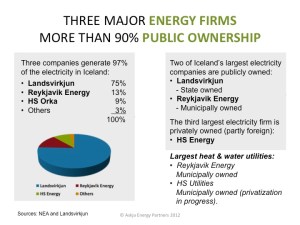
Slide12State-owned Landsvirkjun is by far the largest Icelandic energy company, providing approximately 75% of all the electricity produced in Iceland. Landsvirkjun is responsible for more than 96% of all hydro generation in Iceland, and its share in the generation of electricity from geothermal power is around 11% of the total. Most of the electricity Landsvirkjun generates (80%) is sold to energy intensive industries via long term contracts. The remaining 20% is bought by public utilities and the Icelandic Transmission System Operator (TSO); Landsnet.

Today, Landsvirkjun owns eleven hydropower stations and two geothermal power stations with a combined capacity of 1,895 MW.  The stations generate close to 12.6 TWh annually. Landsvirkjun’s hydropower plants generate around 96% of the company’s total production, while geothermal power contributes around 4%. The share of geothermal power may increase in the forthcoming years with the planned execution of several large geothermal projects in the near future. Lansdvirkjun is one of Iceland’s largest companies.

Orkuveita Reykjavíkur (OR) or Reykjavik Energy is a public utility company that provides electricity and hot water for heating. It is by far the largest local provider of electricity and heating to end-users. The main service area of the company is the larger Reykjavik Metropolitan Area, covering two-thirds of the Icelandic population. Besides producing and distributing electricity, OR sells and distributes both hot and cold water (from groundwater reservoirs). Also it operates an extensive sewage system for the Reykjavik area, as well as some adjacent municipalities. OR’s power-generation plants currently have a total capacity of 435 MW. In total, OR now generates around 2.9 TWh of electricity annually.

HS Orka is the third main electricity-generating firm in Iceland. Until 2007 it was a public company owned by the Icelandic state and few municipalities in Southwest Iceland. It was later privatized and today its largest shareholder is the Canadian Alterra Power, which owns two-thirds of the company. The rest is owned by a group of Icelandic pension funds. HS Orka operates two geothermal power stations, with a total capacity of 175 MW and generates around 1.3 TWh annually.

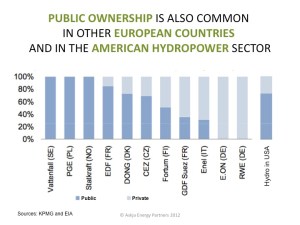
Slide13Iceland’s two largest energy companies are in 100% public ownership. In addition, there are several small publicly owned generating firms around the country.  In total, more than 90% of all electricity in Iceland is produced by public companies.

Public ownership in the electricity sector is also quite common in many other European countries. The largest electricity generating companies of both Norway and Sweden (Statkraft and Vattenfall) are owned by the government of Norway and Sweden, respectively, and the government of Denmark owns close to 70% of the largest energy company in Denmark (Dong Energy). Even in the United States, the main share of the hydropower industry is publicly owned, either by federal departments and/ or state agencies.

The reasons behind the large governmental share in Iceland’s electricity industry are historical. Ever since the early days of electricity generation in Iceland, the state and  the municipalities have always plaid an important role as providing electricity. However, the electricity sector in Iceland is open to private investment and even to foreign private (and public) investors. Couple of years ago, the Canadian private company Alterra Power became the main owner of Iceland’s third largest energy company; HS Orka. Click here for more information about the Icelandic Energy Business.

New low-cost renewable capacity

The main sources of Iceland’s primary energy are hydropower and geothermal power.

Iceland-Electricity-and-Heating-Sources-Hydro-Geothermal86% OF THE TOTAL ENERGY IS GREEN

Presently, the Icelandic hydro- and geothermal resources supply close to 100% of Iceland’s consumption of electricity and approximately 86% of Iceland’s total consumption of primary energy (of that total, 20% comes from hydropower- and 66% from geothermal sources). This is the world’s highest share of renewable energy in any national total energy budget.

Hydropower is the main source of the country’s electricity production, accounting for approximately three-quarters of all electricity generated and consumed. The remaining quarter is generated in geothermal power stations.

GEOTHERMAL DIVERSITY

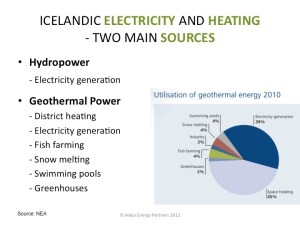
Although hydropower is the main source for Iceland’s electricity production, geothermal heat is the main energy source in Iceland. As mentioned above, geothermal energy makes up around 66% of all primary energy use in the country.

The principal use of geothermal energy is space heating. Close to 90% of all energy used for house heating comes from geothermal resources, thanks to the country’s geophysical conditions and extensive district heating system. Geothermal energy also plays an important role in fulfilling an increasing electricity demand. Other sectors utilizing geothermal energy directly include swimming pools, snow and ice management, greenhouses, fish farming, and industrial uses.

STRONG GROWTH AHEAD

It is expected that demand for Icelandic renewable electricity will grow quite fast over the next few years. Iceland’s main power company, Landsvirkjun, has introduced plans for increasing its electricity production up to 75% within a decade.

Iceland-New-Green-Energy-Capacity

The fact that Iceland still has numerous very competitive unharnessed hydro- and geothermal options, makes the country an interesting location for all kinds of energy intensive industries and services. This may for example apply to data centers, aluminum foils production, several silicon production facilities etc.

The abundant natural hydro- and high temperature geothermal resources make the Icelandic power industry able to offer electricity at substantially lower prices than for example can be found in any other European country. Even the present low spot-price for electricity in the USA (due to extremely low price of natural gas) are no threat to the Icelandic electricity industry.

Companies that need substantial quantity of electricity and wish to operate within the OECD / Europe, will hardly find better long-term agreements than offered at the Icelandic market (43 USD/MWh in 12 year contracts are being offered by Landsvirkjun).

In addition to attractive electricity contracts, Iceland is a member of the European Economic Area and has a modern business environment based on European standards. For those considering energy-related investments in Iceland, a positive first step is contacting Icelandic professionals on the relevant subjects. At Askja Energy Partners we provide information and access to the most experienced and knowledgeable engineering, legal, tax, and accounting services.

McKinsey on Icelandic energy issues

The management and consulting firm McKinsey & Company recently published an independent report on the current state of the Icelandic economy and its future priorities. The title of the report is “Charting a Growth Path for Iceland”.

According to the report, the Icelandic power industry has provided the foundation for a strong export-based heavy industry sector. However, McKinsey also points out that capital productivity in the Icelandic energy sector is the lowest across all sectors of the Icelandic economy:

“With 25-30% of the capital stock directly or indirectly invested in the energy sector, this is a serious matter for resolution. We identify several important themes to this end, e.g. diversification of the industrial buyer market and systematic enablement of the most profitable expansion projects based on their ability to pay. Additionally, the opportunity to connect the Icelandic electricity market to Europe via a physical interconnector is an attractive option that should be explored in detail.”

McKinsey then goes on making some suggestions on how to increase value capture from the energy sector. According to the report, the keyword for higher capital productivity is increased integration with other markets. Since the Icelandic power system is an island-system there is, according to McKinsey, a “significant slack in the system to ensure that sufficient margins are in place to meet domestic demand.”

McKinsey argues that the isolated market is “reflected in the design of hydro plants where investments have been optimized accordingly, i.e. with relatively small reservoirs allowing surplus water to bypass generation as there are no alternative markets available.”  Hence, nearly 15 per cent of the energy available for electricity production is wasted each year (on average).

McKinsey emphasizes that these factors will have to be taken into consideration during the next growth phase to maximize the value captured. In this regard, McKinsey seems ecpecially positive towards constructing an interconnector between Iceland and Europe:

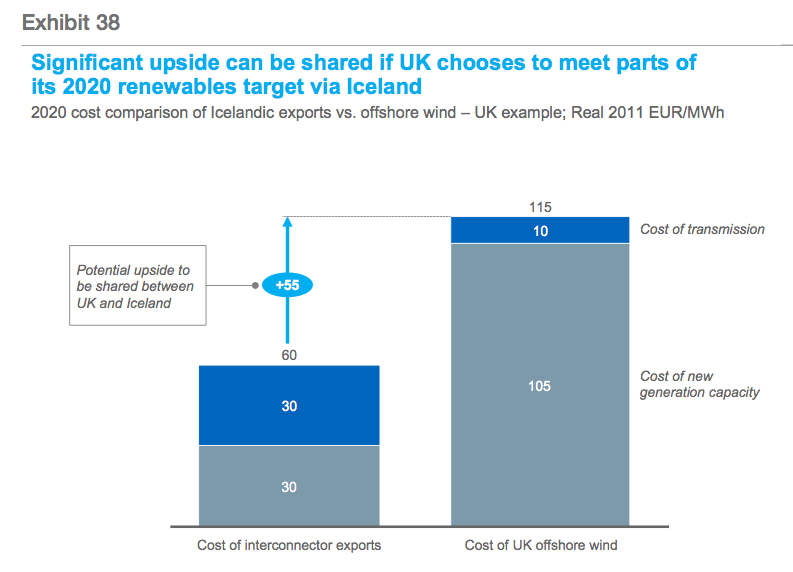
“The economic rationale for an interconnector is based on the opportunity of supplying the receiving market with green energy and thus contributing to decarbonization more efficiently than through other means e.g. offshore wind power. Iceland could share the benefit of such cost savings with the partner. Taking into account generation costs in Iceland, the cost of the interconnector itself and the anticipated cost of offshore wind power in 2020, cost savings of around EUR 60/Mwh could be shared.”

What makes the business model of an interconnector especially interesting, is the fact that so far Iceland has only harnessed  20-25 percent of its theoretically available hydro and geothermal energy. With environmental considerations and the economic feasibility of the investments taken into account, new projects could probably almost double current production (from 17 TWh to approximately 34 TWh annually). This is a substantially less costly renewable energy option than for example wind power in the United Kingdom.

The report concludes with strong future prospects. McKinsey is of the opinion that “Iceland is in the privileged position of having multiple growth levers that can greatly improve average production in the economy. The country therefore has good reason to be optimistic, provided policymakers utilize the opportunities available.” To access the report follow this link.

BMW and Icelandic energy in the media

Recently, there has been a lot of international media coverage about Icelandic energy issues.

This includes numerous news-stories about the decision of the flash German car maker BMW to move its high performance computing to a data centre in Iceland, powered by renewable energy. This will save around 3,600 tonnes of carbon emissions per year.

According to the news, BMW  is moving ten of its high performance computing clusters, consuming 6.31 GWh of energy each year annually, from Germany over to the Verne Global Data Centre in Southwest Iceland. The data centre uses electricity from 100 percent renewable sources – Iceland’s geothermal and hydroelectric generators.

Besides the carbon free renewable energy, Icelandic electricity is much cheaper than in any other OECD-country. Thus, BMW will save around 80 percent of the power costs of running calculations including crash test and aerodynamics simulations, as well as computer aided design and engineering calculations.

For more news about Icelandic energy issues, please go to our media-page.

Energy producers in Iceland

There are several energy companies in Iceland, producing electricity and heating. In total, they generate about 17 TWh of electricity annually and close to 22 TWh of geothermal heat. Almost all this energy comes from renewable sources (hydropower and geothermal power). In total, close to 85% of Iceland’s consumption of primary energy is renewable energy. This is the world’s highest share of renewable energy in any national energy budget.

The largest energy generating firms in Iceland are Landsvirkjun, Orkuveita Reykjavíkur (Reykjavik Energy), and HS Orka. State owned Landsvirkjun is by far the largest, providing approximately 76% of all the electricity produced in Iceland. More than 96% of all hydro generation in Iceland is produced by Landsvirkjun, and its share in the generation of electricity from geothermal power is around 11% of the total.

Landsvirkjun owns eleven hydropower stations and two geothermal power stations with a combined capacity of 1,895 MW.  Lansdvirkjun is also the main owner of the Icelandic Transmission System Operator (TSO), with a share of 65%.

Landsvirkjun receives much of its revenue in foreign currency (USD) as a result of extensive electricity sales to large foreign-owned aluminum smelters in Iceland (80% of the electricity Landsvirkjun generates is sold to energy intensive industries via long term contracts). The economic turbulence Iceland experienced recently did not affect Landsvirkjun nearly as much as most other Icelandic firms (the devaluation of the Icelandic currency did not have negative effects on Landsvirkjun’s income).

Landsvirkjun is one of Iceland’s largest companies and currently it has more equity than any other Icelandic firm . Of all the Icelandic power companies, Landsvirkjun is by far the strongest player and currently the only large Icelandic power company expanding its operations.

Orkuveita Reykjavíkur (OR, but also called Reykjavik Energy) is Iceland’s second largest energy firm. This public utility company provides both electricity and hot water for heating. It is by far the largest local provider of electricity and heating to end-users. The main service area of the company is the larger Reykjavik Metropolitan Area. OR’s largest single customer is Norduaral Aluminum Smelter, that is located not far from Reykjavik. In recent years OR has been struggling with heavy debt, which has led to rising costs for its general customers.

OR’s power-generation plants have a total capacity of 435 MW. Most of the electricity from OR is generated at two geothermal plants that utilize high-pressure steam. Besides producing and distributing electricity, OR sells and distributes both hot and cold water. The water from OR for space heating comes from low-temperature fields in and close to the city and from the combined heat and power plants at the Nesjavellir and Hellisheiði Stations. Cold water is collected from groundwater reservoirs outside of Reykjavík. Also OR operates an extensive sewage system for the Reykjavik area, as well as some adjacent municipalities.

HS Orka is the third main energy firm in Iceland. Until 2007 it was a public company owned by the Icelandic state and municipalities in Southwest Iceland. It was later privatized and today its largest shareholder now is the Canadian Alterra Power. The rest is owned by a group of Icelandic pension funds. HS Orka operates two geothermal power stations with a total capacity of 175 MW. HS Orka owns a few subsidiaries, including ¼ of the well known Blue Lagoon.

Strong Icelandic electricity growth

The recent growth in electricity generation and transmission in Iceland has been impressive.

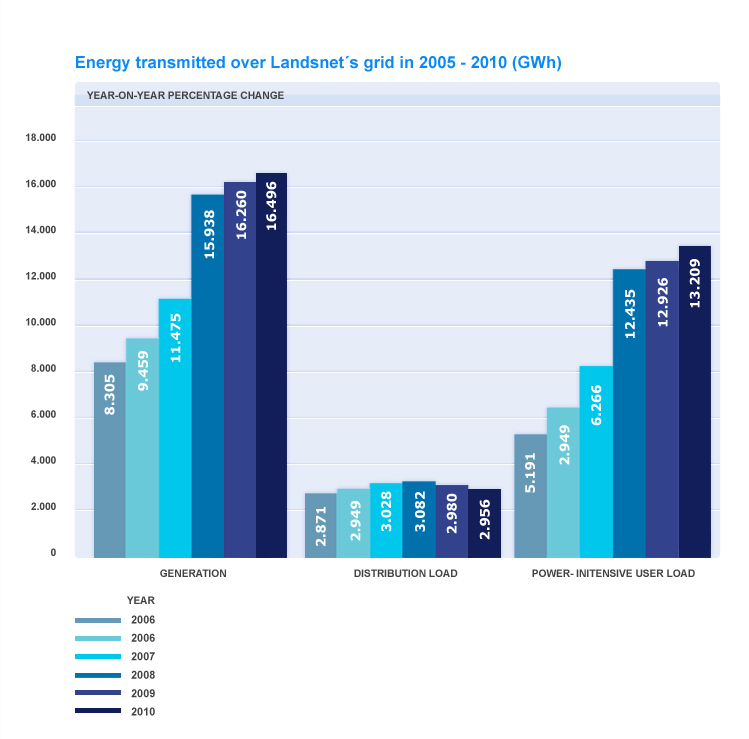
Between 2005 and 2010 the Icelandic electricity generation doubled. It is important to keep in mind that all this increase was in low cost renewable generation (mostly hydropower). And remember that almost 100% of all electricity generated in Iceland comes from renewable sources (hydro- and geothermal power).

This rapid increase in Iceland’s green electricity generation is shown on the histogram at left / above. Most of the increased production is supplied to new industries and services. One of the main explanation behind this growth is the competitive electricity price Iceland offers.

The abundant natural hydro- and high temperature geothermal resources make the Icelandic power industry able to offer electricity at substantially lower prices than for example can be found in any other European country. Even the present low spot-price for electricity in the USA (due to extremely low price of natural gas) are no threat to the Icelandic electricity industry. Companies that need substantial quantity of electricity and wish to operate within the OECD, will hardly find better long-term agreements than offered at the Icelandic market (43 USD/MWh in 12 year contracts are being offered by the Icelandic power company Landsvirkjun).

It is expected that demand for Icelandic renewable electricity will grow quite fast over the next few years. The fact that Iceland still has numerous very competitive unharnessed hydro- and geothermal options, makes the country an interesting location for all kinds of energy intensive industries and services. This may for example apply to data centers, aluminum foils production, several silicon production facilities etc.

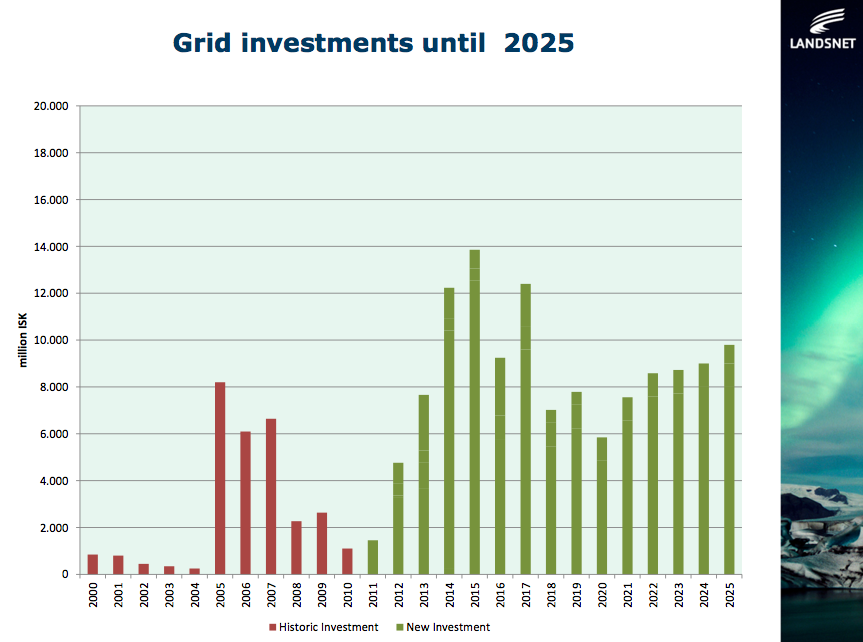
When having in mind the probable high growth in Icelandic electricity generation in the forthcoming years, it is not surprising that Landsnet (the Icelandic Transmission System Operator; TSO) is considering major investments in the electricity transmission system. The diagram at left is from Landsnet. It is interesting that even the major increase in transmission investments during 2005-2010 is fairly small compared to what may be expected in the next 10-15 years.

This plan for new transmission projects is not final yet. But it gives a clear view of the opportunities Iceland has regarding new and competitive green energy projects. No other western country enjoys similar economic possibilities based on 100% renewable energy.