Skip to content

Posts from the ‘Subsea Interconnector’ Category

UK’s electricity strike prices positive for IceLink

In last October, the Government of the United Kingdom (UK) gave the go-ahead for a new nuclear plant. This will be the first nuclear power station to be be constructed in the UK for numerous decades. The agreement regarding this nuclear plant shows well how competitive Icelandic electricity is, and makes it clear that an electric cable between Iceland and the UK could be very positive for both countries.

The nuclear strike price will be 92.50 GBP/MWh (close to 150 USD/MWh)

The above mentioned agreement on the nuclear energy involves an enlargement of the Hinkley Point Nuclear Plant in Somerset (Hinkley Point C). The new reactors are scheduled to be completed ten years from now (2023). The plant will be built and operated by the French energy firm EDF (Électricité de France) in cooperation with Chinese investors.
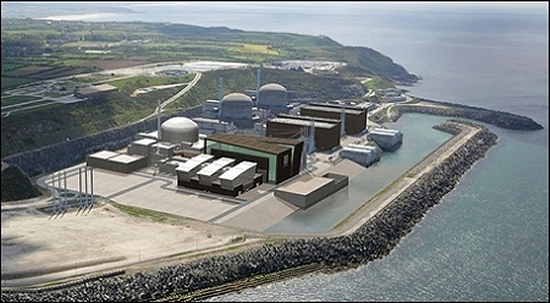
UK-Hinkley-Point-C-new-Nuclear-Plant-diagramEDF has negotiated a guaranteed fixed price – a strike price – for the nuclear electricity at 92.50 GBP/MWh (equivalent to approximately 150 USD/MWh). This strike price is in 2012 prices. The price will be adjusted according to inflation during the construction period and over a subsequent period of 35 years. According to the BBC, the existing nuclear plant at Hinkley produces about 1 per cent of the UK’s total electricity. This is expected to rise to 7 per cent once the construction of Hinkley Point C will be completed in 2023.

Strike Prices effectively remove price volatility risk for electricity generated from low-carbon sources. This ensures greater certainty to generators and minimizes their risk. The goal is to bring forward investment in affordable low-carbon electricity generation, including renewables and new nuclear. In total, renewable energy is expected to make up more than 30 per cent of the UK’s electricity mix in 2020, helping to significantly decarbonize the power sector by 2030. This means that the UK has very ambitious plans in expanding the production of renewable power.

Strike price for renewable power will be even higher

Earlier this year (2013), the British Government introduced the strike price which renewable energy technologies can expect in the coming years (2014-2019). The proposals are expected to become legislation in early 2014. According to a publication by the UK Department of Energy and Climate Change (DECC) the new regime will make the UK market one of the most attractive for developers of most renewables technologies, whilst minimising the costs to consumers. The proposed renewable electricity technologies eligible for the strike prices for example include hydro, geothermal, onshore and offshore wind, tidal and solar projects.

UK-Renewable-Energy-Strike-Price_2014-2019-The strike price for geothermal power will be 120-125 GBP/MWh (approximately 190-200 USD/MWh) and strike price for hydro will be 95 GBP/MWh (approximately 150 USD/MWh). The lowest strike price is for sewage gas; 85 GBP/MWh (close to 135 USD/MWh).

However, what is probably most important and interesting is the strike price for wind power. The British Government expects the overwhelming majority of the new renewable-capacity will be new wind farms, both onshore and offshore. This is understandable, because the utilization of wind power for electricity production is a well known and mature technology. In fact the strike price for wind power can be said to be the base price for new renewable generation. And the strike price introduced for onshore and offshore wind is 95-100 GBP/MWh and 135-155 GBP/MWh, respectively.  This is equivalent to approximately for 150-180 USD/MWh for onshore wind, and 215-250 USD/MWh for offshore wind.

IceLink could be an important part of the solution

In comparison, Iceland could most likely offer the UK electricity from renewable sources at prices similar or even substantially lower than the strike price for new offshore- or even onshore wind capacity in the UK. And actually the Icelandic electricity can be seen as a better product and thus a better option than massive wind power in the UK. Both hydro- and geothermal power offer stable base load electricity, which is very different from the unstable wind power.
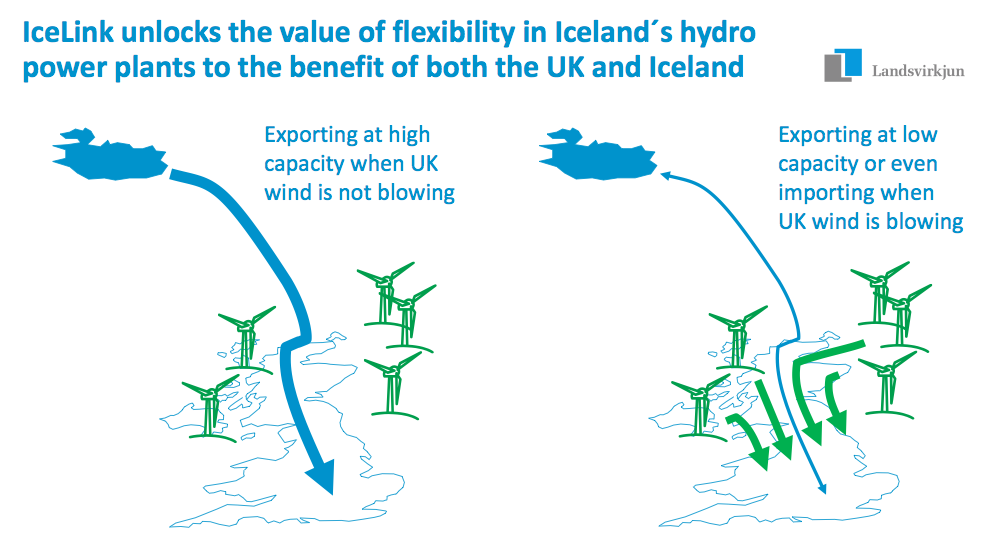
Iceland-UK-BICC-meeting-Nov-2013-Landsvrkjun-Hordur-Arnarson-slide-7With an electric cable between Britain and Iceland (IceLink), the Icelandic energy sector could provide the UK with stable and reliable power from the Icelandic hydro- and geothermal power plants, at very competitive prices. Iceland could also import some of the unstable wind power from the UK; especially during the night. This would give an option to “store” even more of the controllable hydro power in the dams in Iceland during the night. When demand in UK rises during the day this power can then be transferred through the cable to the electricity markets in UK.

The UK wants to be able to move away from fossil fuels towards low-carbon power. What is even more important for the UK is to gain more energy independence and be able to rely on energy from politically stable neighbours (rather than for example importing more LNG from Algeria). Both the nuclear plant at Hinkley Point and plans for more renewable energy in the UK’s energy mix, are important in this context. In addition, a fifth of Britains’ aging power plants are due to close over the coming decade (with further closures in the 2020’s). Thus, the UK needs not only huge investment in energy production and -infrastructure, but also need to secure it self access to numerous reliable energy sources. Therefore the IceLink is a project that undoubtedly will interest the British energy sector and investors.

Successful energy summit in London

The Iceland Energy Summit was held in London on November 1, 2013. The event was organized by the British-Icelandic Chamber of Commerce (BICC) and hosted by Bloomberg.

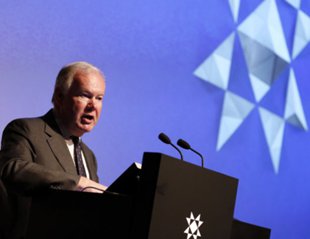
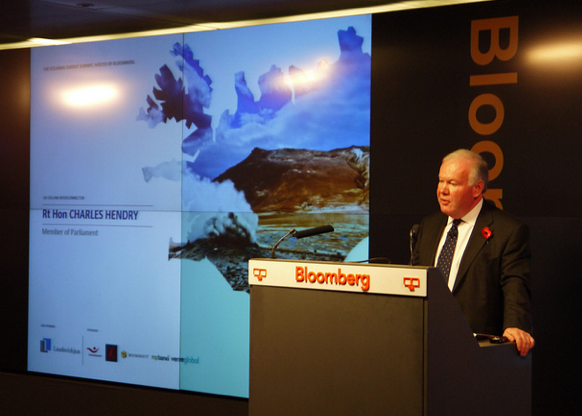
Iceland-UK-BICC-meeting-Nov-2013-CHThe event provided insight into Iceland’s renewable energy resources, the birth and growth of the data storage industry in the country, as well as the search for offshore oil on the Icelandic continental shelf. Strong focus was on a plan for an undersea power cable to connect the British and Icelandic grids. This plan or proposal is attracting strong investor interest, according to Mr. Charles Hendry, the former Energy Minister of the United Kingdom and current Member of Parliament.

Mr. Hendry, who promoted the project, said that there’s “no doubt that in Britain the political will is there, so if there is a political will in Iceland, we want to work together”. According to Mr. Hendry the project offers low-risk, predictable returns attractive to institutional investors including pension funds. The UK is preparing to change policies needed for the cable, Mr. Hendry said.

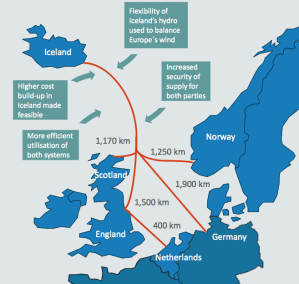
In May last year (2012), Mr. Hendry helped spur an agreement between Iceland and the UK to explore proposals regarding the cable (sometimes referred to as the IceLink). The cost of the link is still not clear, but if it will go ahead it could probably be completed within 7-10 years.. It would extend more than 1,000 kilometers,  thus be longer than any of the subsea electrical cables currently in operation.

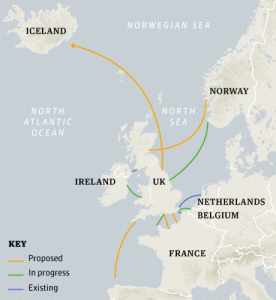
Iceland-UK-BICC-meeting-Nov-2013-Landsvrkjun-Hordur-Arnarson-slide-7Electric cables like that already connect the grids of Norway and Britain to the Netherlands. The Dutch grid operator (TenneT) is planning links between Germany and Norway and the Netherlands and Denmark. There are already connections of this type between Britain and France, between Vancouver island and Canada, between Sardinia and Italy, and between Tasmania and Australia, to name a few well known examples .

According to Bloomberg, Mr. Andrew Perkins, a partner in energy and environmental finance at Ernst & Young, stresses that these assets are attractive to financiers, suggesting that the capital costs to build the IceLink should be financed by the private sector. As close to 100 percent of all electricity generated in Iceland comes from natural renewable sources, and several promising renewable energy options are still unharnessed, the IceLink offers great opportunity for the UK to access substantial green power at a very competitive cost.

Here, at the Icelandic Energy Portal, we will soon be covering the Energy Summit in more details. Note that the slides (and videos) from the event can be downloaded from the website of the BICC.

Icelandic Energy Summit, London, November 1st 2013

The British Icelandic Chamber of Commerce is introducing the Icelandic Energy Summit, hosted by Bloomberg, in London on Friday, 1 November 2013.

Iceland-Europe-mapAccording to the website of the British Icelandic Chamber of Commerce the event “will provide participants an insight into Iceland´s renewable energy resources, the birth and growth of the data storage industry in the country, the search for offshore oil – and what all this means for the country and its neighbours. The BICC is proud to have assembled some of the most dynamic voices in the developing story of Iceland and its energy potential.” The event, which is free, is said to be of interest “to finance professionals who conduct business with Iceland, or would like to, renewable energy specialists, academics and all those who take an interest in the future development of the Arctic. Feel free to pass on this invitation to colleagues, but  we expect this event to be well attended.”

The Agenda is as following:

10:30 Registration & Coffee
11:00 Welcome
William Symington, BICC
Keynote speech
Olafur Ragnar Grimsson, President of Iceland
11:45 UK-Iceland Interconnector
Charles Hendry, MP
Hörður Arnason, CEO Landsvirkjun
Paul Johnson, National Grid
Mike Lawn, Bloomberg New Energy Finance
13:00 Buffet Lunch
13:45 Data Centres in Iceland
Verne Global – Isaac Kato, CFO
Risk Management Solutions Inc, Robert Muir-Woood, Chief Research Officer
14:45 Geothermal
Sigurður St Arnalds, Senior Energy Advisor, Mannvit
Mark Taylor, Bloomberg New Energy Finance
15:45 Icelandic Oil exploration and the development of Arctic Resources
Michael Evans, Chief Operating Officer, Iceland Petroleum
Heiðar Guðjónsson, author “The Push for the Arctic”
16:30 Closing & Drinks

Here is a link to the registration.

Premature story in the Guardian

Yesterday, the Guardian published a story about Iceland seeking UK funding for subsea cable project. This is a somewhat premature statement by the Guardian. It is certainly true that the possibility of an electric cable between Iceland and the UK is being considered. However, no formal decision on such a project has been taken yet.

UK-Electric-Subsea-Cables-Map

The Guardian correctly states that such a project could possibly deliver 5 TWh’s of green electrity a year to Britain. And the price of the electricity could be very competitive (lower than from British offshore wind farms). It is also correct that all the electricity from Iceland would be generated by harnessing renewable natural sources (especially hydropower, but also geothermal and wind).

The project would most likely strongly appeal to the UK. The Guardian correctly points out that the highly reliable potential energy in Iceland’s hydro dams can be seen as neatly dovetailing with Britain’s expanding, but unpredictable, wind power generation:

“As wind has become an increasing component of UK electricity generation, those tasked with matching UK supply with demand are increasingly facing a difficulty when usage spikes at times of when wind speeds drop. Few sources of generation, other than hydropower, can be brought on-stream at short notice to cover for lulls in wind.”

According to the Guardian, Iceland’s president Mr. Ólafur Ragnar Grímsson is expected this week to call on the British government to provide financial support for the construction of the subsea electricity cable – which will be the longest in the world – linking the electricity grid’s of Iceland and the UK.  Actually, it is more likely that the president will urge the British government to further cooperate with Iceland in necessary research and development that will be necessary if the cable is to be realized.

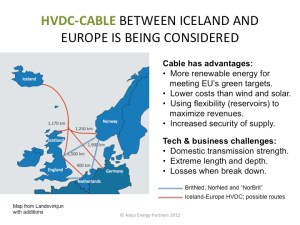
HVDC-Cable-Iceland-Europe-map-slideAs mentioned in the Guardian’s article, the governments of Iceland and the UK have already stared exploring proposals for a cable, after a ministerial meeting in May last year (2012). It would be a sensible step to strengthen the cooperation between the two countries in preparing to link the countries with an electric cable. Hopefully, the necessary cost analysis and research on for example the sea-bed can take place soon. When this will be finished, the financing of the cable may become a relevant issue.

NB: The Guardian says that the length of the cable would be 10,000 km. This is of course wrong; an electric cable between Iceland and the UK would be close to 1,200 km (somewhere between 1,000 and 1,500 km). The Guardian also says that the electricity industry in Iceland produces 12 GWh of electricity annually. The correct number is of course much higher or close to 17.2 TWh (17,200 GWh). Hopefully, the Guardian will correct their numbers. More information about the Icelandic power sector can be found here.

1 GW Iceland-UK electric subsea cable may be close

The governments of United Kingdom (UK) and Iceland may both be interested in a subsea electric connection between the countries.

HVDC-Cable-Iceland-Europe-map-slide

The main purpose of the cable would be to bring electricity from Iceland’s renewable sources to the UK. The UK has ambitious plans to substantially increase renewable energy in UK’s energy mix. According to legally binding goals, set by the member states of the European Union (EU), the UK needs to dramatically increase production and imports of renewable energy. Iceland could become an important player in that green transformation.

Renewable electricity could be provided by Iceland to the UK even at a cheaper cost than offshore wind. In addition the Icelandic hydro- an geothermal power is a very reliable power source. The plans being discussed concern a 1,100-1,200 km subsea cable with a capacity of 1GW. The package might be worth an estimated GBP 4 billion, with the inclusion of related generation and onshore transmission investments and could be operational by within a decade.

bjorgvin-sigurdsson-landsvirkjunMr. Bjorgvin Sigurdsson, executive vice president of Iceland’s main power company (Landsvirkjun), has expressed that the company is now looking at this much more seriously than ever before.  “The technology seems to be there to make it work… the issue is whether this makes sense economically.”

At present, Iceland benefits from some of the most competitive electricity prices in Europe. All the electricity in Iceland comes from renewable hydro- and geothermal sources, which offer the possibility of a very low cost generation. The director general of the National Energy Authority of Iceland (NEA), Mr. Guðni Jóhannesson, has said that the interconnector could provide power to the UK at around 60 to 70 percent of the price of offshore wind.

hvdc-cable-nornedAs Iceland still has numerous options of unharnessed hydro- and geothermal energy, an electrical cable might create a win-win situation for Iceland and the UK. The idea of exporting energy from Iceland to the UK is not a new one, as it was first mentioned decades ago. However, it is not until recently that technological advancement and rising electricity prices in Europe made the idea feasible.

Significant milestone reached on HVDC cable

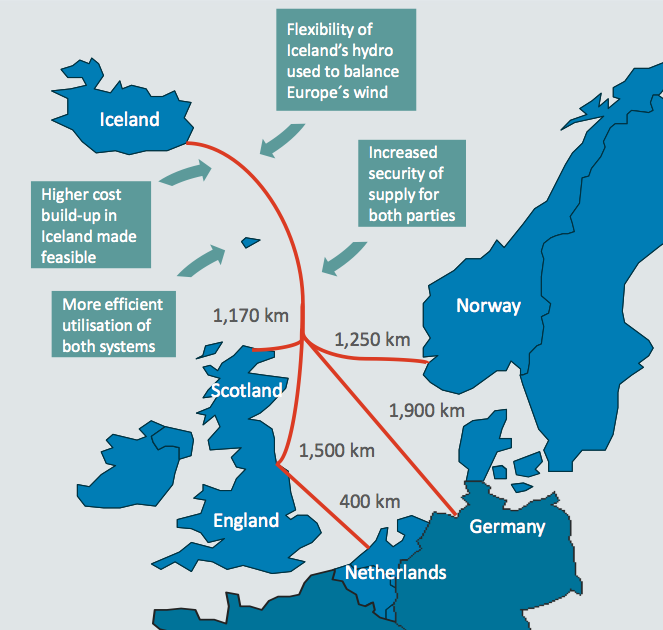
Connecting with another electricity market in Europe could provide Iceland with a unique opportunity to maximise the return from the country’s natural resources:

  • Surplus energy already within the system and presently unutilised by industry could be sold.
  • Further energy generation methods could be introduced.
  • The flexibility of hydropower could be better utilized.
  • Risk distribution could be increased.
  • Iceland’s energy supply security could be increased by opening up the presently isolated system.
  • A number of new and exciting employment opportunities could become a reality and the value created by such a project could be significant.

Iceland-Europe-HVDC-cable-map-LandsvirkjunEarlier this summer an advisory group on a subsea HVDC electricity cable between Iceland and Europe handed over its recommendations to the Icelandic Minister of Industries and Innovation. The report shows that there are indications that such a HVDC cable between Iceland and the United Kingdom could prove macro-economically profitable if certain conditions were to be fulfilled; i.e. if negotiations with the counterparties should prove successful, procuring favourable energy prices and secure long term contracts.

The recommendations of the advisory group are a significant milestone in assessing the feasibility of connecting Iceland with the European electricity market. The advisory group was unanimous in its opinion that work should continue on mapping out the various aspects of the project domestically whilst concurrently seeking out answers on potential operational and ownership models from the counterparties in the UK.

The risk of domestic electricity prices multiplying, with a connection with European markets, seems to be minimal. The Norwegians have set a successful precedent for achieving the consensus of stakeholders whilst utilising the opportunity to sell electricity to the European market. This has been done without threatening the existence of industry within Norway.

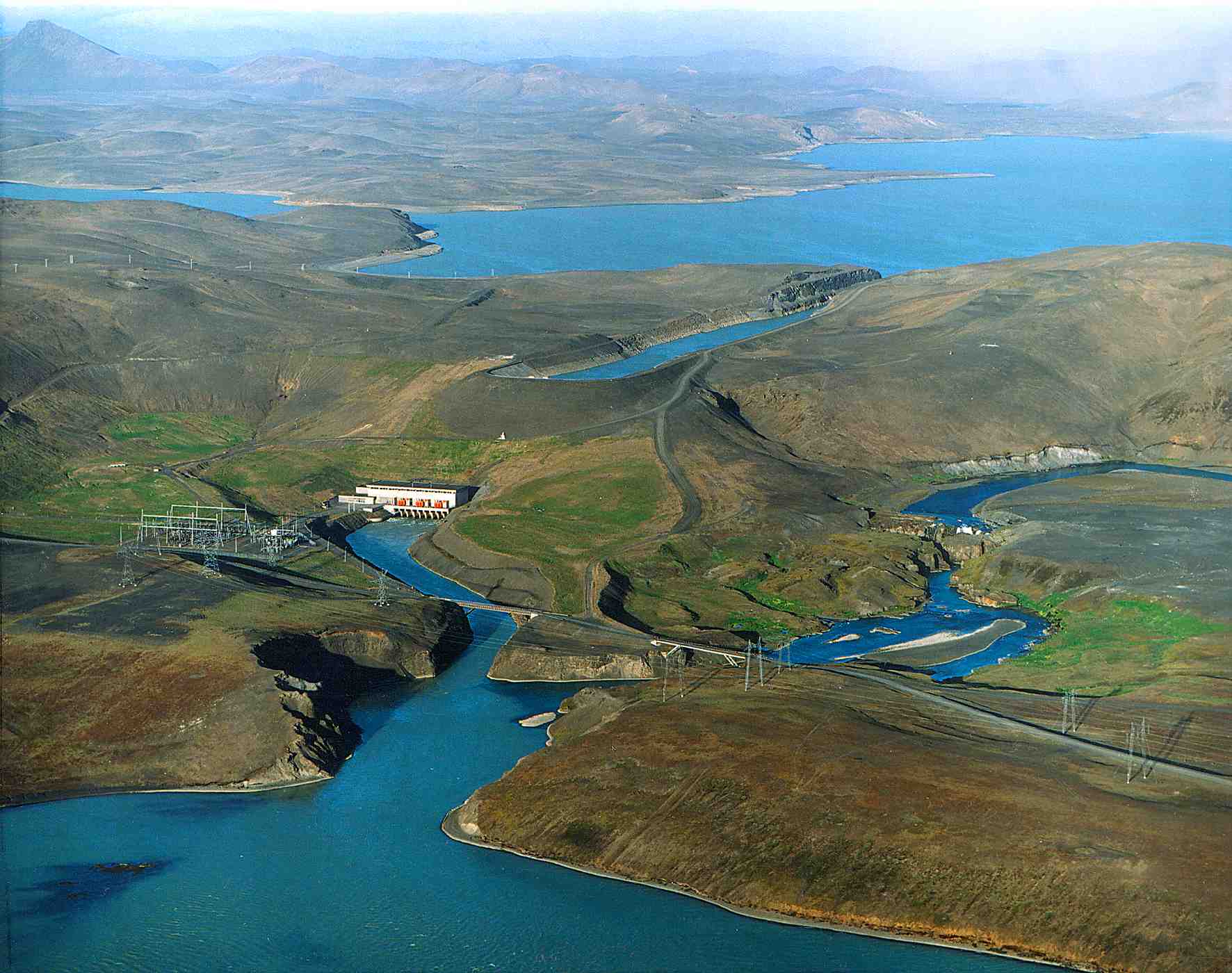
Iceland-Landsvirkjun-Sigalda-HydroThe Minister of Industries and Innovation will assess the recommendations of the advisory group and come to a decision as to the next step. It is estimated that the preliminary findings will be released by the end of this year (2013). This will include a decision on if and when expensive and extensive detailed research on the project will begin.

10 TWh of green energy available

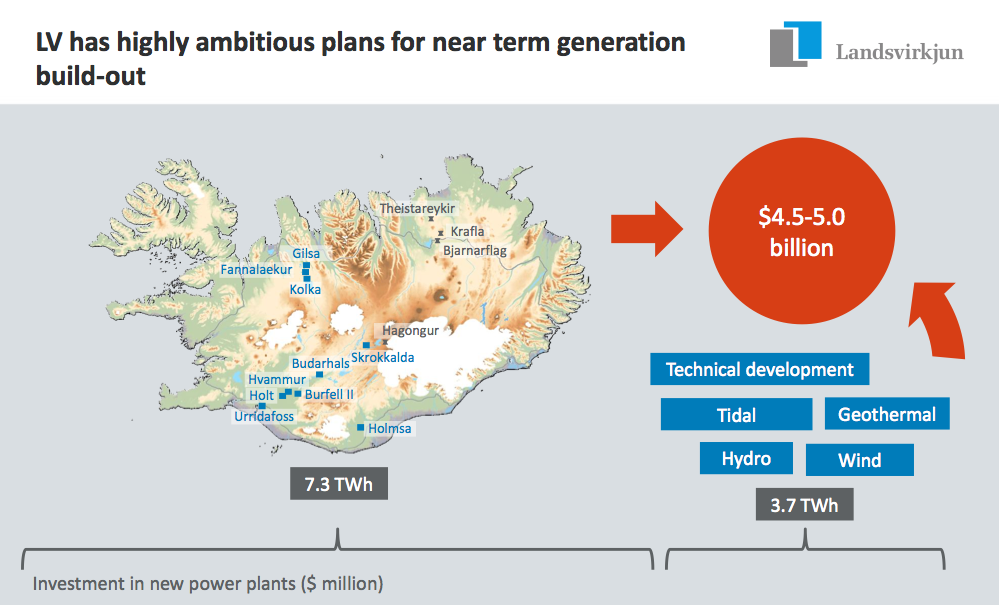
Iceland-Landsvirkjun-New-Renewable-Electricity-GenerationThe Icelandic power company Landsvirkjun has introduced plans for several new renewable energy projects.

If all these projects will be realized, they will add close to 7 TWh of annual generation from natural hydro- and geothermal sources. All the projects have been identified. As Landsvirkjun is owned by the Icelandic government, formal decisions about which of the projects will be realized first depends on the Icelandic parliament.

In addition, Landsvirkjun has put a figure on several other possible new power projects, that could be generating electricity within a decade or so. In total, Iceland may within near future be producing 9-10 TWh more electricity than today. This is not an exact figure; the new additional capacity could be somewhat less or even more. This will depend on the interest of new users of electricity, such as data centers, silicon industry etc. However, the most interesting option may be selling part of the new electricity production to markets in Europe.

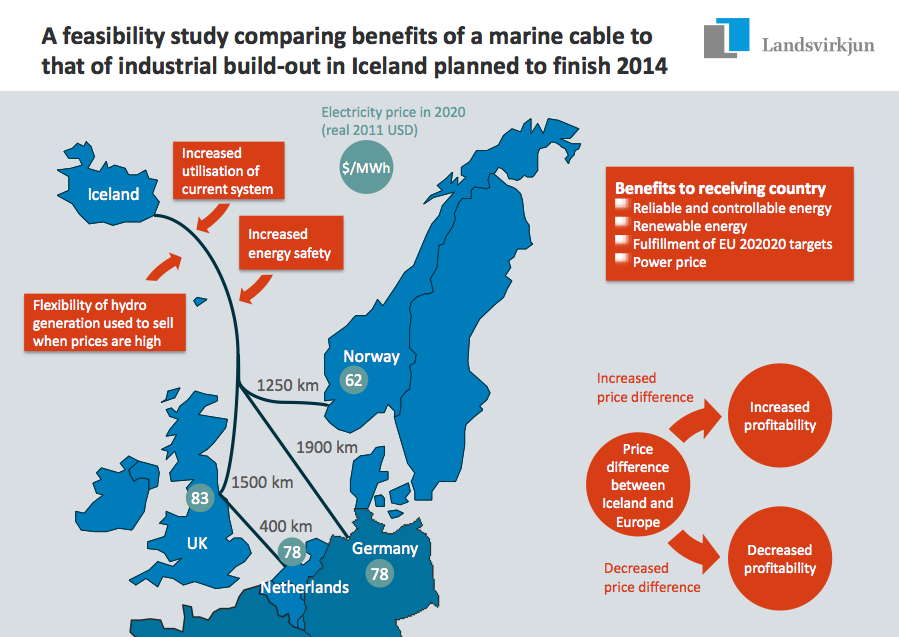
Iceland-Landsvirkjun-HVDC-Feasabilty-StudyA feasibility study on a possible electrical cable (high voltage direct current cable; HVDC) between Iceland and Europe is currently being carried out by a special working group. The group includes people from the Icelandic power sector and other stakeholders, appointed by the Icelandic Minister of Industries and Innovation. It is expected that the working group will deliver its report  during next year (2014).

The high electricity prices in Europe make a cable to Europe an especially interesting option for the Icelandic power generating firms. During the last few years, wholesale electricity prices in Western Europe have often been around three times higher than in Iceland. Thus, an electric cable between Iceland and Europe could increase the profits of Icelandic power companies  substantially.

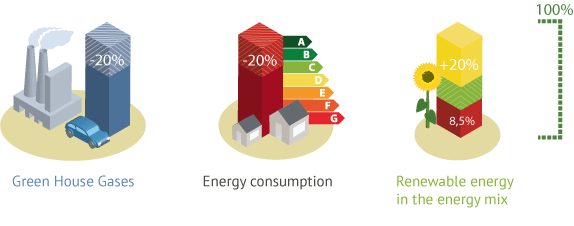
EU-energy-policy-20-20-20There would be numerous other positive gains from such a cable, as presented on the slide at left (the slide is from a presentation by Landsvirkjun). For example, the Icelandic power companies would be able to maximize the current capacity, resulting in more production. Europe would enjoy access to new green electricity generation, which would help the member states of the European Union (EU) in achieving climate- and energy goals (the EU aims at raising the share of EU energy consumption produced from renewable resources to 20% no later than 2020). The issues of such a connection between Iceland and Europe was described in more details in one of our earlier posts.

In the forthcoming months it will hopefully become clearer if Europe may gain access to the geothermal- and hydropower of Iceland.

McKinsey on Icelandic energy issues

The management and consulting firm McKinsey & Company recently published an independent report on the current state of the Icelandic economy and its future priorities. The title of the report is “Charting a Growth Path for Iceland”.

According to the report, the Icelandic power industry has provided the foundation for a strong export-based heavy industry sector. However, McKinsey also points out that capital productivity in the Icelandic energy sector is the lowest across all sectors of the Icelandic economy:

“With 25-30% of the capital stock directly or indirectly invested in the energy sector, this is a serious matter for resolution. We identify several important themes to this end, e.g. diversification of the industrial buyer market and systematic enablement of the most profitable expansion projects based on their ability to pay. Additionally, the opportunity to connect the Icelandic electricity market to Europe via a physical interconnector is an attractive option that should be explored in detail.”

McKinsey then goes on making some suggestions on how to increase value capture from the energy sector. According to the report, the keyword for higher capital productivity is increased integration with other markets. Since the Icelandic power system is an island-system there is, according to McKinsey, a “significant slack in the system to ensure that sufficient margins are in place to meet domestic demand.”

McKinsey argues that the isolated market is “reflected in the design of hydro plants where investments have been optimized accordingly, i.e. with relatively small reservoirs allowing surplus water to bypass generation as there are no alternative markets available.”  Hence, nearly 15 per cent of the energy available for electricity production is wasted each year (on average).

McKinsey emphasizes that these factors will have to be taken into consideration during the next growth phase to maximize the value captured. In this regard, McKinsey seems ecpecially positive towards constructing an interconnector between Iceland and Europe:

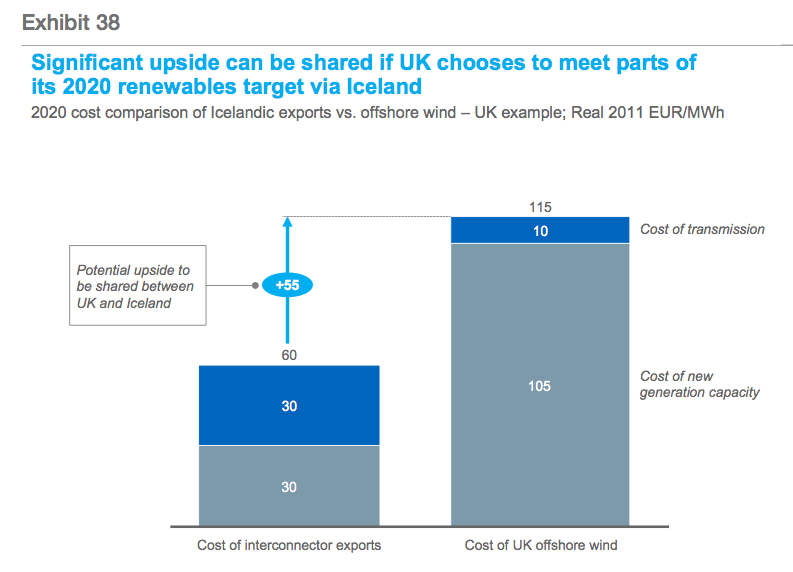
“The economic rationale for an interconnector is based on the opportunity of supplying the receiving market with green energy and thus contributing to decarbonization more efficiently than through other means e.g. offshore wind power. Iceland could share the benefit of such cost savings with the partner. Taking into account generation costs in Iceland, the cost of the interconnector itself and the anticipated cost of offshore wind power in 2020, cost savings of around EUR 60/Mwh could be shared.”

What makes the business model of an interconnector especially interesting, is the fact that so far Iceland has only harnessed  20-25 percent of its theoretically available hydro and geothermal energy. With environmental considerations and the economic feasibility of the investments taken into account, new projects could probably almost double current production (from 17 TWh to approximately 34 TWh annually). This is a substantially less costly renewable energy option than for example wind power in the United Kingdom.

The report concludes with strong future prospects. McKinsey is of the opinion that “Iceland is in the privileged position of having multiple growth levers that can greatly improve average production in the economy. The country therefore has good reason to be optimistic, provided policymakers utilize the opportunities available.” To access the report follow this link.

The Iceland-Europe interconnector

Iceland is currently a closed electricity market with no cable connections to other markets. This may soon change. Technology advancement, strong demand for more renewable energy, and high electricity prices in Europe are making a submarine high voltage direct current (HVDC) cable between Iceland and Europe more feasible than ever before.

Unharnessed renewable energy

Iceland can substantially increase its green electric power production at a reasonable cost. Iceland is the only country in Western Europe that still has several large unharnessed hydro power options. Also, Iceland’s geophysical conditions offer numerous possibilities for low cost utilization of geothermal power, and Iceland has stronger and more stable winds than most of Europe.

Some of this natural energy will be harnessed for varied domestic industries, such as new data centers, metallurgical-grade silicon production, etc. Iceland also has the possibility to do business with electric power through a submarine cable to Europe. Such a connection would not only be based on Icelandic hydro- and geothermal power, but would open up the possibility of large-scale harnessing of Icelandic wind power.

Choosing the best business model

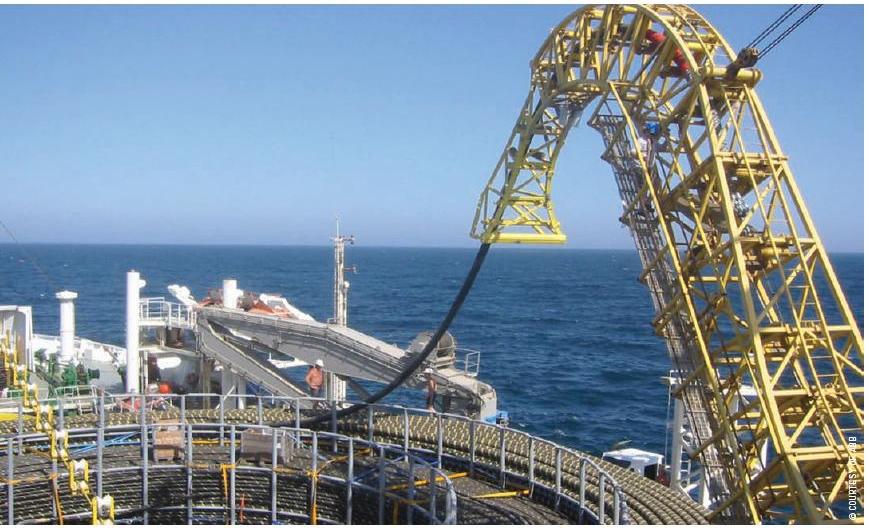
So far the longest submarine HVDC-cable is the NorNed between Norway and the Netherlands (580 km / 369 miles). The interconnector between Iceland and Europe would be at least double that length, so it will definitely be a challenging project.

Such an  interconnector would not only enable sales of renewable electricity at high prices but also have various other benefits for the Icelandic electricity system, such as more efficient use of the generation capacity and enhance the security of supply. Currently, three scenarios are being studied. The first concerns an interconnector that would be used for export/import only, based on market prices.  The second involves a cable used for export only, and the third assumes an interconnector used in part for export/import and in part for export.

Green AND competitively priced

The main drivers behind an electric cable between Iceland and Europe are high electricity prices in Western Europe and the growing demand in Europe for more renewable energy.

According to engineering and management firm Parsons Brinckerhoff and consultancy firm  Mott MacDonald Group, as presented by Landsvirkjun, Iceland’s electricity prices are much lower than can possible be offered by new electricity generation projects in the United Kingdom (UK). This is especially interesting when having in mind UK’s energy policy, with the goal of increasing its renewable energy consumption from the present 54 TWh to 234 TWh no later than 2020.

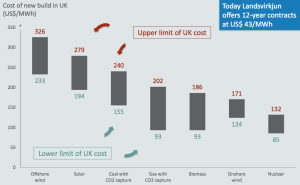
This goal, which is based on European Union’s (EU) and UK’s energy policy, will only be achieved with major investments in new green energy projects. Those projects will for example include very expensive and controversial onshore and offshore wind farms in the UK. For example, the minimum cost for offshore wind electricity in the UK is equivalent to 233 USD/MWh.

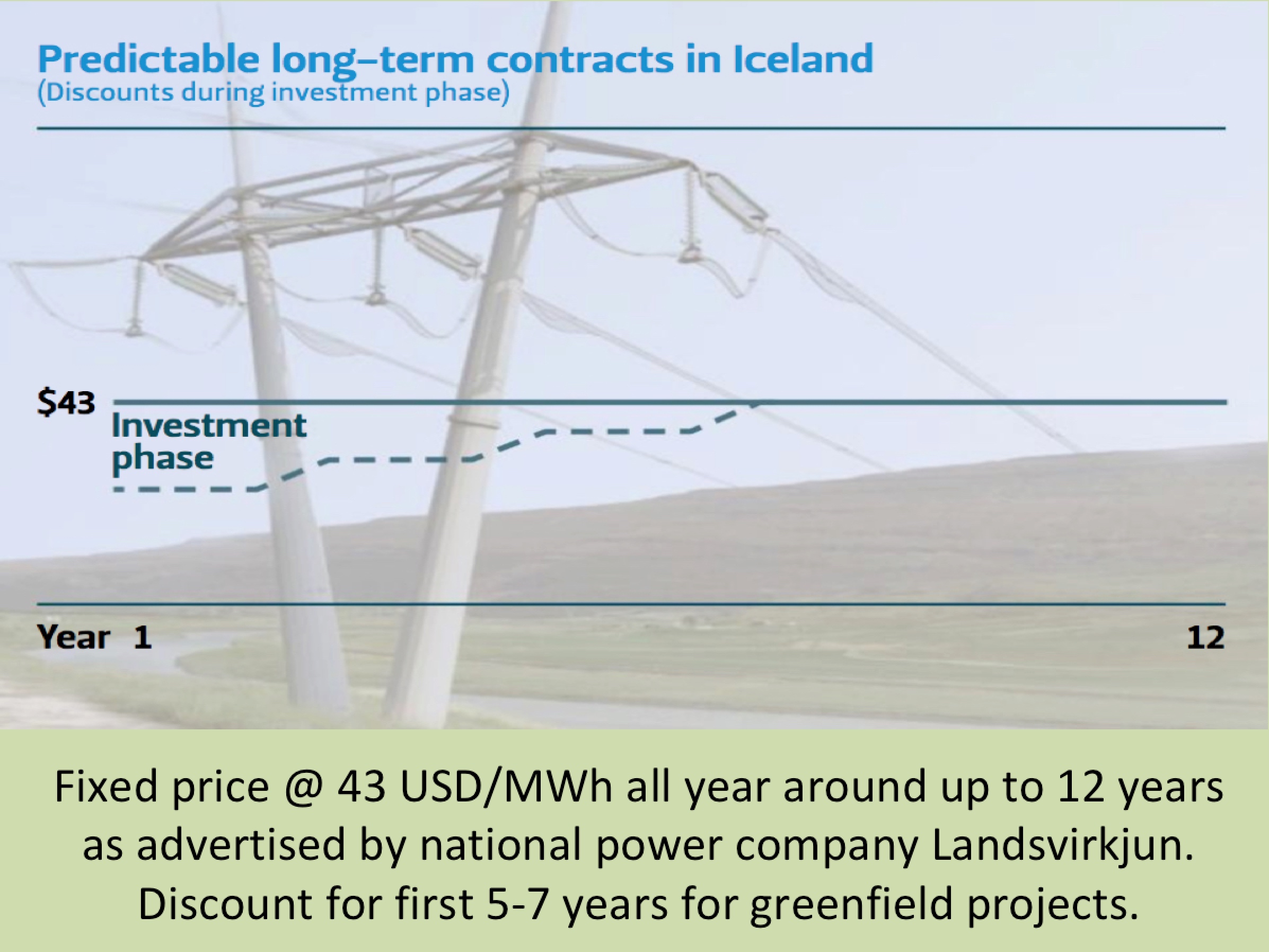
When comparing this to Icelandic renewable energy cost, it is quite obvious that an electric cable between Iceland and UK is an exciting option (Icelandic Landsvirkjun is currently offering long-term electricity contracts at 43 USD/MWh). Thus, it is not surprising that Mr. Hörður Arnarson, CEO of Landsvirkjun, has described the laying of a submarine cable to Europe, together with vigorous industrial development in Iceland, as probably being “one of the biggest business opportunities Iceland has faced”.

The two charts above are from a presentation by Landsvirkjun, given at an energy seminar in Reykjavik in last May (2012).

The United Kingdom and Icelandic electricity

The British Minister for Energy and Climate Change, Mr. Charles Hendry, was recently in Reykjavik discussing energy issues with Icelandic authorities and people in the industry. Mr. Hendry also gave a speech at an energy-seminar at the headquarters of the Icelandic Arion bank.

One of the main issues discussed were the possibility of connecting Iceland and the United Kingdom (UK) with an electric cable. The cable would transfer green electricity from Iceland’s natural renwable sources to the UK. Such a cable would also offer Iceland access to competitively priced electricity genereted in the UK during night (when demand in the UK is low). Thus, this could be a win-win project.

It is no surprise that the British Government is looking for acess to new sorces of green electricity. The share of renewable energy in the UK is very low. The total annual production of renewable energy in the UK is 54 TWh, which only accounts to approximately 3.5% of the country’s energy consumption.

The UK is determined to increase the share of renewable energy substantially. This is not only a governmental position but also a binding obligation according to the common energy policy of the European Union. Thus, the UK Department of Energy and Climate Change now has published the goal of having 15% of the UK’s energy consumption delivered from renewable sources by 2020.

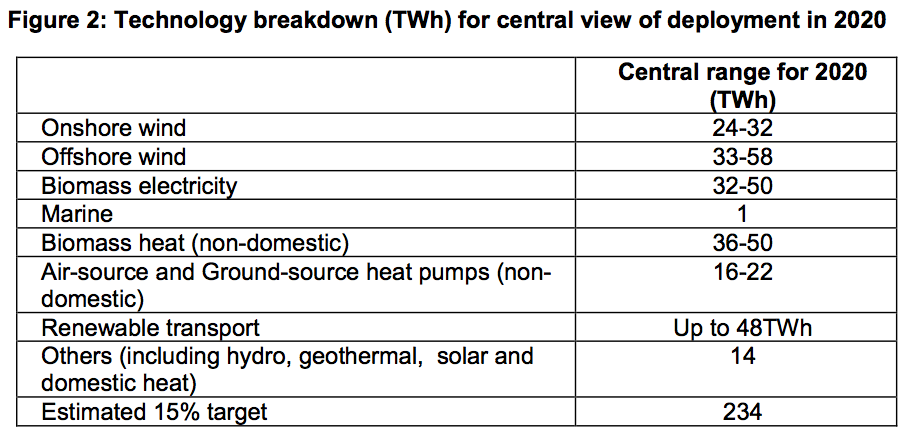
Let’s look at what this means in numbers. The cost is very uncertain but definitely very high. It is of course hard to foresee exactly how much energy the UK will consume by 2020. According to the Department of Energy and Climate Change it is expected that the UK’s total annual energy consumption in 2020 will be 1,557 TWh. And 15% of 1,557 TWh is 234 TWh.

This means that the UK has to increase its renewable energy consumption from the present 54 TWh to 234 TWh no later than 2020. This is an increase of 180 TWh! 180 TWh of new green energy that needs to beavailable within less than a decade from now. In comparison the whole nuclear industry in the UK produced 69 TWh last year (2011.)

To achieve this goal of adding 180 TWh of renewable energy by 2020, green energy consumption in the UK will need to increase by 22.5 TWh each year over a period of 8 years. Obviously this renewable energy target calls for major investment in all kinds of green energy projects, including for example biomass, geothermal, hydro, solar and wind. Large portion of the new green energy will come from new renewable electricity generation (renewable heat and renewable fuels will have to increase substantially). Renewable electricity will need to maintain a growth rate of approximately 15% per annum from the 2010 baseline.

In addition to more renewable generation at home the UK is also focusing on major imports of electricity from renewable sources in neighbouring countries – like Norway and Iceland. This is why the British Minister for Energy and Climate Change is very positive towards an electric cable between UK and Iceland.

In fact Iceland has been considering such a connection between Iceland and Europe for years and even decades. However, it is probably not until now that such a high voltage direct current cable (HVDC) is becoming both tecnically possible and financially feasable.

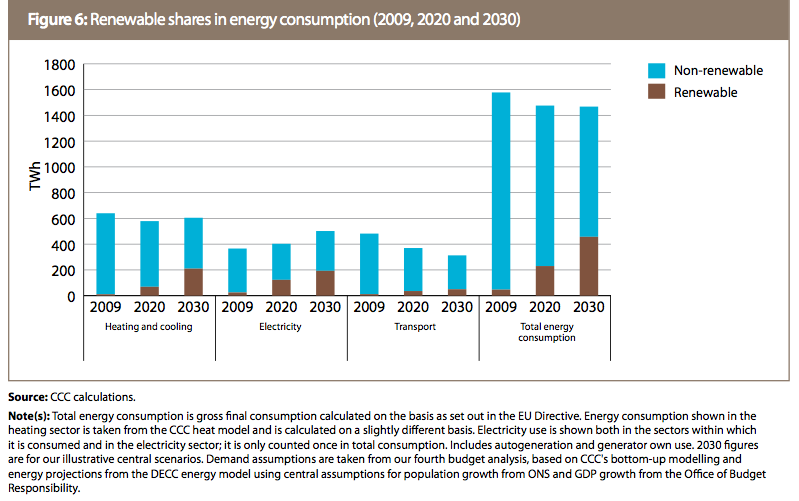
And keep in mind that the British Government is already considering even more ambitious renewable energy targets for 2030 and beyond. Recent independent advice from the British Committee on Climate Change (CCC) has concluded that there is scope for the penetration of renewable energy to reach 30-45% of all energy consumed in the UK by 2030!

At the same time Iceland is in the somewhat unique position to have access to several excellent unharnessed renewable energy opportunities. In the coming weeks we will be presenting more information about the possible Iceland-UK interconnector  and explain Iceland’s potentials for generating more renewable electricity and gaining from Europe’s high electricity prices.

More information about UK’s energy policy and future scenarios:
–  UK Renewable Energy Roadmap
–  UK’s Renewable Energy Review
The charts above are from these two reports.