Skip to content

Archive for

Iceland’s new energy segment

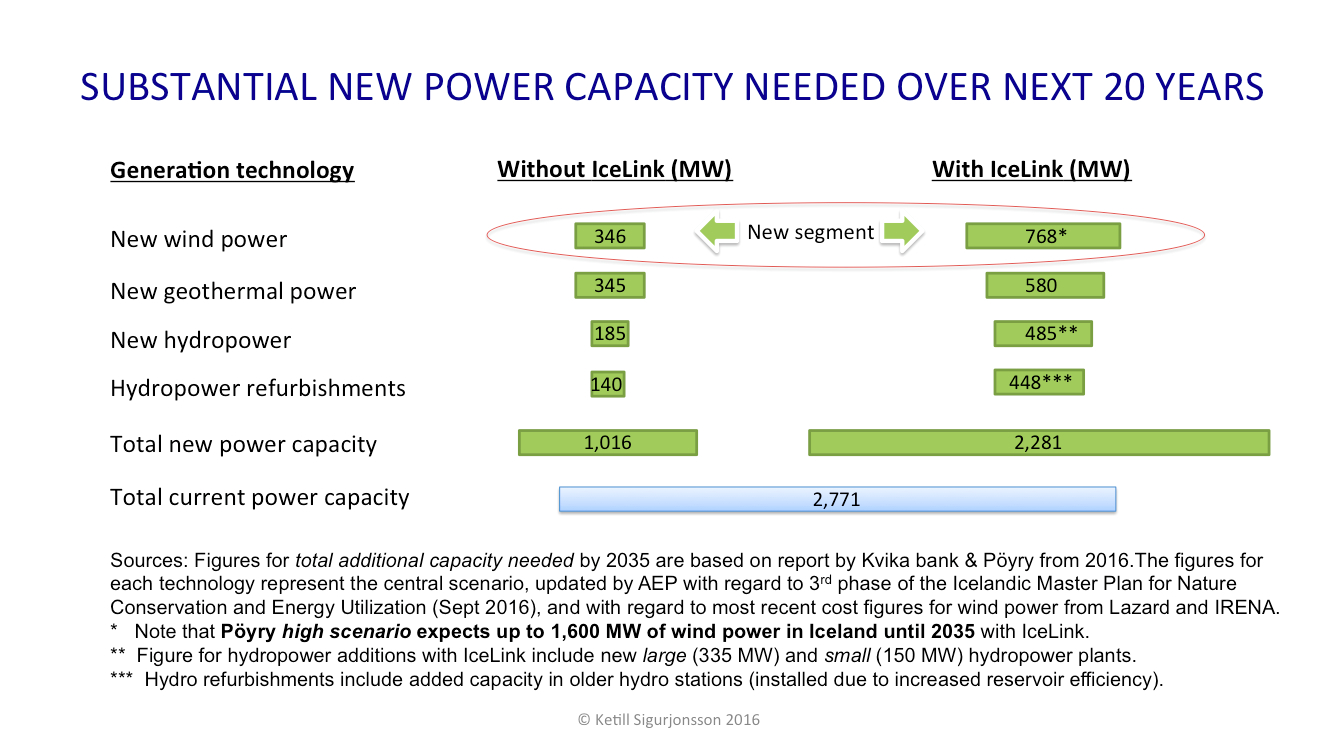
If the IceLink HVDC subsea interconnector between Iceland and UK, will be developed, more than 2,000 new megawatts (MW) of power capacity is expected to be developed in Iceland in the coming two decades. All these capacity additions will all be in renewable power technology. Most of it will be in the traditional types of Icelandic electricity generation, which is hydro- and geothermal power. However, substantial amount of the new capacity will be in wind power, making wind power the fastest growing type of generation in Iceland.

Low-Cost Wind means Slower Growing Geothermal

It is hard to predict with precision how much capacity will be added to each of the three types of renewable generation mentioned above. The table below shows two predictions, one by Kvika/Pöyry and the other by Askja Energy Partners. According to Kvika/Pöyry, IceLink will need approximately 1,459 MW of new capacity, bringing total new capacity in Iceland to 2,137 MW by 2035.

Analysis of Askja Energy shows that Kvika/Pöyry may be over-estimating how fast new geothermal power can be developed in Iceland (and under-estimating the potentials of Icelandic wind power). We at Askja Energy, predict slower growth in new Icelandic geothermal power, and somewhat faster growth in wind power. In addition, it is very likely that new Icelandic hydropower can be developed somewhat faster than Kvika and Pöyry are forecasting in their central scenario.

Table: New power capacity (MW) in Iceland until 2035
Central scenario with IceLink HVDC cable
Forecast by Forecast by
Technology Kvika/Pöyry Askja Energy
Geothermal 722 580
Hydro 865 933
Wind 550 768
Total new capacity added 2,137 2,281

Note that the Askja Energy scenario assumes faster capacity additions in hydropower and wind power than Kvika/Pöyry, but substantially slower geothermal capacity additions. The result is less generation pr. each new MW (thus, higher new capacity needed in total to deliver same/similar generation). All numbers are an estimation and may vary, such as due to what power projects exactly (in each category) will be developed.

Wind Power the Fastest Growing Segment

No matter if the forecast by Askja Energy or the forecast by Kvika/Pöyry will be closer to the real development, wind power can be expected to become Iceland’s fastest growing energy segment. If IceLink will be constructed, no type of generation in Iceland will grow as fast (in percentages) as wind power. As explained on the graph below.

iceland-power-capacity-additions-until-2035_ketill-sigurjonsson-2016The question that remains, is if and when the decision will be taken on IceLink. But even without IceLink, it is likely that new wind power will be developed in Iceland in the coming years, as numerous locations in Iceland offer very high capacity factor for wind turbines.

Pöyry overestimating Icelandic geothermal

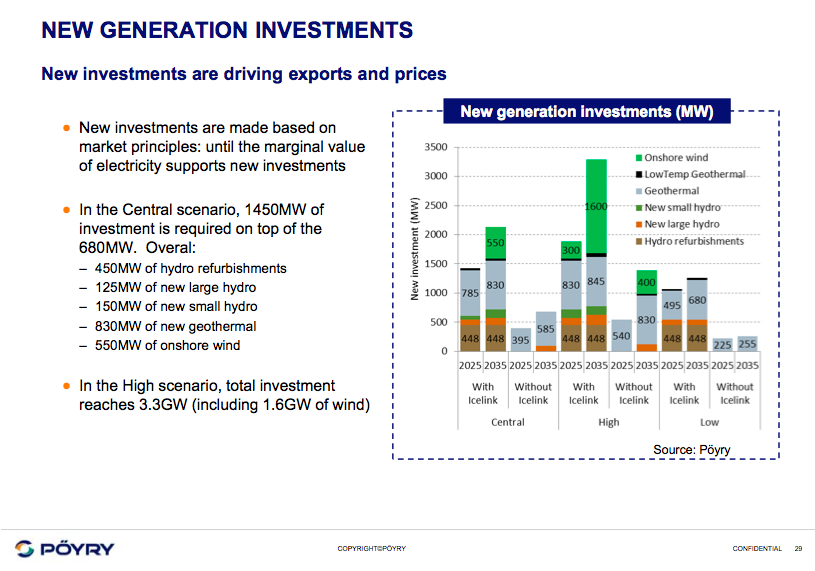
In their recent report titled “Subsea electric cable between Iceland and Britain – cost-benefit analysis”, Kvika bank and Pöyry seem to overestimate how fast Icelandic geothermal power can be developed. In their central-scenario, having regard to new demand from the IceLink subsea power cable, Kvika and Pöyry predict that by 2025 Iceland may have developed 820 MW of new geothermal capacity. This is somewhat surprising estimation, as it seems unrealistic to expect such a fast construction of new geothermal plants in Iceland.

kvika-poyry-iceland-new-electricity-generation-until-2035

According to Kvika and Pöyry, Iceland will need around 1,416 MW of new power capacity by 2025 if IceLink will be constructed. As shown on the graphs at left and below, Kvika/Pöyry expect most of this new capacity to be in new geothermal power plants, with a capacity of 820 MW. According to their report, 785 MW will be new traditional geothermal power plants and 35 MW will be smaller low temperature geothermal stations (totally 820 MW in new geothermal power).

The rest of the needed capacity by 2025, around 596 MW, is expected to include 448 MW in hydropower refurbishment (such as added capacity in current hydro stations), 93 MW in new large hydropower plants, and 55 MW in new small hydropower plants. Note that the exact predicted megawatts for each category are not absolute figures, so for each category there may be a few more or less MW. Thus, it is maybe not very surprising that the given figures in Pöyry’s slide-presentation for hydropower refurbishment, do not quite match (450/448), as can be seen on the graphs and also here on Twitter.

kvika-poyry-iceland-new-electricity-generation-until-2035-graphIceland offers very good geology for geothermal power development. However, it is costly and complicated to sufficiently establish and harness the geothermal resource in each new area. Having regard to the Icelandic experience in geothermal development so far, 785 MW of new large geothermal power stations may call for approximately eight to ten new development areas, each area with close to 100 MW of power capacity constructed in preferably two steps (starting with 50 MW or so).

There may be some possibilities to construct new Icelandic geothermal stations with 100 MW capacity before 2025. However, such an intensive construction/utilization in a new area could substantially increase the risk of over-exploitation of the geothermal area. And it is also important to have in mind that due to environmental regulations, such as regarding planning and impact assessment, it becomes even more unlikely that up to ten new geothermal projects can be developed in Iceland in less than a decade.

This does not mean that Iceland would not be able to deliver the power needed for IceLink in time. Due to well-known hydropower opportunities and good wind potentials, economical wind- and hydropower (in addition to substantial new geothermal power) would most likely ensure sufficient power supply for IceLink. But the scenario for each power category (geothermal, hydro, and wind) will most likely be somewhat different from what Kvika/Pöyry estimate.

For some reason, Kvika/Pöyry made little effort to cost-analyze the development of wind power in Iceland. Having regard to numerous good sites for high-capacity wind farms in Iceland, it can be argued that wind power can fill in the gap which may occur due to slower than expected development of geothermal power. In our next article, we will be looking further into this issue, explaining how much wind power may be developed in Iceland in the coming decade.

Pöyry’s analysis on Icelandic wind power potentials

Following a tender in 2015, the Icelandic Ministry for Industries and Innovation signed Kvika bank and Pöyry to deliver advanced macroeconomic cost-benefit analysis of the impact of a subsea power cable between Iceland and Great Britain on Icelandic society. The report was published around mid-year 2016. The Icelandic title of the report is “Raforkusæstrengur milli Íslands og Bretlands, kostnaðar- og ábatagreining“, which in English would read as “Subsea electric cable between Iceland and Britain – cost-benefit analysis”.

The key assumptions of the report are based on the following issues: Development of electricity demand in Iceland, the possibilities of new electricity generation in Iceland (including wind power), the cost of the project (including cost of the subsea interconnector, converter stations, new power capacity, and new transmission lines), cable-capacity and cable-uptime, cost of capital, development of electricity prices in the UK, and possible support from the British government. These issues include a.o. analysis on how much new hydro-, geothermal- and wind power capacity is expected to be constructed in Iceland until 2035.
kvika-poyry-icelink-report-2016-coverThe report by Kvika/Pöyry is highly interesting and includes extensive information which is very relevant to the project. However, it is obvious that its authors have made little effort in analyzing the possibilities of Icelandic wind power. This becomes evident when reading the part of the report that focuses on wind power (chapter 15.3.3). It is also noteworthy that the report makes absolutely no reference to the numerous recent university theses on Icelandic wind energy. And very limited direct references are made to the scientific paperThe wind energy potential of Iceland” by Nawri et.al., which so far is probably the main scientific examination on Icelandic wind potential.

The result is that the report by Kvika/Pöyry only offers a somewhat general introduction of wind energy utilization, without any real analysis on the potentials of harnessing wind for electricity generation in Iceland. The authors of the report simply make the general claim that wind power is still more costly than most planned hydro- and geothermal power projects in the utilization category of the Icelandic Master Plan for Nature Protection and Energy Utilization. This claim is not very well supported in the report. But the result is a conclusion by Kvika/Pöyry, that it is unlikely that any wind power will be harnessed in Iceland unless the IceLink HVDC subsea interconnector will be constructed.
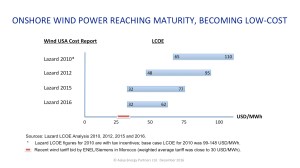
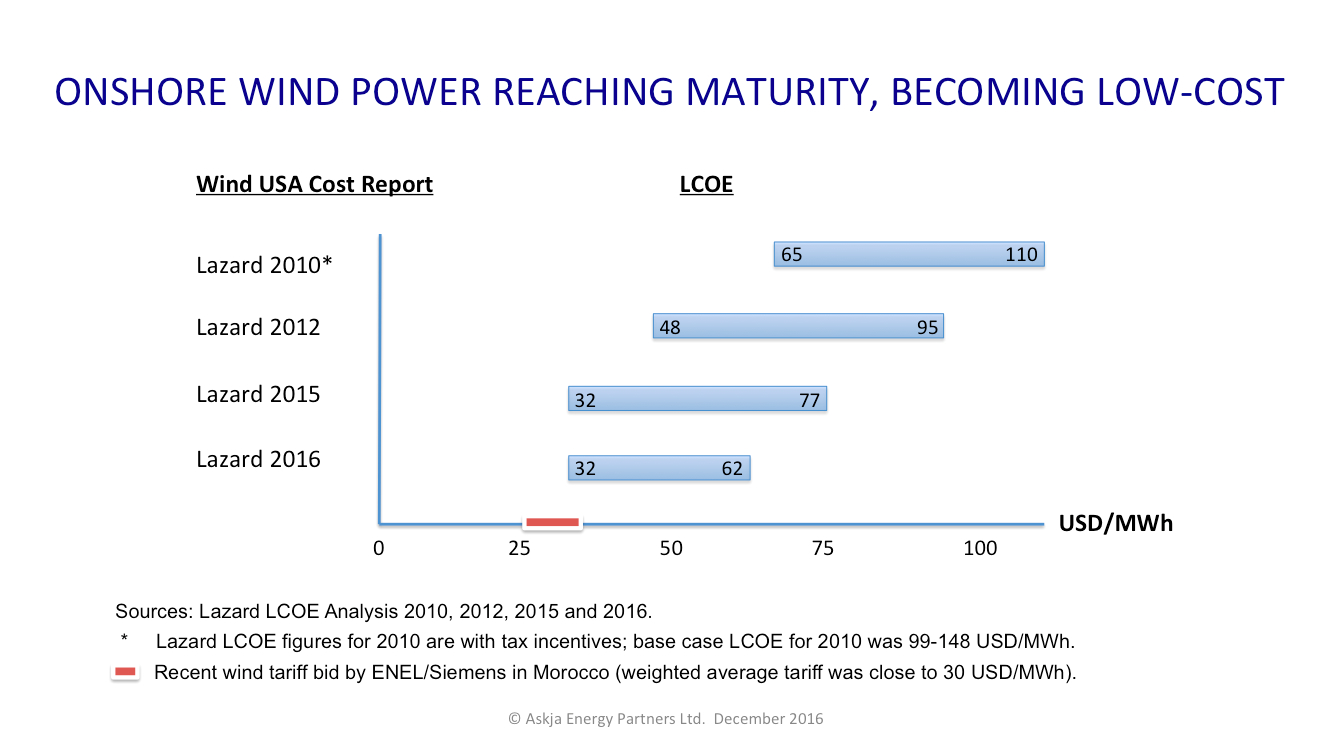
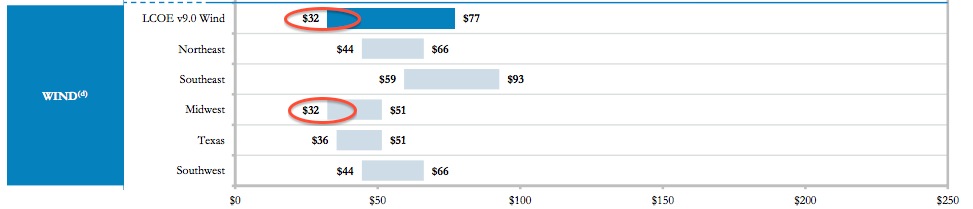
wind-lcoe-history_lazard_askja-energy-partners-2016It should be noted that many of the power projects, described in the utilization category of the said Master Plan, have an expected LCOE between 40 and 50 USD/MWh (this especially applies to the geothermal projects). Having those cost figures in mind, it is interesting that high capacity wind locations outside Iceland offer as low LCOE as 32 USD/MWh (as explained by Lazard) and in rare cases even lower. When also having regard to other recent wind projects in high capacity areas, it seems clear that such projects offer LCOE that is lower than the expected cost of some of the planned geothermal projects in Iceland.

We could refer to several other recent wind power cost-analysis for the same outcome. As an example, Goldman Sachs expects onshore wind costs to fall into the range of 30-35 USD/MWh due to technology advancements. With this all is mind, it would have been both interesting and important if Kvika/Pöyry would have made further effort to analyze the potentials and cost of possible upcoming wind power projects in Iceland.

Of course it is also important to remember that extensive wind capacity may call for an increase in backup power. The extra cost due to such capacity additions may indeed make wind power more costly than explained by simple LCOE-analysis. However, the general assumption by Kvika/Pöyry, declaring Icelandic wind power in most cases more expensive than geothermal power in Iceland, seems somewhat hasty. The result may be an under-estimation of the potential of Icelandic wind power. And due to sensitivity of geothermal resources to over-exploitation, it is even possible that the expected fast-capacity growth of geothermal power in Iceland may in fact be an over-estimation.

—————————————–

The report by Kvika/Pöyry is officially only available in Icelandic. To give our readers a clear idea about how the report explains and analyses wind energy, we hereby publish an English translation of the part of the report that focuses on wind power (chapter 15.3.3). Note that the somewhat long sentences and un-precise references simply reflect how the Icelandic text is put forward in the report. And we express that all the following text is a translation of chapter 15.3.3 in the report, so the text does not reflect opinions of the Icelandic Energy Portal.

—————————————–

Chapter 15.3.3:   Options for Onshore Wind Power in Iceland

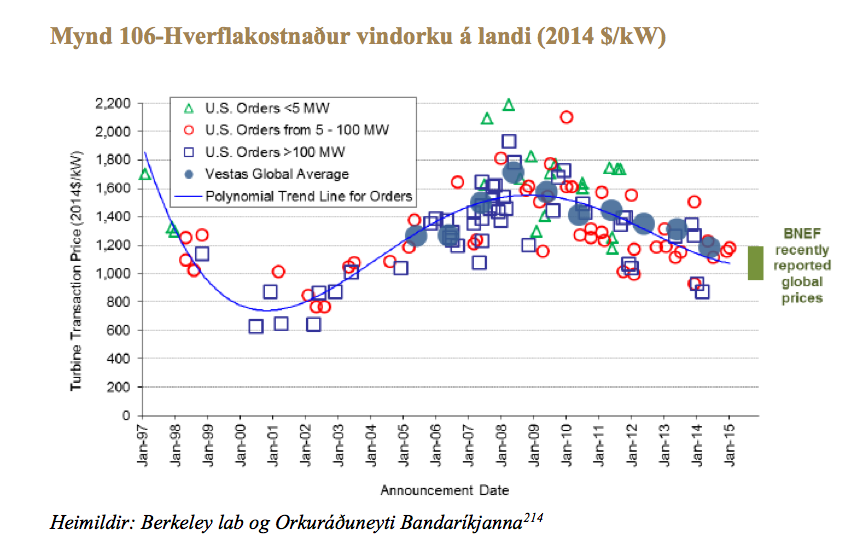
Wind is a well-known energy source. In recent years, technological development has made wind turbines more efficient and more stable. Also, the cost of constructing and operating onshore wind farms have decreased significantly in a short time, as seen on figure 106. Thus, wind power is closer to becoming competitive with other new energy projects in Iceland. Wind energy is increasingly harnessed worldwide. It is estimated that by 2020, the installed capacity of wind power in the world will be 1,000 GW, or as much as the hydropower in the world today.

kvika-poyry-icelink-report-2016-fig-106[Fig. 106 – Cost of onshore turbines (2014 USD/kW). Sources: Berkeley lab and US Energy Ministry; US Energy Ministry Wind Technology Market Report 2014. Link to source.].

Given the limited environmental impact of wind power compared to prolonged or permanent impact of hydropower, wind power should be considered as an important option for renewable energy production, especially in a country like Iceland, which has great wind power potential and is sparsely populated. [Ref. 215: Icelandic Meteorological Office, Wind energy potentials in Iceland 2013].

Windmills need to be connected to the grid, which preferably should be close to the location of the windmill. It also makes sense to take population density and tourism into account when deciding where to locate windmills, as many feel they spoil the beauty of the landscape in which they stand. All in all, numerous factors need to be taken into account when deciding where to locate windmills. [Ref 216: Wind energy as option in Iceland 2012, Environmental considerations, James Dannyell Maddisson and Rannvá Danielsen]. 
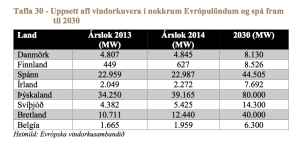
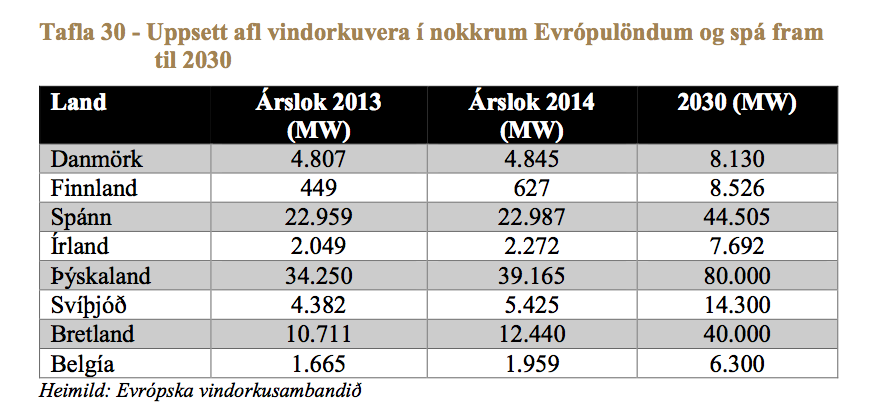
kvika-poyry-icelink-report-2016-table-30In 2014, Europe had 12,820 MW of installed wind power capacity. [Ref 217: Wind energy in Energy statistics 2014 and wind energy scenarios for the year 2030, European Wind Energy Association 2015]. Table no. 30 shows the installed wind power in selected European countries by end of 2014 and forecast for 2030. [Table 30 – Installed wind energy capacity in some European countries and forecast for 2030. Source: European Wind Energy Association].

By end of 2014, installed onshore wind power capacity in Iceland was only 3 MW. Landsvirkjun [the national power company] has presented plans for two onshore wind farms to be evaluated in the third phase of the Master Plan [Icelandic Master Plan for Nature Protection and Energy Utilization]; one wind farm with an installed capacity of 200 MW delivering up to 705 GWh/year and the other 100 MW delivering up to 350 GWh/year, a total of 300 MW and more than 1 TWh/year. Private parties, both domestic and foreign, have also been exploring the possibility of building and operating onshore wind farms in Iceland.

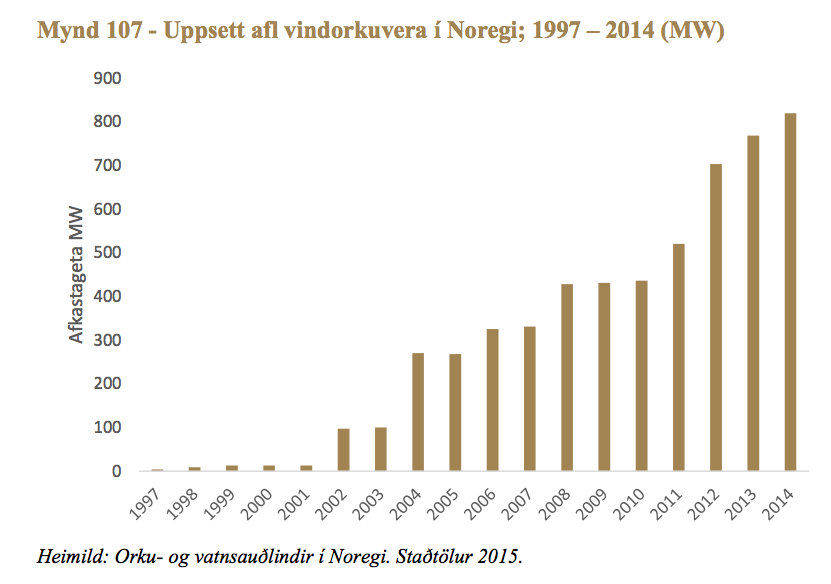
By end of 2014, Norway had constructed wind parks with an installed capacity of 856 MW, delivering an average of 2.2 TWh of electricity annually, with 31% capacity factor [ref 218: Governing department of water resources and energy matters in Norway, NVE], which constitutes to 1.2% of the country’s electricity generation. See Figure 107 – Installed capacity of wind power in Norway.
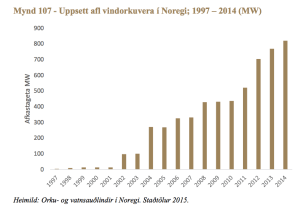
kvika-poyry-icelink-report-2016-fig-107[Fig. 107 – Installed capacity of wind power stations in Norway; 1997-2014 (MW)].

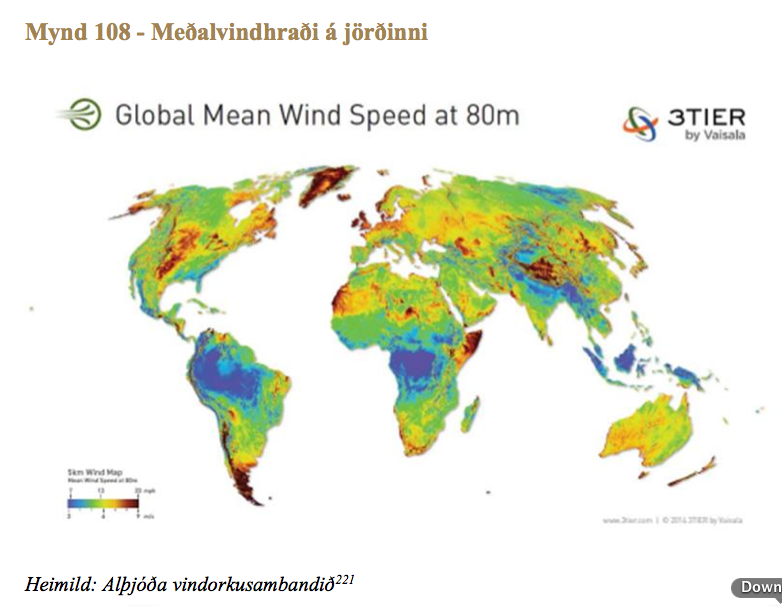
The development of wind power in Norway has so far not been economical without subsidies and the wind farms that have been constructed have been subject to subsidies. Yet, Norway has in general good wind resources, compared to other countries. By the start of 2014, new wind power projects with a generation of about 9.1 TWh/year had been authorized in the country. However, it is unclear whether all this power will be developed. The possibility, however, exists if market conditions supports the investment, all the necessary planning has been completed, and permits have been given. [Ref 219: Figures from 2015, Energy- and water resources in Norway, Norwegian Oil and Energy Ministry]. Iceland is very well suited for electricity generation by onshore wind, as shown in Figure 108, which shows the average wind speed at 80 m height .
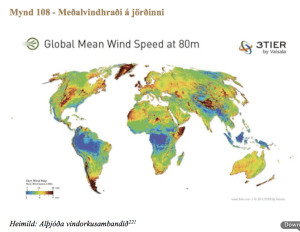
kvika-poyry-icelink-report-2016-fig-108[Fig. 108 – Average wind speed on Earth. Source: World Wind Energy Association. Global evaluation on wind resources. December 2014. Link to source].

Wind measurements give very good results and a limiting factor for the development of wind energy in Iceland will not be lack of wind, but political and environmental concern, proximity to other industries and services, power transmission and wholesale prices of electricity. In our simulation, the cost of onshore wind power is set higher than most other options and thus large-scale wind power development is not expected unless domestic demand will grow much or a subsea cable will be laid. This may change if the cost of new onshore wind power plants continues to decline. Thus, onshore wind energy could become a more economical option than geothermal power plants in the near future.

How fast will wind energy develop in Iceland?

So far only four large wind turbines have been constructed in Iceland, all of them in the southern part of the country. The first were two 900 kW turbines from Enercon, which started operating in early 2013. The second two were 600 kW used Vestas turbines, set up in Iceland in 2014. The project owners are the national power company Landsvirkjun and private firm Biokraft.

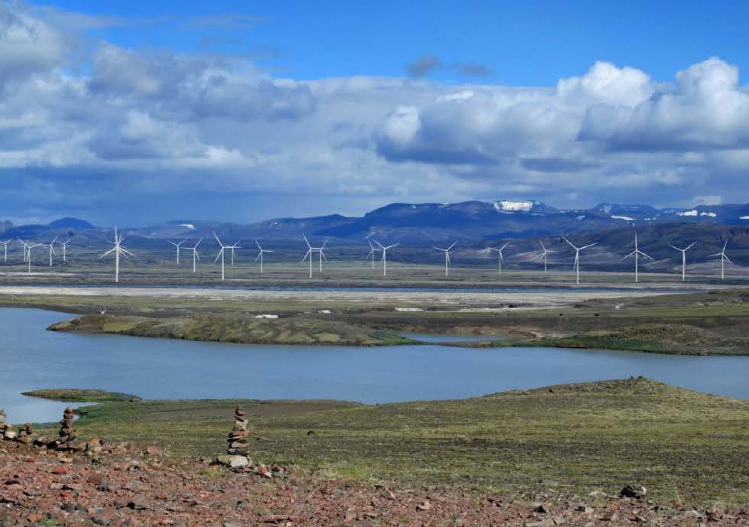
Wind-Power-IcelandThe nature of these first wind energy projects in Iceland is to obtain operational experience with onshore wind turbines in the Icelandic climate. The turbines are connected to the grid and both projects have been quite successful, offering more than 40% capacity factor.

According to a report by Kvika bank and Pöyry, published earlier this year (2016), most if not all upcoming power projects in Iceland will be either hydro or geothermal. Kvika and Pöyry are not expecting substantial wind power to become developed in Iceland unless Iceland will have an interconnector to Europe,

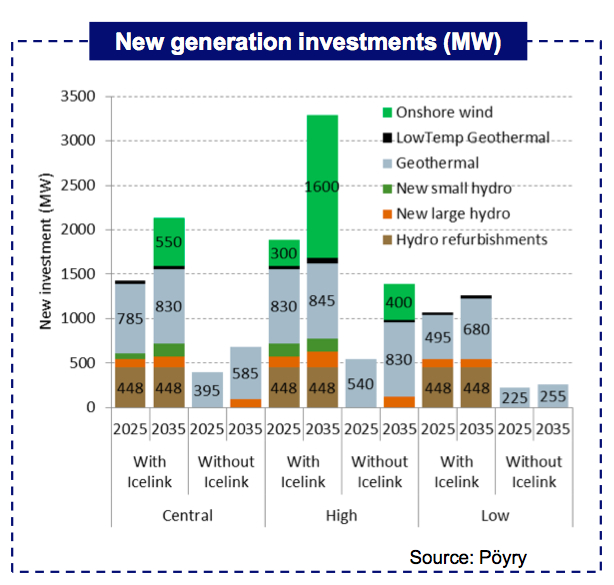
Having regard to the low- and central scenarios, according to the report by Kvika/Pöyry, absolutely no wind power is expected to be developed in Iceland in the next two decades unless the IceLink (or other subsea HVDC cable to Europe) will become reality. On the other hand, Kvika/Pöyry expect quite high investment in Icelandic wind power if IceLink will be developed.

iceland-new-generation-until-2035_kvika-poyry-report-2016According to the high scenario, 1,600 MW of new wind power capacity may be developed in Iceland if the subsea electricity interconnector will be constructed. This is explained on the graph at left; the wind power is expressed by the green part of the columns. The graph is from a recent presentation by Pöyry.

What is somewhat surprising about these assumptions by Kvika and Pöyry is the extremely low wind power investment expected in Iceland if an interconnector will not be developed. The fact is that Iceland has already harnessed the most economical options in geothermal power (and also in hydropower). The expected new geothermal projects will be quite costly.  According to a recent report published by Samorka (the Federation of the Icelandic electricity industry, district heating, waterworks and sewage utilities in Iceland), the levelized cost (LCOE) of many of the new geothermal projects expected until 2035 is believed to be close to 35-45 USD/MWh.

In addition, Kvika/Pöyry seem to have over-estimated how fast new geothermal power in Iceland can be developed. In fact Iceland does not have a very long history of extensive geothermal harnessing for electricity generation. The experience so far tells us that the geothermal areas are quite sensitive to over-exploitation. Thus, it seems possible if not very likely, that the true LCOE for new geothermal projects in Iceland may in fact normally be more expensive than Samorka claims. At least it is quite possible that to avoid over-exploitation, geothermal power development in Iceland may have to become substantially slower than expected by Kvika/Pöyry. Which would make more space for wind power development.

Iceland has very good wind conditions in numerous locations close to the grid; locations which offer wind capacity between 40-50%. This has been confirmed by the two positive research projects in Southern Iceland, developed by Landsvirkjun and Biokraft, as mentioned above. The project by Landsvirkjun consists of two 0.9 MW Enercon turbines, while Biokraft has relied on two somewhat smaller and older (used) Vestas turbines.

Iceland-Wind-Power-Landsvirkjun-Burfellslundur-Wind-ParkAs the cost of wind power technology has been coming down, and is expected to become even lower in the coming years and decades, it seems likely that wind power will be developed in Iceland even without IceLink. One should also have in mind that Icelandic power companies are already buying generation from the first wind turbines in Iceland at a price equivalent to roughly 40-45 USD/MWh.

Due to the positive outcome of the two ongoing experimental wind projects, both Landsvirkjun and Biokraft are now planning the construction of first wind farms in Iceland. The combined capacity is expected to be close to 350 MW. In addition, a company called Arctic Hydro has introduced plans for a wind park of 20-30 MW.

We, at the Icelandic Energy Portal, will be informing our readers more on these projects as they develop (two of the projects are currently in the phase of EIA). At this stage we will leave you with the claim that wind farms located in high-capacity locations in Iceland are likely to offer as low cost as new geothermal plants and even lower. This means a LCOE between 35-40 USD/MWh.

lazard-lcoe-wind-usa-version-9-0-2015Also, keep in mind that according to most recent report from Lazard, wind farms in Midwest USA offer as low LCOE as 32 USD/MWh. Having regard to Icelandic wind conditions, we should not be surprised if wind farms in Iceland may offer similar cost. And if so, wind power in Iceland is likely to develop a lot faster than predicted by Kvika/Pöyry.

Surprising claims about IceLink in the Financial Times

The Financial Times (FT) has published an interesting article, titled City financier urges UK support for £3.5bn Icelandic power cable – Plan to send geothermal electricity 1,000 miles under the sea to north-east England. The article is written by Andrew Ward, Energy Editor at Financial Times.

edmund-truell-icelink-hvdc-cableAccording to the article, the City financier Edmund Truell has “plans to open a £200m cable factory in the north-east of England if the government backs his project to build a £3.5bn undersea cable connecting the UK to geothermal power from the hot springs of Iceland.”  Actually, the article draws up a somewhat surprising and/or imprecise picture of the project, as explained here:

IceLink is indeed an interesting project. But is doubtful that Mr Truell’s proposal is the “most detailed” plan on the cable to emerge, as stated in FT. So far, the most detailed official document on the project yet, is a recent report by Kvika Bank and Pöyry (the report was published last summer but is in Icelandic only). Numerous of the comments made by Mr. Truell do not align well with this report.

According to Mr. Truell’s comments to the FT, “Iceland could supply 1.2 gigawatts of baseload power”. From this comment it seems that Mr. Truell has somewhat unclear understanding about how the project is seen by the governments of Iceland and UK.

The plan is not really sending “geothermal electricity” to UK. Nor will the cable serve as access to base-load power, but rather be access to a flexible hydro power source. Readers should note that Iceland’s power system is mostly based on hydropower. The idea regarding the cable is mainly to utilize large hydro reservoirs to offer access to highly flexible renewable power source.

Of course part of the power would be from geothermal sources (and also from onshore wind power which is likely to be constructed in Iceland). But the main power source for the cable would/will be the hydropower. In fact Iceland’s main problems in the power sector now relate to too fast construction of geothermal power plants. As was recently explained here on the Icelandic Energy Portal.

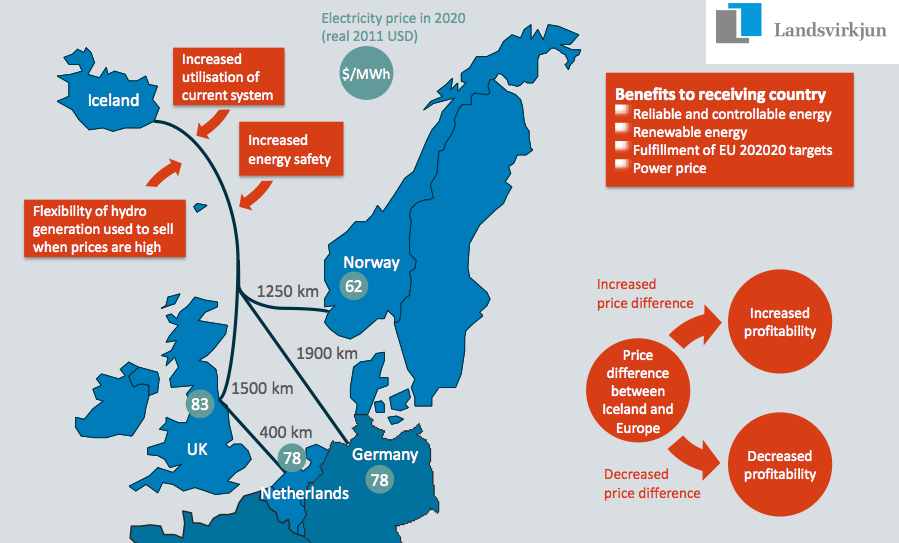
Iceland-Europe-HVDC-Interconnector-Landsvirkjun-Map_Askja-Energy-PartnersIt is possible that the cable would have a capacity of 1,2 GW. However, it is somewhat imprecise that the cable would offer a “supply of 1,2 gigawatts”, as Mr. Truell says to the FT. What really matters is how much electricity would be sent through the cable. According to plans introduced in Iceland, the annual amount is likely to be close to 5,000 GWh (5 TWh). This is the important power figure, rather than the capacity of the cable (which has not yet been decided and might be somewhat lower than the claimed 1,200 MW).

The length of the cable might indeed become 1,000 miles, as Mr. Truell is quoted to say in FT. But according to plans presented in Iceland it is more likely that the length would be closer to 750 miles. In the end the length will of course greatly depend on where the cable will/would come on land in Great Britain. No such decision has been taken yet.

According to reports presented in Iceland, the cost of the cable is not expected to be 3.5 billion GBP, as says in the FT article, but rather close to 2.4 billion GBP (central scenario). Total cost of the whole project would of course be a lot higher figure, due to the cost of new power plants and new transmission lines within Iceland. According to the Icelandic ministry of Industries and Innovation the total cost of the whole project would be 5-6 billion GBP (ISK 800 billion).

According to Mr. Truell, UK would get the electricity from Iceland at about 80 GBP/MWh. This figure is probably 25% to low (when having in mind the cost of the transmission from Iceland to UK). According to Pöyry, likely price would probably not be lower than close to 100 GBP/MWh.

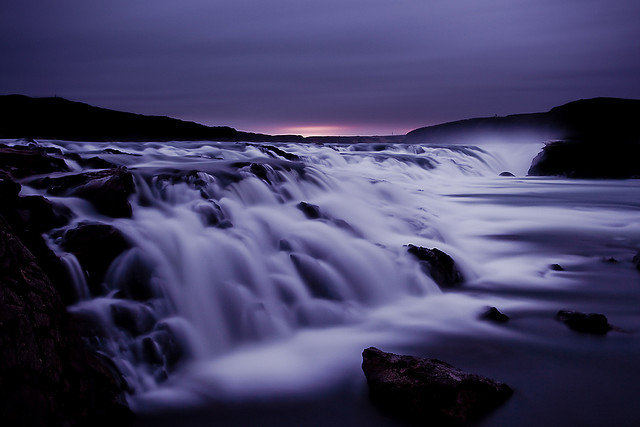
urridafoss-vrirkjunIn the article in FT, it says that Iceland has offered “surplus electricity” to aluminium smelters, and Mr Truell says there is “still plenty left for export”. In reality the situation is a bit more complex. Currently, there is very little surplus-electricity in the Icelandic power system. It is expected that IceLink would need close to 1,500 MW of new capacity.  To be able to supply the subsea interconnector with electricity, Iceland would need to build numerous new and quite expensive power plants. Such plants would harness hydro, geothermal and wind. Also Iceland would need to strengthen its transmission system. So the cable would mean huge new investment in the Icelandic power system and the project is only partly based on “surplus” electricity.

An electric subsea HVDC cable between Iceland and the UK is indeed an interesting opportunity, such as to increase the amount of reliable and flexible renewable energy in UK’s power consumption. And it would be wise for the UK to make the project a priority. However, note that Iceland is not at all an endless source of green power. And the people of Iceland will hardly have much interest in such a project unless receiving strong economical gains from it. In addition the project would/will be a major environmental issue in Iceland, due to impacts from constructing new power plants and transmission lines. And to avoid misunderstanding about the project it is extremely important to have the facts right.

Facts or fiction about IceLink?

The IceLink subsea interconnector is a proposed power cable that would connect the power markets of Iceland and Great Britain (UK). On the website of Icelandic national power company Landsvirkjun, the rational for the IceLink cable is described. In this article we will fact-check this rationale:

Claim no.1:  IceLink lifts the isolation of the Icelandic electricity market and it assists Europe to achieve interconnection capacity targets amounting to 10% of installed capacity, and it opens up new markets for both Icelandic and UK suppliers.

  • Correct: The Icelandic power market is isolated. With IceLink, that would change.
  • Correct: IceLink would be part of Europe’s projects to achieve interconnection capacity targets.
  • Correct: IceLink do open up new markets for Icelandic and UK suppliers.

The EU Commission has set a target of 10% electricity interconnection by 2020. This means that all EU countries should construct electricity cables that allow at least 10% of the electricity produced by their power plants to be transported across its borders to its neighboring countries. However, IceLink will not be ready by 2020. Thus, it seems likely that the IceLink project would rather become a part of EU’s new energy policy and targets for 2030. In fact, this development or process has already started.

lv-hvdc-subsea-power-cables-mapThe EU Commission has already proposed to extend the interconnection target from 19% to 15% by 2030. The targets will be reached through the implementation of Projects of Common Interest. A new special expert group on electricity interconnection targets established by the EU Commission  had its first meeting in Brussels on 17th and 18th October 2016. It is yet to be seen what will become the new interconnection target for each of the EU member states, but so far the UK’s share is only less than 5%. In 2015 domestic installed capacity in GB was 91 GW, while total capacity of interconnectors between UK and other countries was 4 GW.

Regarding IceLink opening up new markets, it should be noted that the general power market in Iceland is very small compared to GB or UK. Thus, for suppliers in the UK the Icelandic power market is probably not very interesting. However, it might be positive for suppliers of wind energy in Scotland to have access to Iceland, as we will now explain:

Claim no.2:  Through bi-directional flows, IceLink could potentially reduce the cost of managing constraints between northern GB and the major consumption centres further south as energy is directed to Iceland at times of excess wind power generation in the north, stored in hydro reservoirs, and returned at times of lower wind output.

  • Correct: IceLink would open up the possibility to store for example Scottish wind power in Iceland’s reservoirs.
  • Correct: During time of low wind in Scotland, Icelandic hydropower stations could be utilized to bring  the wind power back to Scotland.

Claim no.3:  By providing flexible energy in near term spot markets and the balancing mechanism, IceLink can lower the cost of balancing, in particular in a system with a high penetration of intermittent generation.

  • Possibly: There is a possibility that IceLink would lower the cost of balancing electricity supply/demand. However, this of course depends on several factors, such as the British capacity market.

Claim no.4:  IceLink connects currently isolated Iceland´s renewable electricity system with the broader European system and offers a means to decrease Europe´s dependency on imported fossil fuels in a cost efficient way.

  • Correct, but not very relevant: IceLink is expected to offer the UK (and thus the European system) access to approx. 5,000 GWh annually. The current total annual electricity consumption in the UK is close to 335,000 GWh. Access to power generated in Iceland would thus only add a fraction to the current power supplied and consumed in the UK.

However, note that in 2015 the renewable power generation in the UK was close to 83 TW, so an addition of 5 TWh of renewable generation is substantial. This of course means that IceLink would in fact make UK (and Europe) a little bit less dependent on power from for example coal and natural gas (fossil fuels)

Claim no.5: IceLink increases diversity of power supply at both ends and enhances further deployment of renewables through coupling highly flexible hydro generation with that of intermittent wind and solar generation.

  • Correct: Iceland and UK utilize different sources for their power generation. While UK is mainly dependent on natural gas, coal and nuclear energy for its power generation, Iceland utilizes hydro and geothermal for close to all its generation. Moreover, most of the generation in Iceland comes from hydro. IceLink will thus indeed increase diversity of the power supply, and Iceland’s flexible hydro power is perfect to balance supply and demand while solar and wind power fluctuates.

Claim no.6: IceLink delivers reliable and flexible energy into the GB system at times of thin supply margins.

  • Correct: IceLink could indeed deliver reliable and flexible energy into the GB/UK system at times of thin supply margins. To better understand the importance of access to flexible hydropower, based on large reservoirs, we would like to refer to our earlier article; IceLink offers flexibility rather than base load power.

Claim no.7: IceLink allows energy to flow to Iceland at times of low hydro generation potential, e.g. due to unusually low precipitation levels.

  • Correct: Every few years, the Icelandic reservoirs fill up quite late due to low precipitation or cold weather (resulting in low glacial melting). This decreases the efficiency of the Icelandic hydropower stations and adds a risk to the system. With IceLink this risk would become less.

Claim no.8: Iceland generation is 100% renewable. The interconnector would provide an export opportunity for the surplus energy in the renewable hydro system that is not currently harnessed due to economical and operational limitations.

  • Correct: The closed Icelandic electricity system is constructed in the manner of securing stable supply to heavy industries (especially to aluminum smelters, who need stable power supply 24/7 all year around). In years with unusually much precipitation or heavy glacial melting (warm periods), excess amounts of water runs into the reservoirs, resulting in overflow. Turbines could be added to harness this excess, but such development is costly and not economic unless having access to a market where power prices are higher than in Iceland. IceLink would create access to such a market.

Claim no.9: The UK has committed itself to ambitious reduction of greenhouse gas emissions. IceLink contributes with its lower cost of low carbon energy compared to domestic marginal alternatives and its flexibility contributes to reducing the cost of enabling the integration of UK intermittent renewables.

  • Correct: Even though the Icelandic geothermal,- hydro- and wind power sources are fairly limited when having regard to the enormous size of the British power market, it would make economic sense for the UK to buy Icelandic renewable power instead of for example more expensive British offshore wind power. For more on this subject, we refer to our earlier article; UK’s electricity strike prices positive for IceLink. And we can add that even though strike prices for new offshore wind power seems to be coming down quite fast, electricity from Iceland could be substantially cheaper than new offshore wind farms off the British coast.

Claim no.10: IceLink involves the deployment of relatively mature low carbon technologies. As such, it allows GB to reduce reliance on particular domestic technologies, thereby reducing exposure to lower than expected cost reduction trajectories.

  • Correct: Currently, almost all power generation in Iceland comes from mature geothermal- and hydro technology. In the coming years and decades the Icelandic power sector is likely to also start utilizing wind power on land – which is also a mature technology and less problematic than offshore wind power.

The conclusion is that most of the claims set forward by Landsvirkjun, regarding IceLink, are not only correct but also very relevant. However, it is possible that the project could be delayed by Britain’s decision to leave the European Union.

Reykjavík Energy searching for steam

Geothermal developer Reykjavík Energy (Orkuveita Reykjavíkur in Icelandic) is facing problems due to fast declining geothermal wells. To keep up the power generation in its recently constructed 303 MW Hellisheiði Power Station, the company will need to invest close to USD 175 million in geothermal wells in the next six years.

This somewhat serious situation is expressed in a new financial plan for 2017 and forecast for the period 2019-2022, as presented by the company-board of Reykjavík Energy on 3rd of October 2016. Reykjavík Energy (Orkuveita Reykjavíkur; OR) is Iceland’s second largest power company and is the parent company of Orka nátturunnar (ON), which is the power-generating arm of Reykjavík Energy. Reykjavík Energy‘s principal owner is the City of Reykjavík.

665 MW of geothermal power

Iceland’s current geothermal capacity is 665 MW. The Hellisheiði station is one of five large geothermal power plants in Iceland. There are additionally two very small geothermal plants, so there are seven geothermal stations in total.

Reykjavík Energy is by far the largest producer of electricity from geothermal sources in Iceland, with two geothermal stations with a combined capacity of 423 MW. Both stations are in the Hellisheiði/Hengill geothermal area in Southwestern Iceland. Privately owned HS Orka operates two geothermal stations at the Reykjanes peninsula, with a total capacity of 175 MW The national power company Landsvirkjun operates two geothermal stations in Northwestern Iceland, with a total power capacity of 63 MW. The five large geothermal stations in Iceland are as follows:

Hellisheiði geothermal station (303 MW), operated by Reykjavík Energy / ON (OR).
Krafla geothermal station (60 MW), operated by Landsvirkjun.
Nesjavellir geothermal station (120 MW), operated by Reykjavík Energy / ON (OR).
Reykjanes geothermal station (100 MW), operated by HS Orka.
Svartsengi geothermal station (77 MW), operated by HS Orka.

In addition, Landsvirkjun is currently constructing the first phase of Þeistareykir geothermal station in Northeast Iceland (45 MW). With a further second phase at Þeistareykir, which is expected to be developed soon after the first phase will be ready, the Þeistareykir plant will have a capacity of 90 MW. And a total cost of EUR 250 million (equivalent to USD 280 million).

Running out of steam

Reykjavík Energy does not only plan to drill for more steam for the Hellisheiði geothermal station, but also the company will spend close to USD 44 million during next six years in pumping water back into wells (to uphold steam). Thus, in total it will cost the company close to USD 263 million to withhold the power generation of the Hellisheiði station – during the next six years. It is noteworthy that this amount is almost as high as the total cost of building Landsvirkjun’s new 90 MW Þeistareykir station.

iceland-geothermal-hellisheidi-steamThe falling production at the Hellisheiði geothermal station is a reminder of the risk which developers of geothermal power face. Despite extensive research before construction, it is always very important to limit the risk of possible declining steam by developing geothermal power in fairly small steps. In Iceland, it is now generally accepted that each geothermal step should not be larger than 50-100 MW.

Developing geothermal power in small phases offers important information and data about the field. Such a methodology strengthens predictions of how much energy the area can deliver in a sustainable manner. Unfortunately the 303 MW Hellisheiði project was developed without necessary precaution, resulting in unsustainable generation.

Upcoming power projects in Iceland

The following list explains what power projects are being considered in Iceland, according to the Icelandic Master Plan for Nature Protection and Energy Utilization. The projects have been cost analyzed (levelized cost of energy; LCOE), as described in a recent report published by the Icelandic Energy Industry Association (Samorka).

The projects are classified into three different groups (not all the possibilities have been officially cost-analyzed):

Utilization category: The project is likely to be developed if/when there is power demand and interest by the energy sector.

Projects on hold: More information and/or data is needed to decide if the project will be classified as Utilization or Protection.

Protection category: The project is unlikely to be developed, due to environmental issues.

The current classification is being reconsidered by the government  However, it is the Icelandic Parliament (Alþingi) that takes final decision regarding how each project is categorized. This means that over time, project(s) may be moved from one category to another, based on a political decision by the Parliament. The following classification is up to date as of August 2016. Note that in Samorka’s report on the LCOE, the cheapest option, Norðlingaölduveita, is said to be on hold. In fact this option is currently in the protection category.

 Project name Current  Type MW Annual LCOE
  classification GWh USD/MWh
1 Norðlingaölduveita* Protection Hydro n/a 670 22.50
2 Búlandsvirkjun On hold Hydro 150 1,057 25.00
3 Jökulsárveita/Blönduveita On hold Hydro n/a 100 25.00
4 Urriðafossvirkjun On hold Hydro 140 1,037 25.00
5 Þeistareykir I** and II Utilisation Geothermal 270 2,214 28.90
6 Hrafnabjargavirkjun* On hold Hydro 89 585 30.50
7 Villinganesvirkjun On hold Hydro 33 215 30.50
8 Skrokkölduvirkjun On hold Hydro 45 345 30.50
9 Hólmsárvirkjun* Protection Hydro 72 470 30.50
10 Bjarnarflag Utilisation Geothermal 90 756 35.20
11 Meitillinn Utilisation Geothermal 45 369 35.20
12 Sandfell Utilisation Geothermal 100 820 35.20
13 Sveifluháls Utilisation Geothermal 100 820 35.20
14 Austurengjar On hold Geothermal 100 820 35.20
15 Gjástykki On hold Geothermal 50 420 35.20
16 Trölladyngja On hold Geothermal 100 820 35.20
17 Bitra Protection Geothermal 135 1,100 35.20
18 Brennisteinsfjöll Protection Geothermal 90 711 35.20
19 Hvammsvirkjun Utilisation Hydro 93 720 38.80
20 Búðartunguvirkjun On hold Hydro 27 230 38.80
21 Hagavatnsvirkjun On hold Hydro 20 120 38.80
22 Holtavirkjun On hold Hydro 57 450 38.80
23 Hraunavirkjun* On hold Hydro 126 731 38.80
24 Selfossvirkjun On hold Hydro 35 258 38.80
25 Stóra-Laxárvirkjun Unclassified Hydro 35 200 38.80
26 Tungnaárlón On hold Hydro n/a 70 38.80
27 Bláfellsvirkjun Protection Hydro 89 516 38.80
28 Djúpárvirkjun Protection Hydro 86 499 38.80
29 Markarfljótsvirkjun Protection Hydro 121 702 38.80
30 Gráuhnúkar Utilisation Geothermal 45 369 44.80
31 Eldvörp Utilisation Geothermal 50 410 44.80
32 Hverahlíð Utilisation Geothermal 90 738 44.80
33 Krafla II Utilisation Geothermal 150 1,260 44.80
34 Stóra-Sandvík Utilisation Geothermal 50 410 44.80
35 Botnafjöll On hold Geothermal 90 711 44.80
36 Fremrinámar On hold Geothermal 100 840 44.80
37 Grashagi On hold Geothermal 90 711 44.80
38 Hágönguvirkjun On hold Geothermal 150 1,260 44.80
39 Innstidalur On hold Geothermal 45 369 44.80
40 Sandfell On hold Geothermal 90 711 44.80
41 Þverárdalur On hold Geothermal 90 738 44.80
42 Grændalur Protection Geothermal 120 984 44.80
43 Hverabotn Protection Geothermal 90 711 44.80
44 Kisubotnar Protection Geothermal 90 711 44.80
45 Neðri-Hveradalir Protection Geothermal 90 711 44.80
46 Þverfell Protection Geothermal 90 711 44.80
47 Blanda II Utilisation Hydro 31 194 49.70
48 Hvalárvirkjun Utilisation Hydro 55 320 49.70
49 Austurgilsvirkjun On hold Hydro 35 228 49.70
50 Blöndudalsvirkjun On hold Hydro 16 92 49.70
51 Brúarárvirkjun On hold Hydro 23 133 49.70
52 Hafrálónsárvirkjun efri On hold Hydro 15 87 49.70
53 Hafrálónsárvirkjun neðri On hold Hydro 78 452 49.70
54 Haukholtavirkjun On hold Hydro 17 99 49.70
55 Hestvatnsvirkjun On hold Hydro 34 197 49.70
56 Hofsárvirkjun On hold Hydro 39 226 49.70
57 Hverfisfljótsvirkjun On hold Hydro 42 243 49.70
58 Hvítá við Norðurreyki On hold Hydro 14 82 49.70
59 Kaldbaksvirkjun On hold Hydro 47 273 49.70
60 Kljáfossvirkjun On hold Hydro 16 93 49.70
61 Núpsárvirkjun On hold Hydro 71 412 49.70
62 Reyðarvatnsvirkjun On hold Hydro 14 82 49.70
63 Skatastaðavirkjun* On hold Hydro 156 1,090 49.70
64 Vatnsdalsárvirkjun On hold Hydro 28 162 49.70
65 Gýgarfossvirkjun Protection Hydro 22 128 49.70
66 Bakkahlaup On hold Geothermal 15 119 57.30
67 Hrúthálsavirkjun On hold Geothermal 20 160 57.30
68 Hveravallavirkjun On hold Geothermal 10 79 57.30
69 Reykjabólsvirkjun On hold Geothermal 10 79 57.30
70 Sandfellsvirkjun On hold Geothermal 10 79 57.30
71 Sköflungsvirkjun On hold Geothermal 90 711 57.30
72 Seyðishólavirkjun On hold Geothermal 10 79 57.30
73 Fljótshnjúksvirkjun On hold Hydro 58 405 60.50
74 Vörðufellsvirkjun On hold Hydro 58 174 60.50
75 Glámuvirkjun On hold Hydro 67 400 nyca
76 Arnardalsvirkjun* Protection Hydro 587 3,404 nyca
77 Bjallavirkjun Protection Hydro 46 310 nyca
78 Blöndulundur Unclassified Wind 100 350 nyca
79 Búrfellslundur Unclassified Wind 200 705 nyca
Notes:
* The project may be developed in a different way for less environmental impacts, resulting in lower generation.
** 45 MW station at Þeistareykir is already under construction, with the electricity sold (long-term contract).
n/a Projects involving new reservoir for current power stations (turbines may be added, but not necessarily).
nyca Projects that have not yet been officially cost-analyzed.

———————————————————————————-

The list above may change at any time and new projects not listed may be introduced and developed.

Planned 45 MW wind power project of Biokraft in Southern Iceland is not included on the list.

No planned power projects under 10 MW (mainly small hydro) are included on the list.

Cost estimates do not include transmission or connection cost.

The list is up to date @ August 2016.

The wish-list of the Icelandic energy industry

Iceland may offer numerous new renewable energy projects where levelized cost of energy (LCOE) is very low. Or as low as 22.50 USD/MWh.

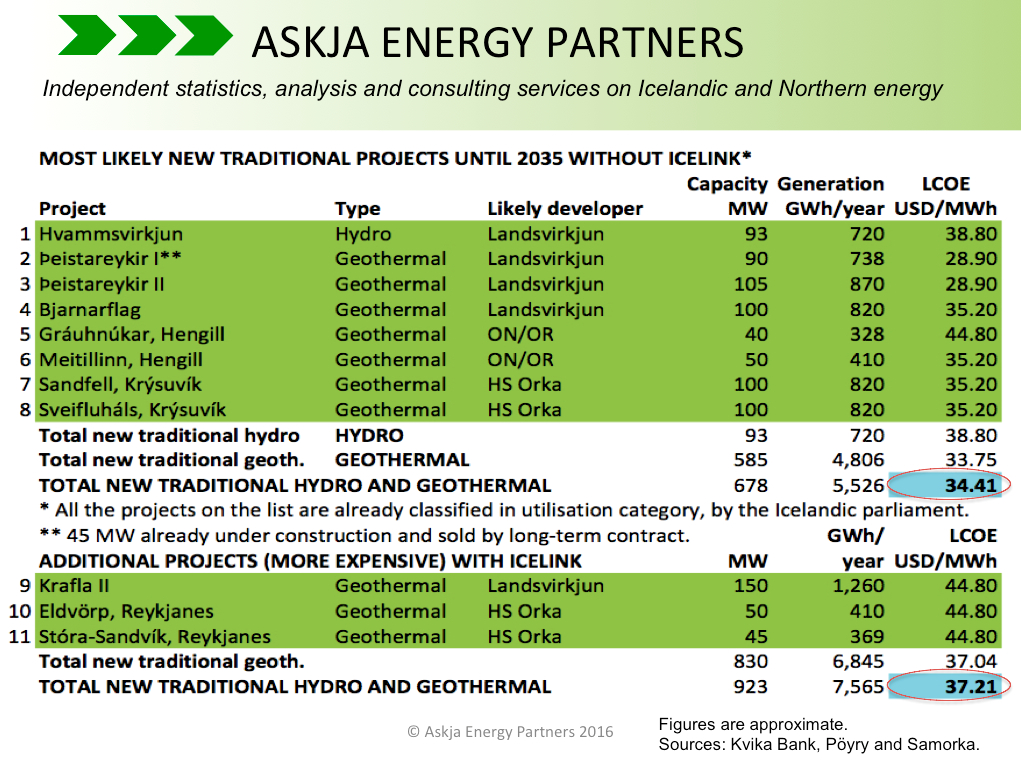
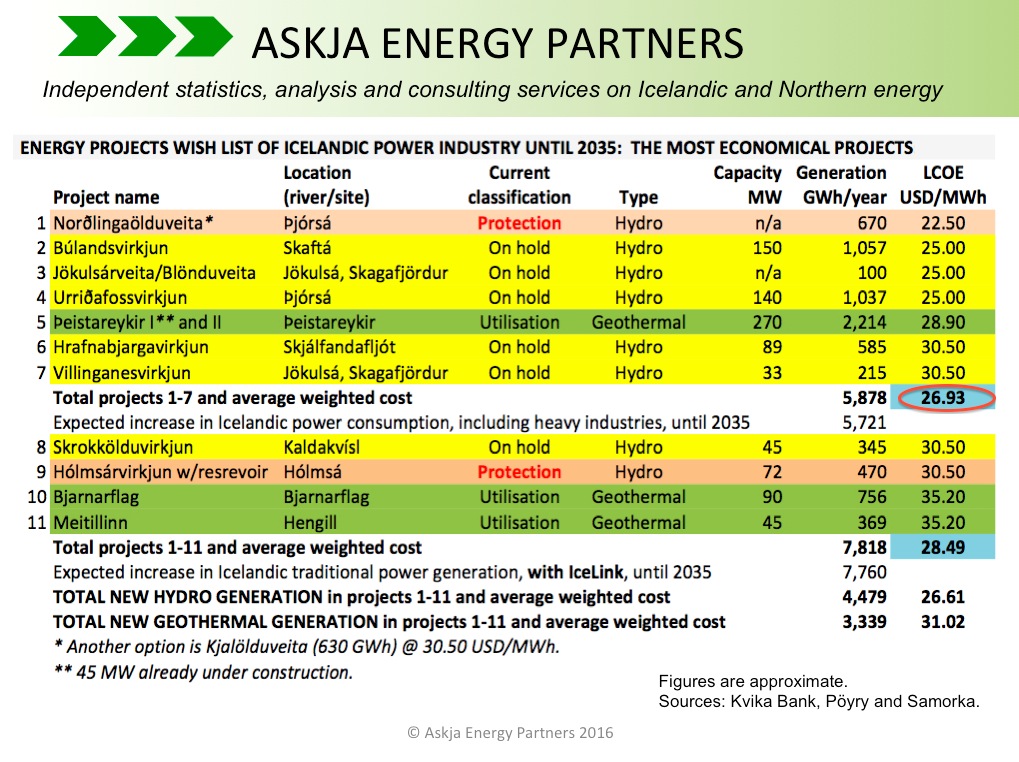
The weighted average cost (LCOE) for all new projects in Iceland needed to meet increased power demand until 2035, could be as low as 26.93 USD/MWh. This can be seen from a new report published by the Icelandic Energy Industry Association (Samorka). However, to realize such a low LCOE the Icelandic energy industry would have to be able to develop several projects that are currently not classified for development/utilization. When only taking into account projects already classified for utilization, the LCOE is substantially higher or 34.41 USD/MWh. Note that those figures are an estimation by contractors working for the Icelandic Energy Industry Association, and are based on cost-information from the Icelandic National Energy Agency (NEA).

LCOE for projects in utilization category is 34 USD/MWh

The Icelandic government has adopted a special Master Plan for Nature Protection and Energy Utilization, where possible new hydro- and geothermal power projects are classified into three categories. The categories are protection, on-hold, and utilization. Many of the possible new energy projects have not made it into the utilization category.

Iceland-New-Power-Projects-Utilization-Category_Askja-Energy-Partners_August-2016The table at left lists the lowest-cost hydro- and geothermal power projects planned by the Icelandic government to be realized, currently classified in utilization category. Some of these projects have substantial higher LCOE than the lowest-cost projects not categorized for utilization. Note that the list is not absolute; for example the Eldvörp project may be developed before the Gráuhnjúkar project.

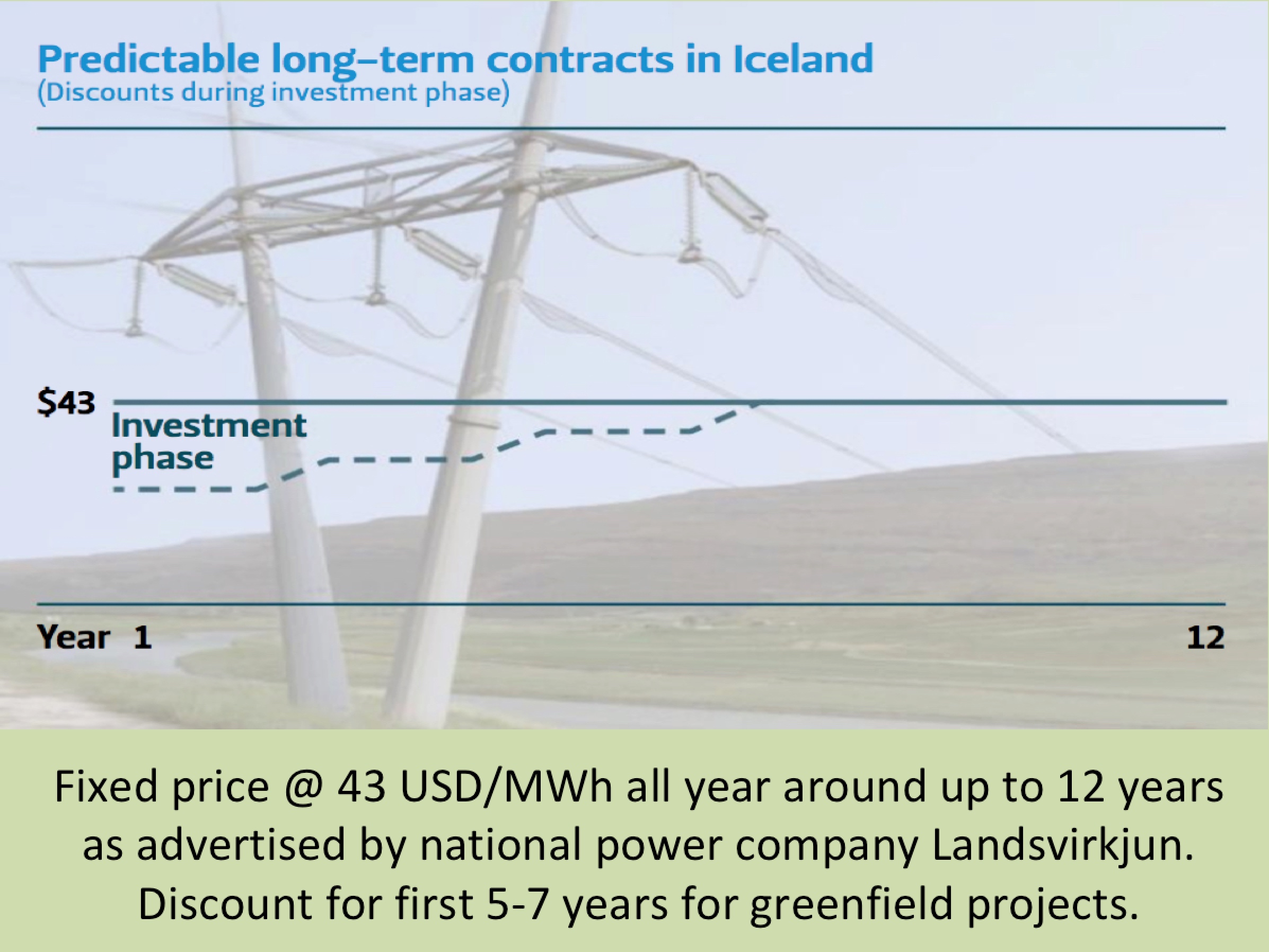
As can be seen on the table, the weighted average LCOE for all projects already categorized for utilization, needed to meet increased domestic demand until 2035, is close to 34 USD/MWh. Which probably explains why Icelandic energy companies are now, according to sources within the industry, offering new long-term power contracts where the tariffs are as low as 34-35 USD/MWh (common unofficial starting tariff; the advertised tariff is 43 USD/MWh).

Different classifications may offer LCOE as low as 27 USD/MWh

Being able to offer new power contracts with a starting price close to 34 USD/MWh, may be quite competitive having regard to the international power market. However, Icelandic energy firms are eager to be able to develop projects that have even lower LCOE. Thus, the industry hopes to have several low-cost projects re-classified by the Icelandic parliament (Alþingi).

Iceland-New-Power-Projects-Wish-List_Askja-Energy-Partners_-Twitter-August-2016To reach the lower LCOE of 26.93 USD/MWh, several projects need to be re-classified. Meaning low-cost projects that are now classified as protection or on-hold, would be re-classified as projects in utilization category. This is illustrated on the table at below.

If the energy industry will be able to convince the Icelandic government and parliament to move certain possible projects from the categories of protection and on-hold, to the utilization category, the levelized cost of new generation needed until 2035 may drop from approximately USD 34 USD/MWh to close to only 27 USD/MWh (meaning almost 20% lower cost). So, the projects listed on the table at left can be said to reflect the wish-list of the Icelandic energy industry (the industry hoping to have all these projects listed for utilization).

With IceLink LCOE could be somewhere between 28-37 USD/MWh

The two tables above also illustrate how different selection of projects affect the LCOE when/if the IceLink subsea power cable between Iceland and United Kingdom (UK) will be realized. If power will be exported from Iceland to UK, Icelandic generation naturally needs to increase more than without IceLink (as we have explained earlier here at the Icelandic and Northern Energy Portal). Depending  on which projects will/would be developed with IceLink, the LCOE for new traditional hydro- and geothermal projects could be as low as 28.49 USD/MWh (note that the overall LCOE for all the generation needed for IceLink would be higher, as it is expected that close to 550 MW of wind power would also be developed in Iceland to fulfill the demand of the cable). To reach such a low target for LCOE, 28.49 USD/MWh, the Icelandic energy industry would have to have its wish-list, as shown on the second table, accepted by the Icelandic authorities.

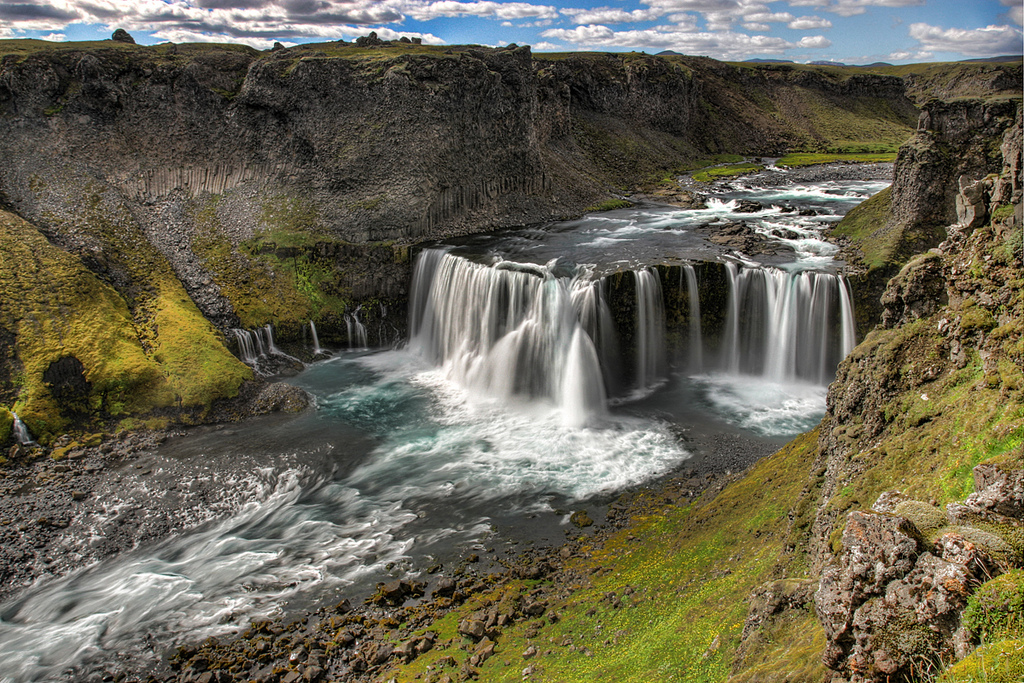
Holmsa-Axlarfoss

Having regard to projects currently categorized for utilization in the Master Plan, the LCOE will be much higher (with IceLink) than the said 28.49 USD/MWh. The LCOE for new traditional hydro- and geothermal stations currently categorized for utilization and needed for IceLink, is expected to be 37.21 USD/MWh (as can be seen on the first table above). Which is close to 30% more than the low-cost options on the wish-list. Thus the Icelandic government and politicians now face difficult and controversial decisions how to balance the economics and environmental issues, when deciding if changes will be made to the Master Plan. It is expected that a new version of the Master Plan may be adopted by the Parliament (Alþingi) even before the end of this year (2016).

Almost 1,000 MW of new large hydro- and geothermal power plants until 2035

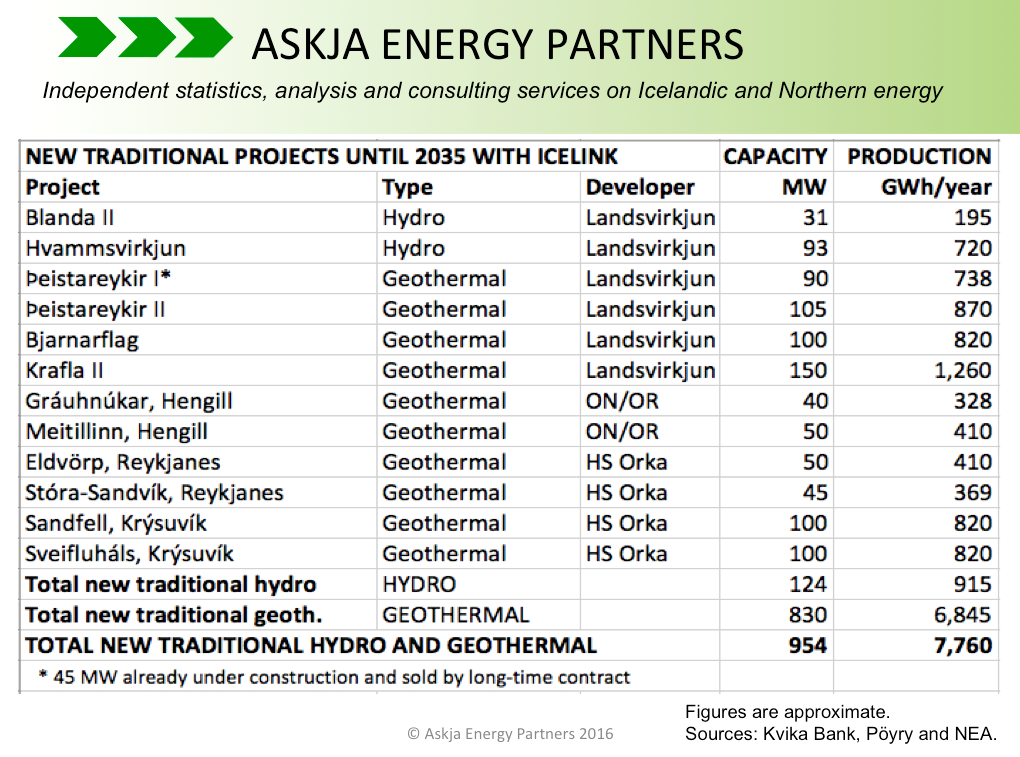
If IceLink subsea HVDC power cable will be constructed, it is expected that totally 954 MW of new traditional large hydro- and geothermal plants will be needed in Iceland. These power plants would be constructed during the next two decades.

IceLink-Kvika-Poyry_New-Power-Stations_Askja-Energy-Partners-Twitter-_July-2016According to the Icelandic Master Plan for Nature Protection and Energy Utilization, the Icelandic government would most likely fulfill the increased demand by permitting the development of twelve new large hydro- and geothermal projects (as listed on the table at left). These are two hydropower projects and ten geothermal projects (or nine projects if Þeistareykir I and II would be defined as one project).

The ten geothermal projects are Þeistareykir I and Þeystareykir II in NE-Iceland, Bjarnarflag and Krafla II in NE-Iceland (Krafla I was constructed almost 40 years ago), Gráuhnúkar and Meitillinn in the Hengill geothermal area in SW-Iceland, Eldvörp and Stóra-Sandvík on the Reykjanes peninsula in SW-Iceland, and Sandfell and Sveifluháls in the Krýsuvík area in SW-Iceland. The two hydropower projects would be Blanda II in NE-Iceand and Hvammsvirkjun in Þjórsá in S-Iceland.

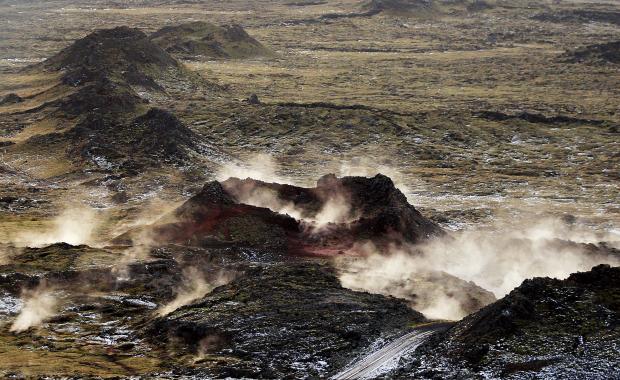
Eldvorp-Geothermal-Area-IcelandAll these twelve projects are already defined in utilization-category in the Master Plan for Nature Protection and Energy Utilization. However, some of these projects are somewhat costly to develop when compared to all possible energy projects in Iceland (which means there are several cheaper options available, although today they are not classified as utilization-projects, by either classified as protected or on hold).

Recently, the Icelandic Energy Industry Organization and some of the power companies in Iceland started pushing for changes of the Master Plan, to have the Icelandic government and the parliament (Alþingi) to include several other lower-cost projects in the utilization-category (we will soon explain the cost-issues further, here at the Independent Icelandic and Northern Energy Portal). As several of the cheapest options for harnessing more hydro- or geothermal power are in environmentally sensitive areas, there will without doubt be strong opposition against major changes of the Master Plan.

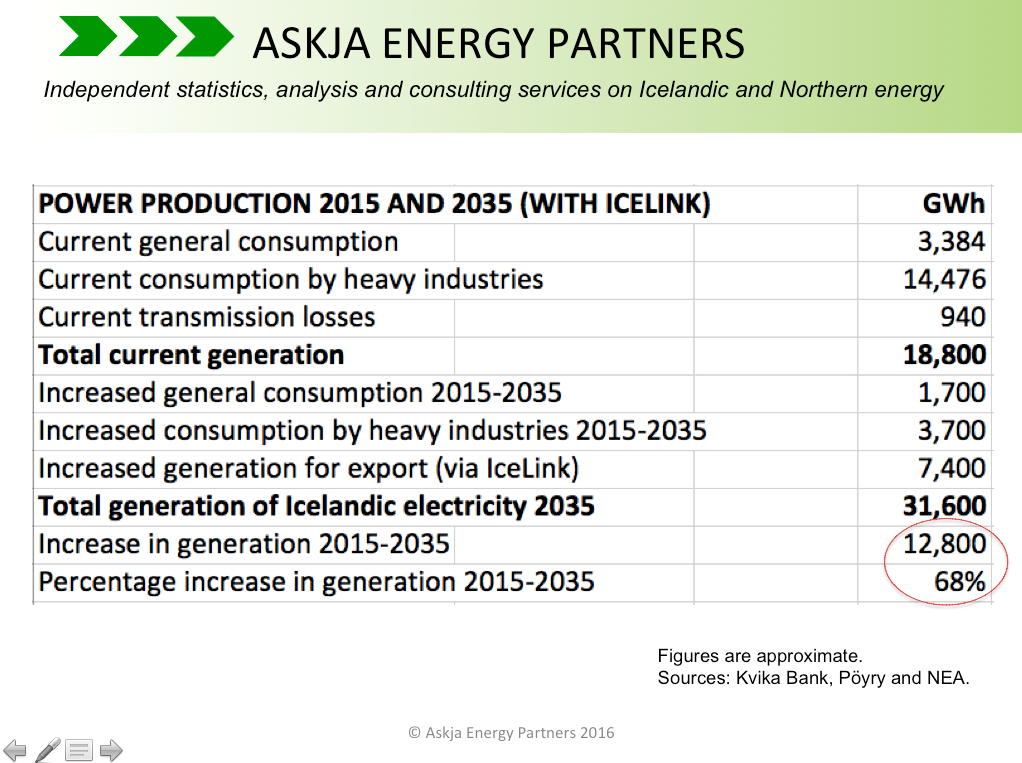
IceLink-Kvika-Poyry_Increase-in-Power-Generation_2015-2035_Askja-Energy-Partners-Table-Portal_July-2016If/when the IceLink project will go through, the total Icelandic power generation will have to increase enormously. Most of the new generation, or 7,400 GWh of the total increase of 12,800 GWh in annual production. would be added as exported power to the UK. In this same period (2015-2035) Icelandic general consumption of electricity is expected to increase by 1,700 GWh and power consumption by heavy industries in Iceland is expected to increase by 3,700 GWh. In total, Icelandic electricity generation would thus increase 68 percent in the period 2015-2035. For more on this subject, we refer to the table at left, and our earlier post from last July 22nd.