Skip to content

Posts by Askja Energy

The Energy of Adventure in Iceland

Today, two young Russians began their world journey to research global energy and explore how the most challenging energy problems are being dealt with in different parts of the world. Later this week they will be heading for Iceland.

Maria Khromova (24) and Egor Goloshov (21) are on a backpacker-style tour of the world to talk with energy leaders around the globe about their energy challenges and innovations. Over their journey, they will meet with an array of energy experts, including scientists and academics, and visit a variety of companies and organizations.

The pair plan to visit almost twenty countries n the next three months to assess how energy challenges are being dealt with. They began their tour in Germany, which has more installed solar energy generation capacity than any other country in the world and has plans for decommission all of its nuclear power plants and replace them with renewable energy sources. Iceland, with its 100% renewable electricity market, will be their next stop.

Besides Germany and Iceland, Maria and Egor are also scheduled to visit China, France, Israel, Italy, Kazakhstan, and South Korea in the first weeks of their trip. Then they will be going to Australia, Brazil, Denmark, India, Japan, Spain, Tanzania, the United Arab Emirates (UAE), and the USA before finishing the trip back in Moscow. Their plan is to talk to country leaders and authorities about how they are preparing to meet the energy challenges the world is facing.

They intend to report about their findings, discussions, and observations over the course of their tour in hopes of inspiring and triggering new thinking and ideas for addressing today’s interconnected energy challenges. Through social media, incorporating video blogging, Facebook and Twitter, the pair will share their stories with the world. The story of the Energy of Adventure will not only be educational, but also personal,  as the pair encounter different environments and cultures, develop their own friendship, and face challenges with only each other to rely on.

Maria Khromova is trained in the power industry and Egor Goloshov is an economist. They were selected in last May out of a competitive pool of 49,000 applicants from across Russia as part of the non-profit Energy of Adventure project.

Energy of Adventure is one of the programs of the Global Energy Prize; an “independent award for outstanding scientific research and technological development in energy, which contribute to efficiency and environmentally friendly energy sources for the benefit of humanity.”  The award was established in Russia, with the support of leading Russian energy companies such as Gazprom. Energy of Adventure is describes as an initiative to draw public attention to critical energy issues in Russia and abroad, to encourage the search for new solutions to energy problems of the present and future.
Maria and Egor are said to be looking forward to their journey in the whole and are impatient to see the world of energy in all its diversity. It will be interesting to hear their experience from visiting Iceland. Not least after they have visited almost twenty of the most interesting energy hot-spots in the world.  According to Icelander Þorsteinn Ingi Sigfússon, Director of the Innovation Center in Iceland and a Global Energy Prize Laureate, this is “a great opportunity for the younger entrants into the energy-business-world to see firsthand how actors across the energy supply chain and in different parts of the world are coping with their unique set of energy challenges and problems.”
Oil exploration in Iceland?

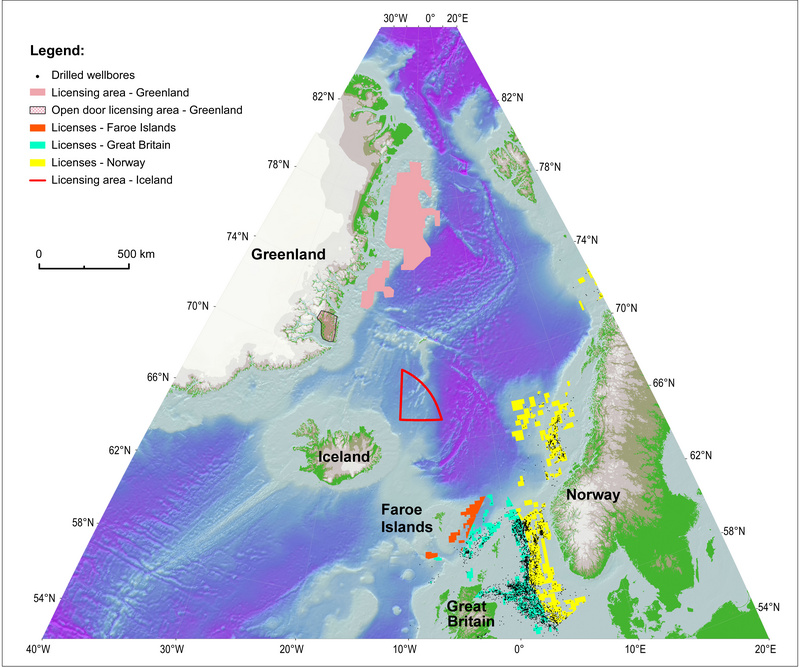
So far Iceland has had no oil industry and imports all its petroleum products (equilvalent to almost 18,000 barrels of crude oil per day). However, there are certain areas on the Icelandic continental shelf that are thought to have potential for hydrocarbon accumulations.

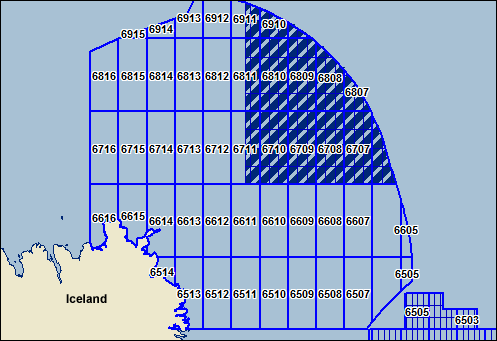
In recent years the main focus regarding possible oil exploration within Icelandic jurisdiction has been on the Dreki Area (dreki means dragon in Icelandic). The area is part of the Jan Mayen Ridge micro-continent on the northeastern Icelandic continental shelf.

The Dreki Area has geological similarities to neighbouring hydrocarbon basins close to Greenland and Norway. Seismic surveys and other geophysical measurements indicate that oil and gas could possibly be found in the area.

Hydrocarbon accumulations on the Icelandic continental shelf are owned by the Icelandic State. Licence from the Icelandic National Energy Authority (NEA) is required for prospecting, exploration and production of hydrocarbons. The legislation has provisions for two types of licences: a prospecting licence, and an exploration and production licence.

Earlier this year (2012) the NEA offered blocks for exploration and production licences on the Dreki Area. The area covers 42,700 square kilometres with water depths ranging from 800 to 2,000 metres. This was Iceland’s second licensing round ;the first round in 2009 attracted no serious applicants.

This time three groups of companies submitted their applications. They are (in alphabetical order) Eykon Energy (an unregistered Icelandic company), Faroe Petroleum and Íslenskt kolvetni ehf., and Valiant Petroleum and Kolvetni ehf. Íslenskt kolvetni ehf. and Kolvetni ehf. are Icelandic firms with well known Icelandic companies and businessmen as shareholders. Faroe Petroleum and Valiant Petroleum are well known exploration companies for example in the North Sea.

In the media the Director General for the NEA has said that the applications this time were beyond his brightest hopes. The NEA will be evaluating the applications during the summer in accordance with the legislative criteria. Possibly we may see the first hydrocarbon exploration and production licences on the Icelandic continental shelf awarded early this autumn.

In he coming weeks we will be adding more information on www.askjaenergy.org about hydrocarbon potentials in Icelandic jurisdiction.

Strong Icelandic electricity growth

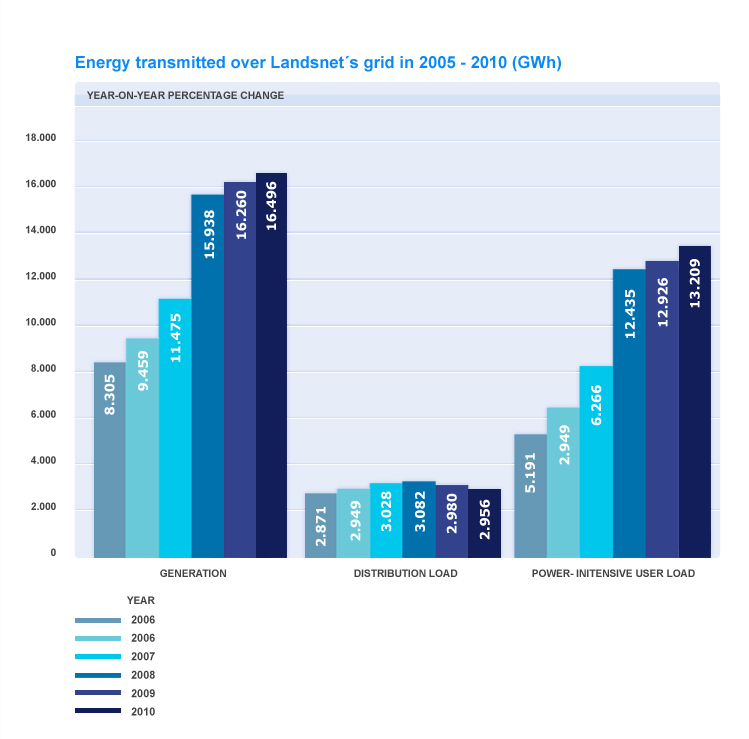
The recent growth in electricity generation and transmission in Iceland has been impressive.

Between 2005 and 2010 the Icelandic electricity generation doubled. It is important to keep in mind that all this increase was in low cost renewable generation (mostly hydropower). And remember that almost 100% of all electricity generated in Iceland comes from renewable sources (hydro- and geothermal power).

This rapid increase in Iceland’s green electricity generation is shown on the histogram at left / above. Most of the increased production is supplied to new industries and services. One of the main explanation behind this growth is the competitive electricity price Iceland offers.

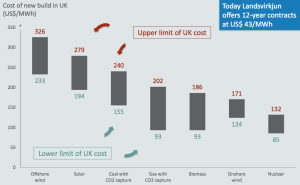
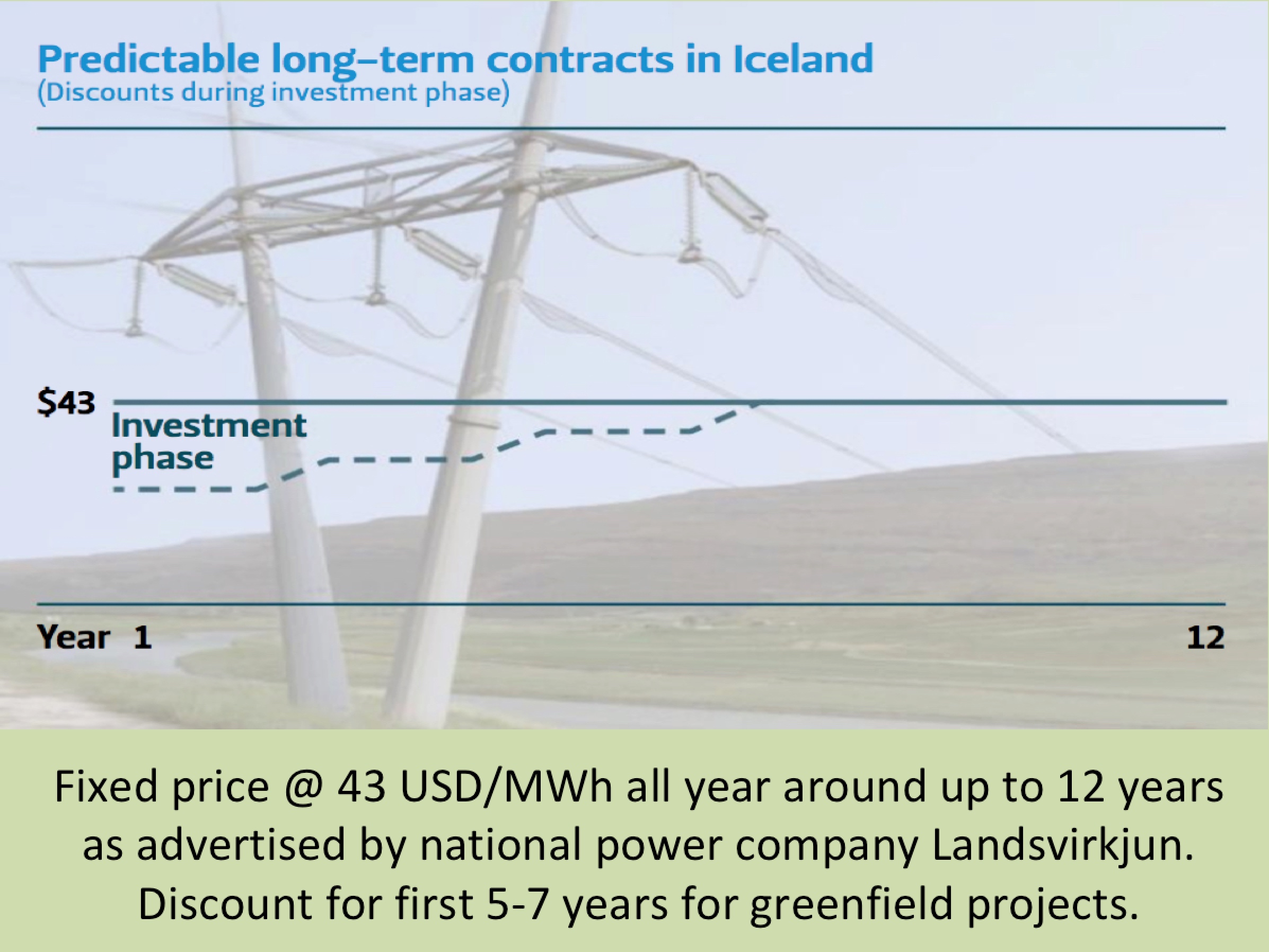
The abundant natural hydro- and high temperature geothermal resources make the Icelandic power industry able to offer electricity at substantially lower prices than for example can be found in any other European country. Even the present low spot-price for electricity in the USA (due to extremely low price of natural gas) are no threat to the Icelandic electricity industry. Companies that need substantial quantity of electricity and wish to operate within the OECD, will hardly find better long-term agreements than offered at the Icelandic market (43 USD/MWh in 12 year contracts are being offered by the Icelandic power company Landsvirkjun).

It is expected that demand for Icelandic renewable electricity will grow quite fast over the next few years. The fact that Iceland still has numerous very competitive unharnessed hydro- and geothermal options, makes the country an interesting location for all kinds of energy intensive industries and services. This may for example apply to data centers, aluminum foils production, several silicon production facilities etc.

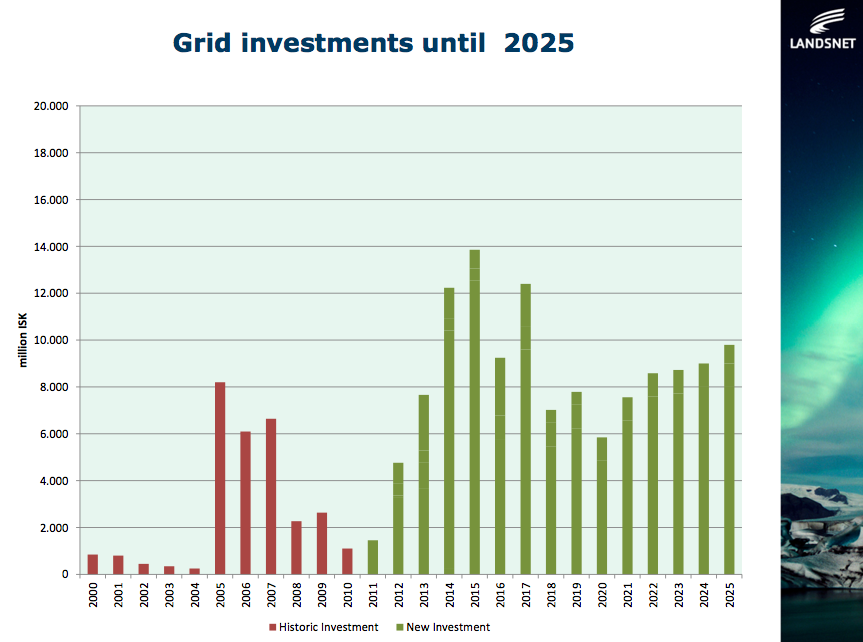
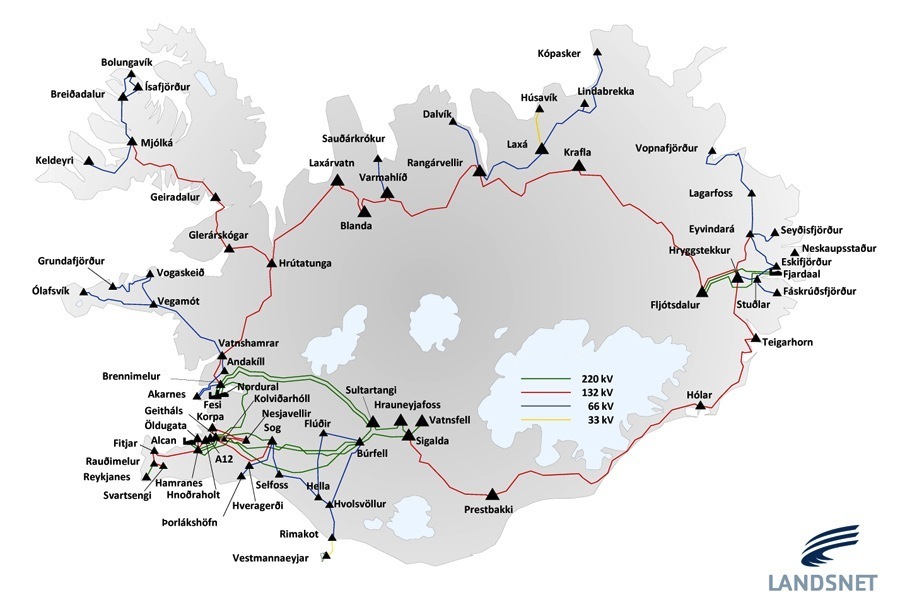
When having in mind the probable high growth in Icelandic electricity generation in the forthcoming years, it is not surprising that Landsnet (the Icelandic Transmission System Operator; TSO) is considering major investments in the electricity transmission system. The diagram at left is from Landsnet. It is interesting that even the major increase in transmission investments during 2005-2010 is fairly small compared to what may be expected in the next 10-15 years.

This plan for new transmission projects is not final yet. But it gives a clear view of the opportunities Iceland has regarding new and competitive green energy projects. No other western country enjoys similar economic possibilities based on 100% renewable energy.

Búðarháls power station

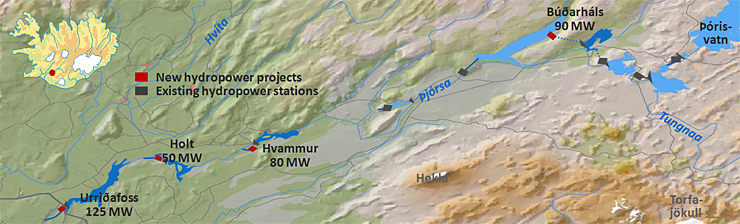
The glacial river system of Þjórsá and Tungnaá rivers in South Iceland is a major source for Icelandic hydropower.

Current capacity of the five power stations in those two rivers is 840 MW, with an annual generation of more than 5,000 GWh. The sixth power station in Þjórsá-Tungnaá, Búðarháls Station, will start operating in late 2013. It will have an installed power capacity of 95 MW and every year it will be generating 585 GWh. Then, the total annual generation in Þjorsá-Tungnaá will be close to 5,600 GWh.

All these six hydropower stations are owned and operated by Iceland’s largest power company; Landsvirkjun. In addition, Landsvirkjun is considering to construct three more power stations in Þjórsá river. Those three stations would have a combined capacity of 265 MW, adding more than 2,000 GWh of power generation per annum.

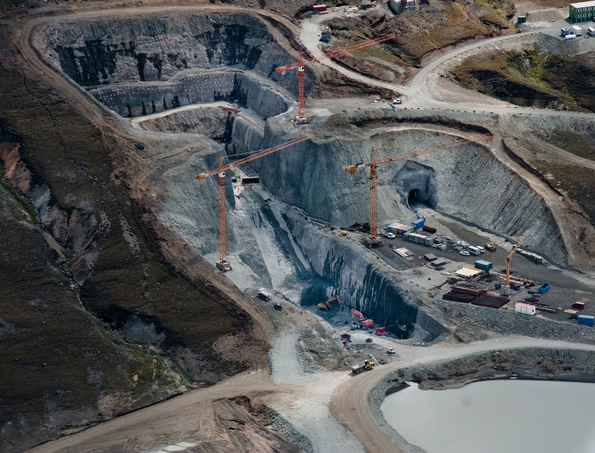
The Búðarháls Power Station received a positive assessment of environmental impact already in 2001 and construction commenced in November 2010. The electricity from the Búðarháls Station has already been sold to the aluminum smelter of Rio Tinto Alcan in Straumsvík in Southwest Iceland. The smelter in Straumsvík has 40 years successful operating history and the electricity from Búðarháls Station will be used for substantial increase in its aluminum production.

The project at Búðarháls includes a new 6 km² intake reservoir, Sporðöldulón, created with a 2.1 km long dam just below the Hrauneyjarfoss Power Station. A 7 km long 220 kW transmission line will be erected from the new power station to the Hrauneyjafoss line to connect Búðarháls Station with the National Grid.

It is worth having in mind that besides the three additional power stations Landsvirkjun is preparing in Þjórsá, as mentioned above, the company is considering several other attractive hydro- and geothermal power projects. Currently, Landsvirkjun is offering new power contracts that probably are the best offer available in all Europe. The company is offering a fixed real rate of $43/MWh in 12 year contracts.

In addition to the very competitive price, all the electricity Landsvirkjun produces comes from harnessing renewable power sources. No less important is the fact that all the Icelandic power stations are known for their excellent reliability – and the same applies to the Icelandic transmission system. This has been confirmed in numerous international reports, where Iceland’s electricity supply is ranked among world’s most secure (see for example IMD’s and WEF’s World Competitiveness reports).

New development at Landsnet

The Icelandic electricity grid is highly modern and extraordinarily reliable and the Icelandic Transmission System Operator, Landsnet, is world-renown for its secure electricity supply to its customers. This fact has been confirmed in numerous international reports, where Iceland’s electricity supply is ranked among world’s most secure (see for example IMD’s and WEF’s World Competitiveness reports).

Landsnet owns and operates all bulk electricity transmission lines as well as all main substations in Iceland. The company is owned by four electricity generating companies, where the state-owned power company Landsvirkjun has almost a 65% share.

The total length of the transmission lines is currently close to 3,200 km. The power flow is always illustrated in real time on Landsnet’s website. To meet growing demand, the grid is constantly being developed and maintained at a high standard, which includes rebuilding older lines and adding new ones. The grid is free of serious bottlenecks and there are no permanent system constraints in Landsnet’s grid.

Although Iceland is already the world’s largest electricity producer per capita, the country has substantial hydro- and geothermal resources unharnessed. This includes numerous very economical options, with minimum environmental effects.

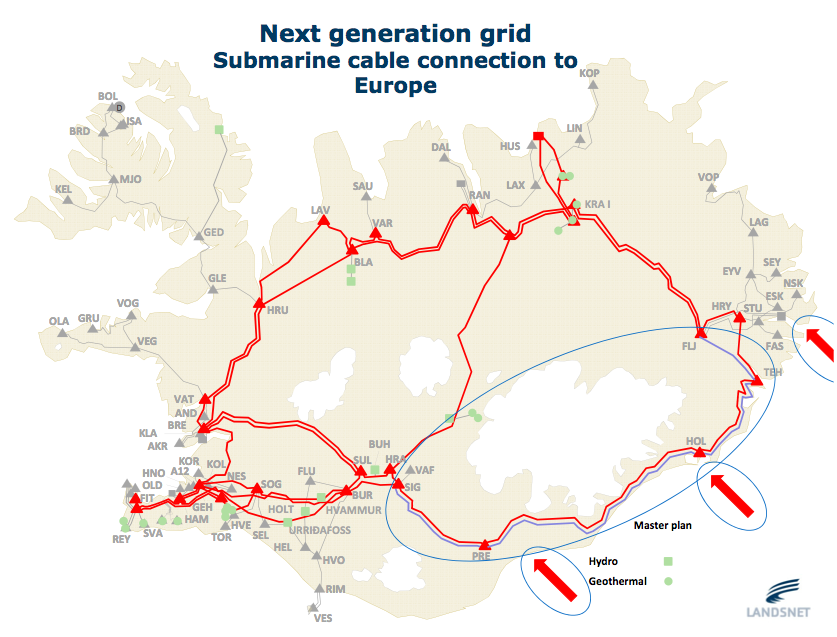
According to a special governmental plan for energy (Master Plan for Hydro and Geothermal Energy Resources) several new renewable energy projects can be expected in Iceland in the forthcoming years. This will call for major investments, not only in electricity generation but also in the construction of new transmission lines.

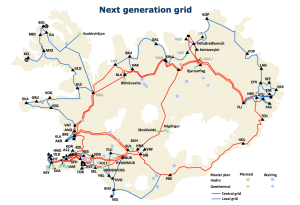
Recently, Landsnet introduced its vision or ideas towards strengthening the grid (as shown on the map above, with the title Next generation grid). However, this is a plan that the company will develop in full accordance with the Icelandic government and its energy policy. It is expected that the Icelandic parliament (Alþingi) will soon vote on the Master Plan, making it clear which new energy- and transmission projects will be emphasized in the coming years.

In addition to the expected build up in the Icelandic transmission system, a high voltage direct current cable (HVDC) is currently being considered between Iceland and Europe. Such a cable would obviously affect the Icelandic TSO. In early July (2012) the Icelandic Minister for Industry, Ms. Oddný Harðardóttir, appointed a working group to scrutinize the feasibility of such a interconnection. Of course Landsnet has a representative in this group, which will look carefully at all the relevant issues, such as the technical, financial, legal and social aspects.

However, the next major step for Landsnet is not regarding the transmission system, but has to do with the electricity market. Within a couple of months, Landnet will be establishing a new efficient electronic market for electricity trading. We at Askja Energy will soon be taking a closer look at this new Icelandic electricity market, that will have strong similarities to for example the Elbas Intraday Market at Nord Pool Spot.

The Iceland-Europe interconnector

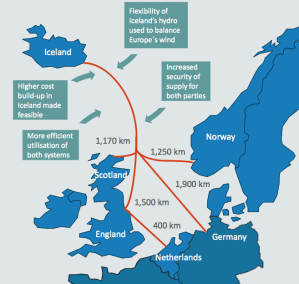
Iceland is currently a closed electricity market with no cable connections to other markets. This may soon change. Technology advancement, strong demand for more renewable energy, and high electricity prices in Europe are making a submarine high voltage direct current (HVDC) cable between Iceland and Europe more feasible than ever before.

Unharnessed renewable energy

Iceland can substantially increase its green electric power production at a reasonable cost. Iceland is the only country in Western Europe that still has several large unharnessed hydro power options. Also, Iceland’s geophysical conditions offer numerous possibilities for low cost utilization of geothermal power, and Iceland has stronger and more stable winds than most of Europe.

Some of this natural energy will be harnessed for varied domestic industries, such as new data centers, metallurgical-grade silicon production, etc. Iceland also has the possibility to do business with electric power through a submarine cable to Europe. Such a connection would not only be based on Icelandic hydro- and geothermal power, but would open up the possibility of large-scale harnessing of Icelandic wind power.

Choosing the best business model

So far the longest submarine HVDC-cable is the NorNed between Norway and the Netherlands (580 km / 369 miles). The interconnector between Iceland and Europe would be at least double that length, so it will definitely be a challenging project.

Such an  interconnector would not only enable sales of renewable electricity at high prices but also have various other benefits for the Icelandic electricity system, such as more efficient use of the generation capacity and enhance the security of supply. Currently, three scenarios are being studied. The first concerns an interconnector that would be used for export/import only, based on market prices.  The second involves a cable used for export only, and the third assumes an interconnector used in part for export/import and in part for export.

Green AND competitively priced

The main drivers behind an electric cable between Iceland and Europe are high electricity prices in Western Europe and the growing demand in Europe for more renewable energy.

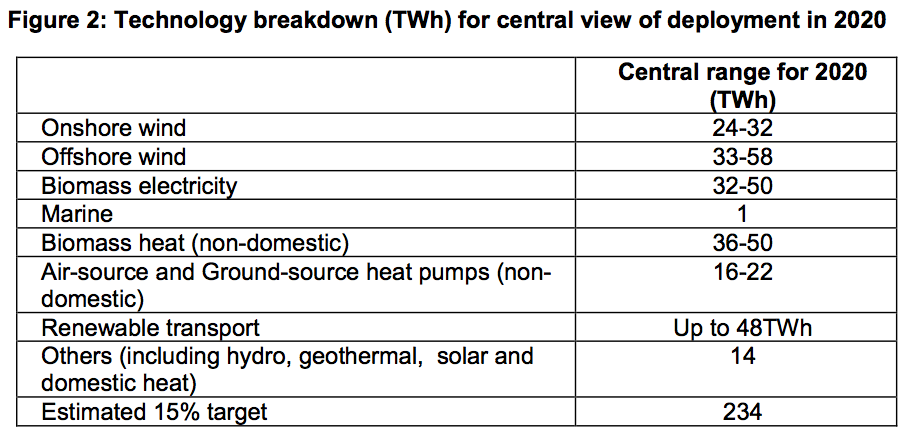
According to engineering and management firm Parsons Brinckerhoff and consultancy firm  Mott MacDonald Group, as presented by Landsvirkjun, Iceland’s electricity prices are much lower than can possible be offered by new electricity generation projects in the United Kingdom (UK). This is especially interesting when having in mind UK’s energy policy, with the goal of increasing its renewable energy consumption from the present 54 TWh to 234 TWh no later than 2020.

This goal, which is based on European Union’s (EU) and UK’s energy policy, will only be achieved with major investments in new green energy projects. Those projects will for example include very expensive and controversial onshore and offshore wind farms in the UK. For example, the minimum cost for offshore wind electricity in the UK is equivalent to 233 USD/MWh.

When comparing this to Icelandic renewable energy cost, it is quite obvious that an electric cable between Iceland and UK is an exciting option (Icelandic Landsvirkjun is currently offering long-term electricity contracts at 43 USD/MWh). Thus, it is not surprising that Mr. Hörður Arnarson, CEO of Landsvirkjun, has described the laying of a submarine cable to Europe, together with vigorous industrial development in Iceland, as probably being “one of the biggest business opportunities Iceland has faced”.

The two charts above are from a presentation by Landsvirkjun, given at an energy seminar in Reykjavik in last May (2012).

Understanding geothermal

Iceland produces substantial share of its electricity by harnessing geothermal resources. Geothermal plants now account for approximately one-quarter of all electricity generated and consumed in Iceland.

Several European countries are also looking towards geothermal heat as a source for electricity production. This for example applies both to Germany and Britain. However, these countries do not share Iceland’s  geophysical conditions and low-cost geothermal electricity is not an option unless you have access to very high temperatures, .

In Iceland, geothermal electricity generation is only considered feasible in areas where geothermal heat is at least 200°C  at a depth that is less than 1,000 m. This applies to many areas within the orange zone on the map above. Outside of this zone the heat is lower and more similar to what can be found in several areas in Europe.

Countries like Germany and Britain are building geothermal power plants in low-heat areas that would not be consider competitive in Iceland. However, it is understandable that European countries want to harness even their low geothermal heat for electricity generation. Wind energy is also an expensive option and so is solar energy (whether PV or CSP). There simply are very limited low-cost options available in European renewable generation.

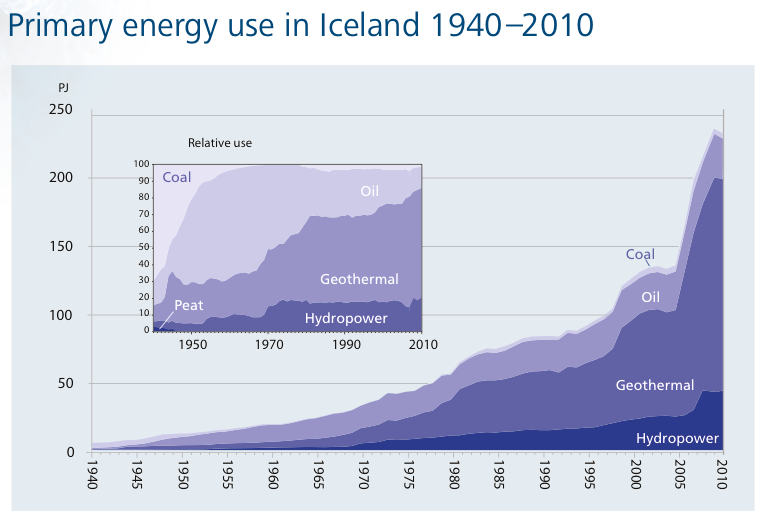
Interestingly, it may be an excellent option for European countries to harness their low geothermal heat for central heating rather than generating electricity. This is an area of expertise where Iceland has great strength. Iceland has a long tradition harnessing low geothermal heat for central district heating, which explains why geothermal is such a large share of the primary energy use in Iceland (as can be seen on the chart above).

Recently, Icelandic engineering firm Mannvit exported this know-how to Hungary. There, the company provided engineering, procurement, and construction management of a geothermal district heating plant in the town of Szentlőrinc in the southwestern part of the Hungary.

The plant provides heating and hot water for some 900  homes in Szentlőrinc, and has excess capacity for further expansion. This new geothermal plant replaces the town’s natural-gas powered district heating system with environmentally-friendly and sustainable geothermal energy.

This type of geothermal harnessing is an option that could be interesting for many communities in numerous countries in Europe. In addition to Hungary, this for example applies to Germany, France, Slovenia and several other countries.

In a nutshell, geothermal is a resource Europeans should consider very seriously for district heating. This especially applies to local communities, taking an initiative not only towards more renewable energy but at the same time greatly  improving peoples living conditions. Instead of focusing too much on wind and solar and renewable electricity generation, governments need to understand and realize the multiple potentials of geothermal.

The United Kingdom and Icelandic electricity

The British Minister for Energy and Climate Change, Mr. Charles Hendry, was recently in Reykjavik discussing energy issues with Icelandic authorities and people in the industry. Mr. Hendry also gave a speech at an energy-seminar at the headquarters of the Icelandic Arion bank.

One of the main issues discussed were the possibility of connecting Iceland and the United Kingdom (UK) with an electric cable. The cable would transfer green electricity from Iceland’s natural renwable sources to the UK. Such a cable would also offer Iceland access to competitively priced electricity genereted in the UK during night (when demand in the UK is low). Thus, this could be a win-win project.

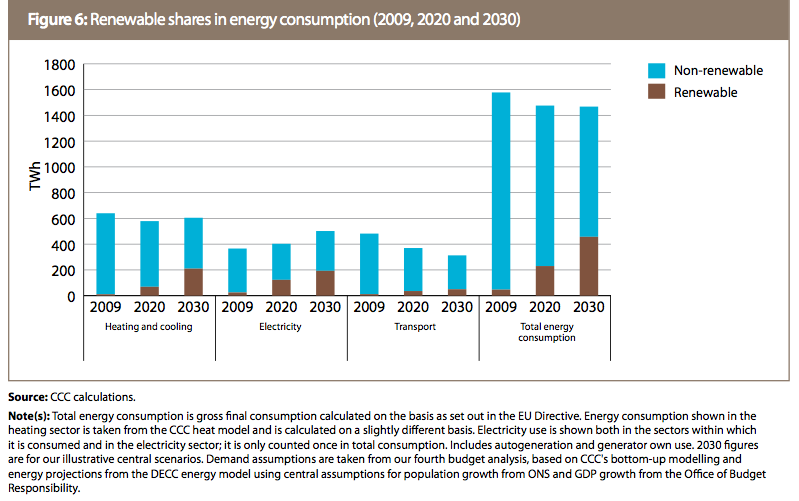
It is no surprise that the British Government is looking for acess to new sorces of green electricity. The share of renewable energy in the UK is very low. The total annual production of renewable energy in the UK is 54 TWh, which only accounts to approximately 3.5% of the country’s energy consumption.

The UK is determined to increase the share of renewable energy substantially. This is not only a governmental position but also a binding obligation according to the common energy policy of the European Union. Thus, the UK Department of Energy and Climate Change now has published the goal of having 15% of the UK’s energy consumption delivered from renewable sources by 2020.

Let’s look at what this means in numbers. The cost is very uncertain but definitely very high. It is of course hard to foresee exactly how much energy the UK will consume by 2020. According to the Department of Energy and Climate Change it is expected that the UK’s total annual energy consumption in 2020 will be 1,557 TWh. And 15% of 1,557 TWh is 234 TWh.

This means that the UK has to increase its renewable energy consumption from the present 54 TWh to 234 TWh no later than 2020. This is an increase of 180 TWh! 180 TWh of new green energy that needs to beavailable within less than a decade from now. In comparison the whole nuclear industry in the UK produced 69 TWh last year (2011.)

To achieve this goal of adding 180 TWh of renewable energy by 2020, green energy consumption in the UK will need to increase by 22.5 TWh each year over a period of 8 years. Obviously this renewable energy target calls for major investment in all kinds of green energy projects, including for example biomass, geothermal, hydro, solar and wind. Large portion of the new green energy will come from new renewable electricity generation (renewable heat and renewable fuels will have to increase substantially). Renewable electricity will need to maintain a growth rate of approximately 15% per annum from the 2010 baseline.

In addition to more renewable generation at home the UK is also focusing on major imports of electricity from renewable sources in neighbouring countries – like Norway and Iceland. This is why the British Minister for Energy and Climate Change is very positive towards an electric cable between UK and Iceland.

In fact Iceland has been considering such a connection between Iceland and Europe for years and even decades. However, it is probably not until now that such a high voltage direct current cable (HVDC) is becoming both tecnically possible and financially feasable.

And keep in mind that the British Government is already considering even more ambitious renewable energy targets for 2030 and beyond. Recent independent advice from the British Committee on Climate Change (CCC) has concluded that there is scope for the penetration of renewable energy to reach 30-45% of all energy consumed in the UK by 2030!

At the same time Iceland is in the somewhat unique position to have access to several excellent unharnessed renewable energy opportunities. In the coming weeks we will be presenting more information about the possible Iceland-UK interconnector  and explain Iceland’s potentials for generating more renewable electricity and gaining from Europe’s high electricity prices.

More information about UK’s energy policy and future scenarios:
–  UK Renewable Energy Roadmap
–  UK’s Renewable Energy Review
The charts above are from these two reports.

Hydro and geothermal country

Electricity production in Iceland is 100% from renewable sources (hydro and geothermal).

And more than 85% of total primary energy supply in Iceland is derived from domestically produced renewable energy sources. Of that total, 20% comes from hydropower- and 65% from geothermal sources. This is the world’s highest share of renewable energy in any national total energy budget.

Hydropower is the main source of the electricity production in Iceland, accounting for approximately three-quarters of all electricity generated and consumed in the country. The total annual production now is around 17,000 GWh, where almost 12,600 GWh is generated by hydropower stations.

The remaining quarter is generated in geothermal power stations. Actually, geothermal heat is the main energy source in Iceland. This great natural resource accounts for about 90% of space heating, thanks to the country’s geophysical conditions and extensive district heating system. As mentioned above, geothermal energy makes up around 65% of all primary energy use in Iceland.

Geothermal- and hydropower utilization in Iceland has increased fast in the last few years. However, so far only half of the best options have been utilized. Construction is under way for both new geothermal and hydropower projects. In addition, Iceland has interesting potentials for harnessing the wind as a power source.

Icelandic transportation is still mainly powered by fossil fuels. The government and private businesses are working towards changing this. Green solutions in the transport sector include electric cars powered by electricity from renewable sources and green fuels like bio-methane and methanol.

KEY FACTS ABOUT ICELAND’S HYDROPOWER UTILIZATION: *

  • Total hydro generating capacity:  1,879 MW
  • Total annual hydroelectric production:  12,592 GWh
  • Share of hydroelectricity in total generation:  73.81%
Numbers from 2010, published by the Icelandic National Energy Authority in December 2011.


KEY FACTS ABOUT ICELAND’S GEOTHERMAL POWER:

  • Total geothermal generating capacity:  575 MW *
  • Total annual geothermal electricity production:  4,466 GWh *
  • Share of geothermal in all electricity production:  26,18% *
  • Geothermal heat production (electricity production not included): 22,020 GWh **

 *  Numbers from 2010, published by the Icelandic National Energy Authority in December 2011.
** Numbers from 2006, published by the Icelandic National Energy Authority in December 2007. 

The charts above are from the website of Iceland’s National Energy Authority.

World’s largest electricity producer per capita

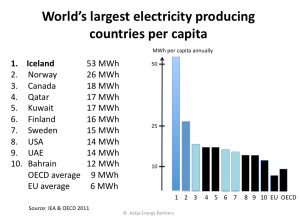
Iceland is the world’s largest electricity producer per capita. Norway comes in second place, by generating approximately half the electricity per capita of that of Iceland.

Other countries on the top-ten list of the world’s largest electricity producers per capita are Canada, Qatar, Kuwait, Finland, Sweden, United States of America (USA), United Arab Emirates (UAE) and Bahrain.

Most of the countries on the top-ten list of the world’s highest electricity producing countries per capita generate most or all their electricity from fossil fuels, especially gas and coal. However, both Iceland and Norway produce close to 100% of their electricity from renewable sources (both countries draw from hydroelectric power, but Iceland has a unique energy source in its geothermal power). Thus, Iceland and Norway are not only the largest producers of electricity (per capita) in the world, but also by far the world’s largest green electricity producers (per capita).

Canada, Finland and Sweden all have extensive hydropower sources and utilize them for electricity generation. Thus, they might be described as semi renewable electric producers (thus marked with light blue color on the graph, whereas Iceland and Norway are marked with dark blue). It is also noteworthy that Canada generates approximately