Skip to content

Posts from the ‘Hydro Power’ Category

New low-cost renewable capacity

The main sources of Iceland’s primary energy are hydropower and geothermal power.
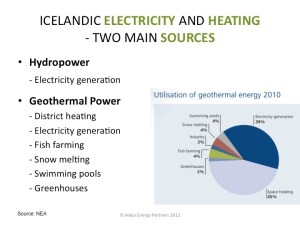
Iceland-Electricity-and-Heating-Sources-Hydro-Geothermal86% OF THE TOTAL ENERGY IS GREEN

Presently, the Icelandic hydro- and geothermal resources supply close to 100% of Iceland’s consumption of electricity and approximately 86% of Iceland’s total consumption of primary energy (of that total, 20% comes from hydropower- and 66% from geothermal sources). This is the world’s highest share of renewable energy in any national total energy budget.

Hydropower is the main source of the country’s electricity production, accounting for approximately three-quarters of all electricity generated and consumed. The remaining quarter is generated in geothermal power stations.

GEOTHERMAL DIVERSITY

Although hydropower is the main source for Iceland’s electricity production, geothermal heat is the main energy source in Iceland. As mentioned above, geothermal energy makes up around 66% of all primary energy use in the country.

The principal use of geothermal energy is space heating. Close to 90% of all energy used for house heating comes from geothermal resources, thanks to the country’s geophysical conditions and extensive district heating system. Geothermal energy also plays an important role in fulfilling an increasing electricity demand. Other sectors utilizing geothermal energy directly include swimming pools, snow and ice management, greenhouses, fish farming, and industrial uses.

STRONG GROWTH AHEAD

It is expected that demand for Icelandic renewable electricity will grow quite fast over the next few years. Iceland’s main power company, Landsvirkjun, has introduced plans for increasing its electricity production up to 75% within a decade.
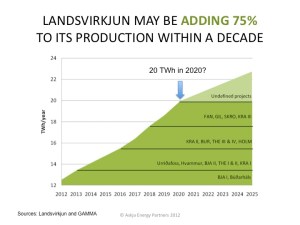
Iceland-New-Green-Energy-Capacity

The fact that Iceland still has numerous very competitive unharnessed hydro- and geothermal options, makes the country an interesting location for all kinds of energy intensive industries and services. This may for example apply to data centers, aluminum foils production, several silicon production facilities etc.

The abundant natural hydro- and high temperature geothermal resources make the Icelandic power industry able to offer electricity at substantially lower prices than for example can be found in any other European country. Even the present low spot-price for electricity in the USA (due to extremely low price of natural gas) are no threat to the Icelandic electricity industry.

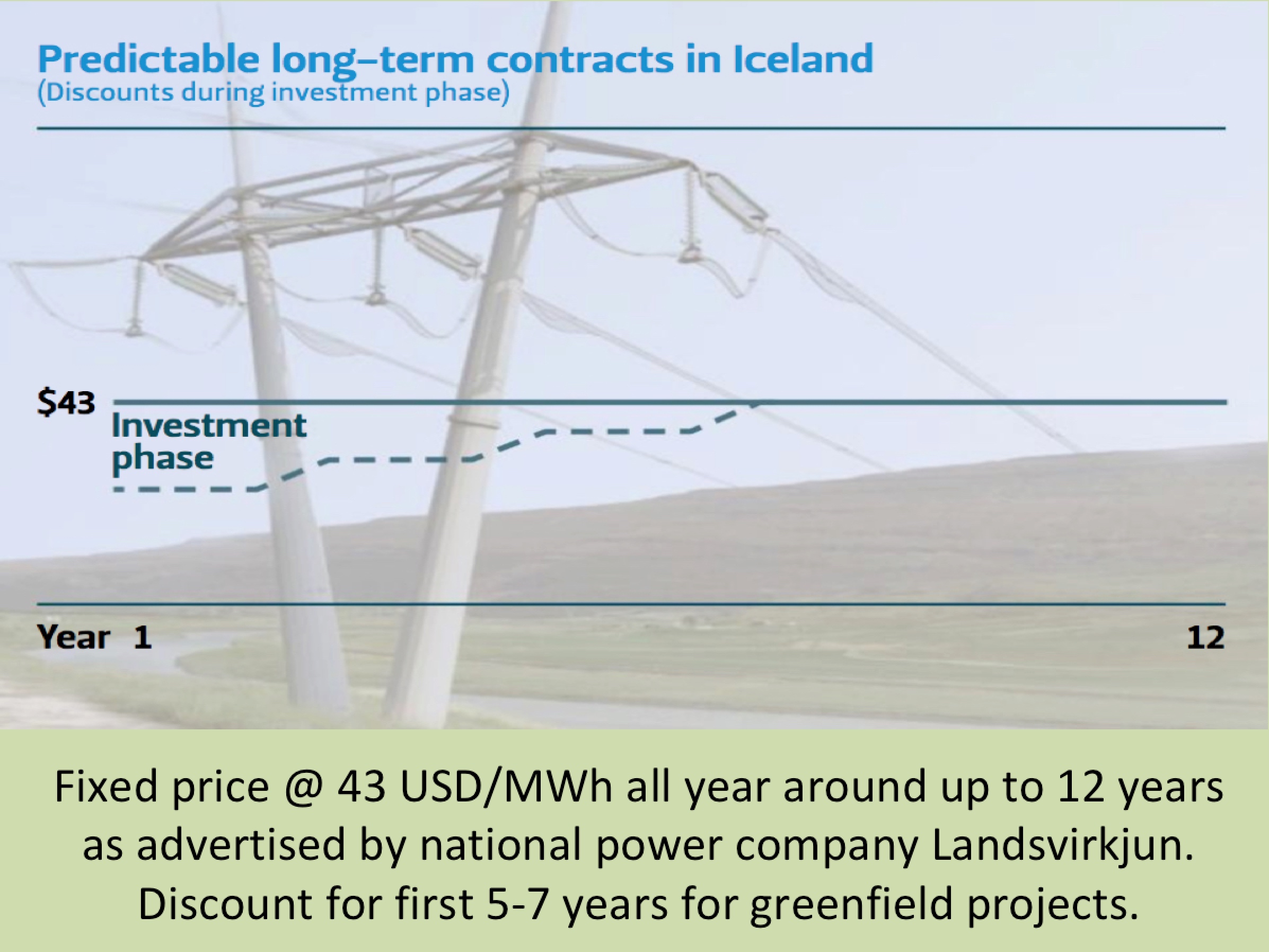
Companies that need substantial quantity of electricity and wish to operate within the OECD / Europe, will hardly find better long-term agreements than offered at the Icelandic market (43 USD/MWh in 12 year contracts are being offered by Landsvirkjun).

In addition to attractive electricity contracts, Iceland is a member of the European Economic Area and has a modern business environment based on European standards. For those considering energy-related investments in Iceland, a positive first step is contacting Icelandic professionals on the relevant subjects. At Askja Energy Partners we provide information and access to the most experienced and knowledgeable engineering, legal, tax, and accounting services.

McKinsey on Icelandic energy issues

The management and consulting firm McKinsey & Company recently published an independent report on the current state of the Icelandic economy and its future priorities. The title of the report is “Charting a Growth Path for Iceland”.

According to the report, the Icelandic power industry has provided the foundation for a strong export-based heavy industry sector. However, McKinsey also points out that capital productivity in the Icelandic energy sector is the lowest across all sectors of the Icelandic economy:

“With 25-30% of the capital stock directly or indirectly invested in the energy sector, this is a serious matter for resolution. We identify several important themes to this end, e.g. diversification of the industrial buyer market and systematic enablement of the most profitable expansion projects based on their ability to pay. Additionally, the opportunity to connect the Icelandic electricity market to Europe via a physical interconnector is an attractive option that should be explored in detail.”

McKinsey then goes on making some suggestions on how to increase value capture from the energy sector. According to the report, the keyword for higher capital productivity is increased integration with other markets. Since the Icelandic power system is an island-system there is, according to McKinsey, a “significant slack in the system to ensure that sufficient margins are in place to meet domestic demand.”

McKinsey argues that the isolated market is “reflected in the design of hydro plants where investments have been optimized accordingly, i.e. with relatively small reservoirs allowing surplus water to bypass generation as there are no alternative markets available.”  Hence, nearly 15 per cent of the energy available for electricity production is wasted each year (on average).

McKinsey emphasizes that these factors will have to be taken into consideration during the next growth phase to maximize the value captured. In this regard, McKinsey seems ecpecially positive towards constructing an interconnector between Iceland and Europe:

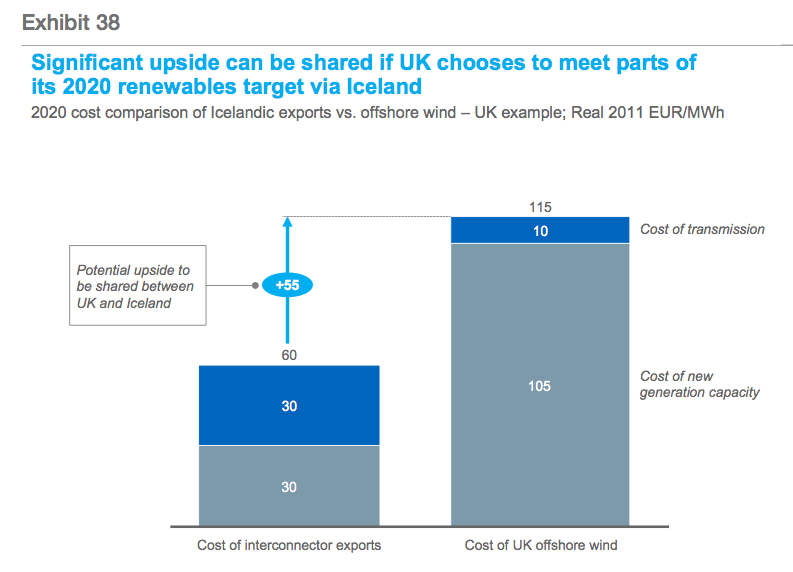
“The economic rationale for an interconnector is based on the opportunity of supplying the receiving market with green energy and thus contributing to decarbonization more efficiently than through other means e.g. offshore wind power. Iceland could share the benefit of such cost savings with the partner. Taking into account generation costs in Iceland, the cost of the interconnector itself and the anticipated cost of offshore wind power in 2020, cost savings of around EUR 60/Mwh could be shared.”

What makes the business model of an interconnector especially interesting, is the fact that so far Iceland has only harnessed  20-25 percent of its theoretically available hydro and geothermal energy. With environmental considerations and the economic feasibility of the investments taken into account, new projects could probably almost double current production (from 17 TWh to approximately 34 TWh annually). This is a substantially less costly renewable energy option than for example wind power in the United Kingdom.

The report concludes with strong future prospects. McKinsey is of the opinion that “Iceland is in the privileged position of having multiple growth levers that can greatly improve average production in the economy. The country therefore has good reason to be optimistic, provided policymakers utilize the opportunities available.” To access the report follow this link.

The Icelandic energy sector is back on track

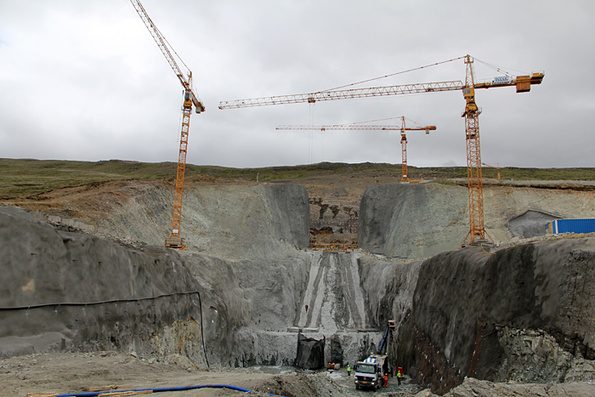
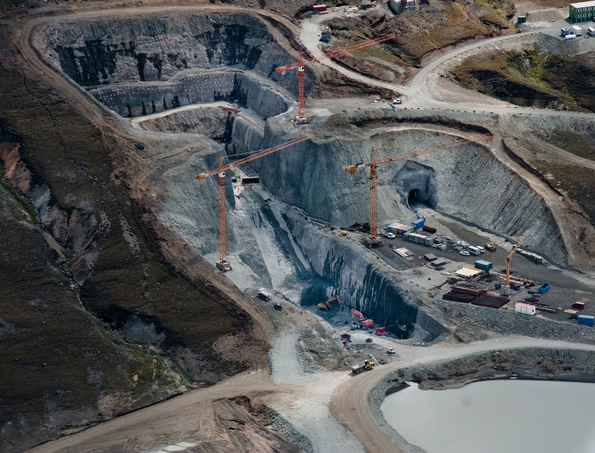
Construction of the new Búðarháls Hydropower Station in the southern highlands of Iceland is proceeding as scheduled.

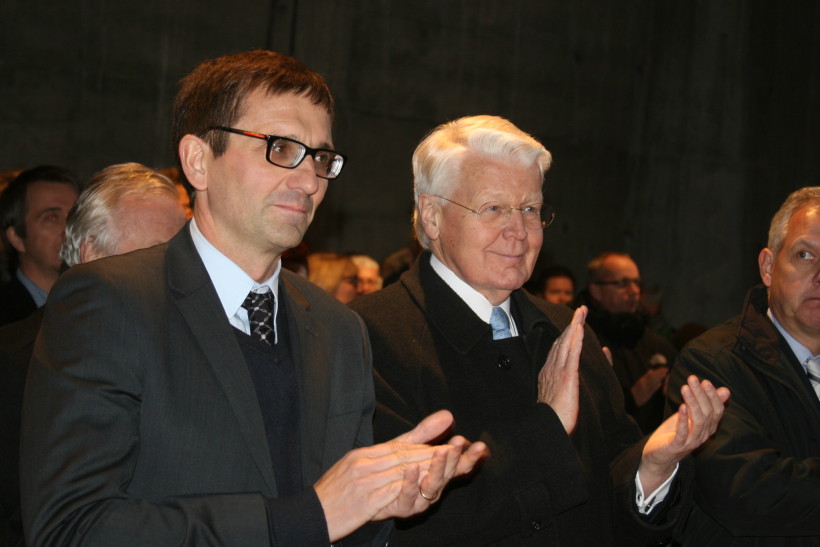
Last week the President of Iceland, Mr. Ólafur Ragnar Grímsson, laid the cornerstone to the station’s powerhouse. The construction of this new power plant commenced in late 2010. The station will have two 47.5 MW turbines, with a total power of 95 MW. It will start operation by end of 2013 and by 2014 the station will produce 585 GWh of electricity annually.

The project is part of Landsvirkjun’s expansion following an agreement to provide an aluminum smelter of Rio Tinto Alcan (RTA) with more power. RTA has more than 40 years operating history in Iceland and is currently expanding its aluminum plant at Straumsvík in Southwestern Iceland. This increases RTA’s electricity demand in Iceland by 658 GWh annually.

When the financial crises hit Iceland in late 2008, a period of economical difficulties followed and foreign investment became minimal. Iceland’s credit rating was downgraded and as the power company Landsvirkjun is state owned this downgrading was negative for the company.

However, the Icelandic economy soon started to show positive signs. In early 2011 Landsvirkjun secured full funding for the Búðarháls Project. This includes two loans from the Nordic Investment Bank (NIB) and the European Investment Bank (EIB), respectively. Each of the loans is 70 million USD. In addition, Landsvirkjun successfully issued bonds for 100 million USD through an Icelandic bank. It certainly seems that Landsvirkjun is back on the track.

Iceland’s hydropower source

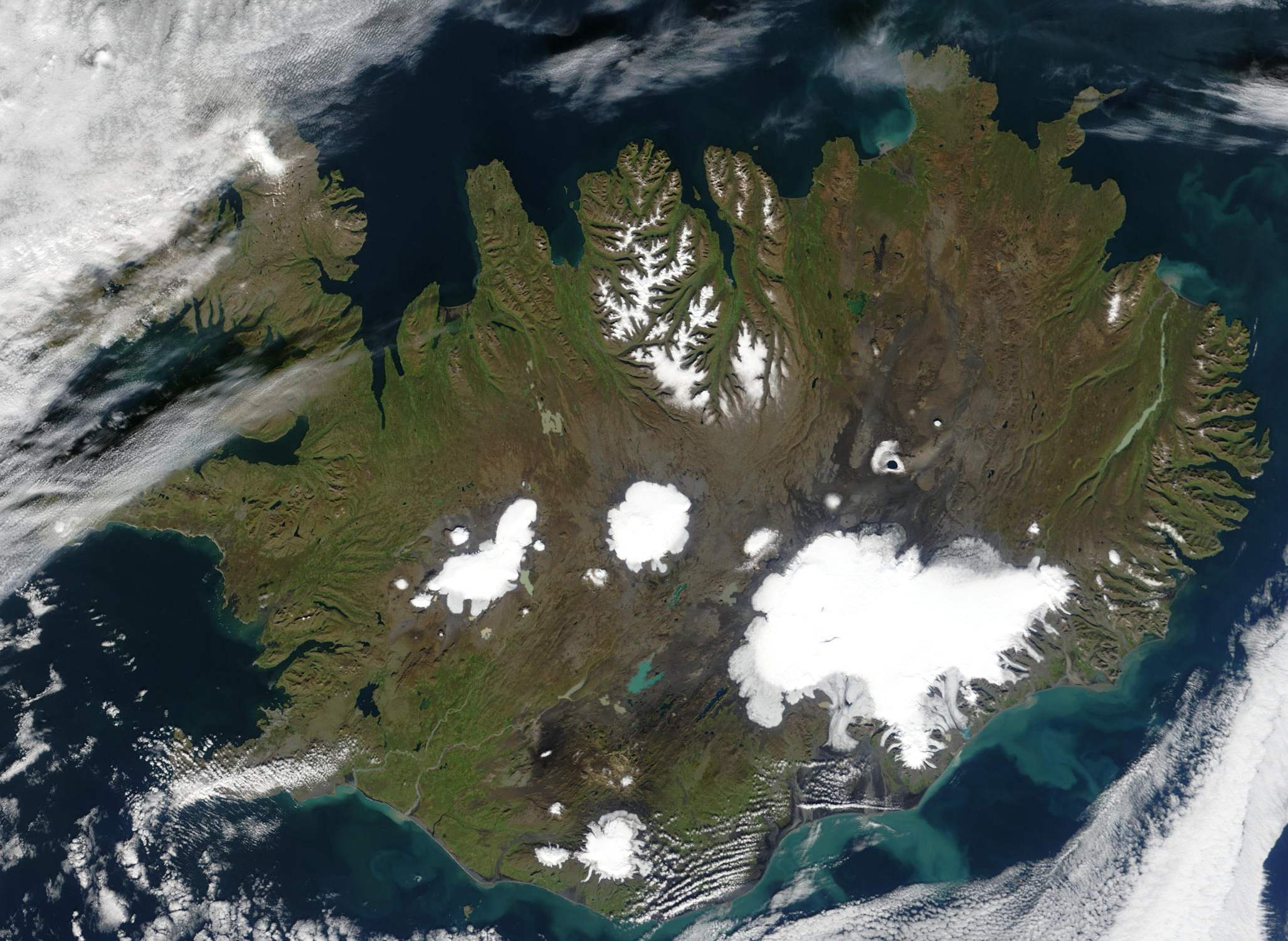
Almost 75% of all electricty consumed in Iceland is generated by hydropower plants. The main source of Iceland’s hydropower are the glacial rivers flowing from Iceland’s glaciers.  The largest glaciers are Langjökull and Hofsjökull in the interior, and the massive Vatnajökull in the southeast (note that “jökull” in Icelandic means glacier).

These three glaciers can clearly be seen on the satellite photo of Iceland at left. Also, the smaller Mýrdalsjökull and the infamous Eyjafjallajökull in south Iceland can be seen.

The glaciers in Iceland cover more than 1/10 of the total area of the country. Some parts of the glaciers are houndreds of meters thick. Maximum thickness of the ice is cose to one thousand meters (in Vatnajökull, which is the largest glacier in Iceland).

Vatnajökull is close to 8,100 sqkm (in comparison, Iceland is 103,000 sqkm). Vatnajökull is the world’s largest glacier apart from Greenland’s ice-sheet and of course Antartica. The glacier itself is now part of Vatnajökull Natonal Park.

Iceland’s electricity generation is very stable, thanks to number of large reservoirs with glacial melt water. The largest reservoirs are between 50-90 sq. km and they can often clearly be seen on satellite photos. The largest reservoirs (in areal size) are Þórisvatn (88 sq. km when full), Blöndulón (57 sq. km), Hálslón (57 sq. km) and Hágöngulón (37 sq. km). Þórisvatn is the light-blue lake in southern Iceland that can be seen on the satellite photo above.

In winter, some of the reservoirs are covered with ice and snow, as can be seen on the photo at left. the photo shows Hálslón reservoir in the middle of winter. In fact the ice never becomes very thick, but it can snow heavily.

Some of the large hydropower stations, dams and reservoirs are quite accessible for travelers. A popular route towards the Icelandic highlands goes past Þórislón and several hydropower plants close by in Þjórsá and Tungnaá rivers. Also, there is a road up to Hálslón and the large Kárhnjúkar dam in the highlands in northeast Iceland.

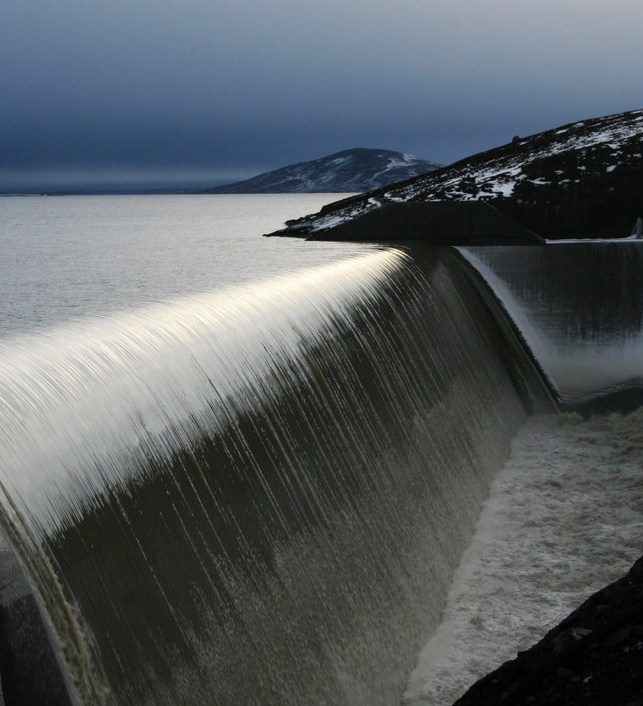
When the Hálslón reservoir becomes full (it normally happens in the period from late July to early September) the water starts to flow over the spillway. From there it falls almost 100 m down to the canyon below, forming a spectacular waterfall called Hverfandi (Vanisher). This year (2012) Hálslón became full on 7th of August.

Icelandic energy expertise in Georgia

The Icelandic energy industry has decades of experience in the hydropower and geothermal power sectors.

Most of the projects have of course been in Iceland. But in recent years Icelandic companies have increasingly been involved in hydropower and geothermal projects overseas. The most recent example of such a project is a consultancy agreement between the Icelandic firm Landsvirkjun Power and a Georgian hydropower company, which is developing new hydropower stations in Georgia.

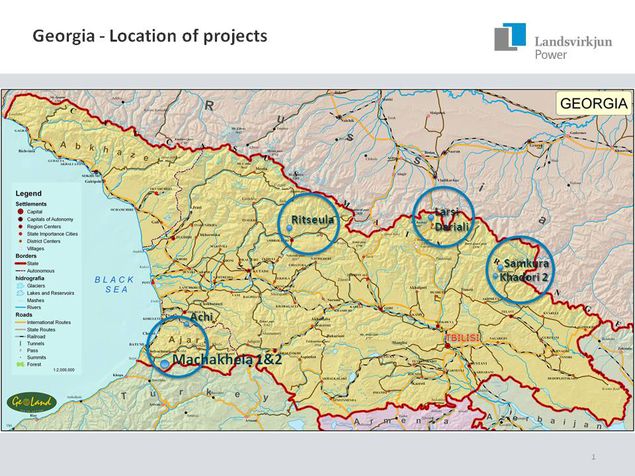
This agreement involves two hydroelectric plants with a capacity of 20-25 MW. They will be constructed on the river Machakhelistskali in the Adjara region,in southwestern Georgia, near the Turkish border. Landsvirkjun Power was the successful bidder for consultancy services and the contract was signed earlier this summer. The map (at left) shows the location of the project and other projects that Landsvirkjun Power has worked on in Georgia in the last few years.

With Icelandic engineers, Landsvirkjun Power will conduct site investigations at the Machakhelistskali and prepare a feasibility study, followed by initial project design, preparation of tender documents for construction work and detail design of civil works and review of design of equipment. The work is to be completed by end of 2015.

Landsvirkjun Power is the engineering, construction and foreign investment arm of Landsvirkjun; the Icelandic National Power Company. The purpose of Landsvirkjun Power is primarily consultancy in development of power schemes, and secondly, investment in such schemes outside of Iceland. The firm has also carried out activities in the hydro- and geothermal power sector e.g. in Albania, Canada, Greenland, and Turkey.

Energy producers in Iceland

There are several energy companies in Iceland, producing electricity and heating. In total, they generate about 17 TWh of electricity annually and close to 22 TWh of geothermal heat. Almost all this energy comes from renewable sources (hydropower and geothermal power). In total, close to 85% of Iceland’s consumption of primary energy is renewable energy. This is the world’s highest share of renewable energy in any national energy budget.

The largest energy generating firms in Iceland are Landsvirkjun, Orkuveita Reykjavíkur (Reykjavik Energy), and HS Orka. State owned Landsvirkjun is by far the largest, providing approximately 76% of all the electricity produced in Iceland. More than 96% of all hydro generation in Iceland is produced by Landsvirkjun, and its share in the generation of electricity from geothermal power is around 11% of the total.

Landsvirkjun owns eleven hydropower stations and two geothermal power stations with a combined capacity of 1,895 MW.  Lansdvirkjun is also the main owner of the Icelandic Transmission System Operator (TSO), with a share of 65%.

Landsvirkjun receives much of its revenue in foreign currency (USD) as a result of extensive electricity sales to large foreign-owned aluminum smelters in Iceland (80% of the electricity Landsvirkjun generates is sold to energy intensive industries via long term contracts). The economic turbulence Iceland experienced recently did not affect Landsvirkjun nearly as much as most other Icelandic firms (the devaluation of the Icelandic currency did not have negative effects on Landsvirkjun’s income).

Landsvirkjun is one of Iceland’s largest companies and currently it has more equity than any other Icelandic firm . Of all the Icelandic power companies, Landsvirkjun is by far the strongest player and currently the only large Icelandic power company expanding its operations.

Orkuveita Reykjavíkur (OR, but also called Reykjavik Energy) is Iceland’s second largest energy firm. This public utility company provides both electricity and hot water for heating. It is by far the largest local provider of electricity and heating to end-users. The main service area of the company is the larger Reykjavik Metropolitan Area. OR’s largest single customer is Norduaral Aluminum Smelter, that is located not far from Reykjavik. In recent years OR has been struggling with heavy debt, which has led to rising costs for its general customers.

OR’s power-generation plants have a total capacity of 435 MW. Most of the electricity from OR is generated at two geothermal plants that utilize high-pressure steam. Besides producing and distributing electricity, OR sells and distributes both hot and cold water. The water from OR for space heating comes from low-temperature fields in and close to the city and from the combined heat and power plants at the Nesjavellir and Hellisheiði Stations. Cold water is collected from groundwater reservoirs outside of Reykjavík. Also OR operates an extensive sewage system for the Reykjavik area, as well as some adjacent municipalities.

HS Orka is the third main energy firm in Iceland. Until 2007 it was a public company owned by the Icelandic state and municipalities in Southwest Iceland. It was later privatized and today its largest shareholder now is the Canadian Alterra Power. The rest is owned by a group of Icelandic pension funds. HS Orka operates two geothermal power stations with a total capacity of 175 MW. HS Orka owns a few subsidiaries, including ¼ of the well known Blue Lagoon.

Búðarháls power station

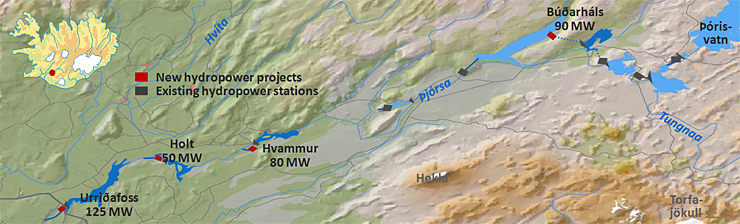
The glacial river system of Þjórsá and Tungnaá rivers in South Iceland is a major source for Icelandic hydropower.

Current capacity of the five power stations in those two rivers is 840 MW, with an annual generation of more than 5,000 GWh. The sixth power station in Þjórsá-Tungnaá, Búðarháls Station, will start operating in late 2013. It will have an installed power capacity of 95 MW and every year it will be generating 585 GWh. Then, the total annual generation in Þjorsá-Tungnaá will be close to 5,600 GWh.

All these six hydropower stations are owned and operated by Iceland’s largest power company; Landsvirkjun. In addition, Landsvirkjun is considering to construct three more power stations in Þjórsá river. Those three stations would have a combined capacity of 265 MW, adding more than 2,000 GWh of power generation per annum.

The Búðarháls Power Station received a positive assessment of environmental impact already in 2001 and construction commenced in November 2010. The electricity from the Búðarháls Station has already been sold to the aluminum smelter of Rio Tinto Alcan in Straumsvík in Southwest Iceland. The smelter in Straumsvík has 40 years successful operating history and the electricity from Búðarháls Station will be used for substantial increase in its aluminum production.

The project at Búðarháls includes a new 6 km² intake reservoir, Sporðöldulón, created with a 2.1 km long dam just below the Hrauneyjarfoss Power Station. A 7 km long 220 kW transmission line will be erected from the new power station to the Hrauneyjafoss line to connect Búðarháls Station with the National Grid.

It is worth having in mind that besides the three additional power stations Landsvirkjun is preparing in Þjórsá, as mentioned above, the company is considering several other attractive hydro- and geothermal power projects. Currently, Landsvirkjun is offering new power contracts that probably are the best offer available in all Europe. The company is offering a fixed real rate of $43/MWh in 12 year contracts.

In addition to the very competitive price, all the electricity Landsvirkjun produces comes from harnessing renewable power sources. No less important is the fact that all the Icelandic power stations are known for their excellent reliability – and the same applies to the Icelandic transmission system. This has been confirmed in numerous international reports, where Iceland’s electricity supply is ranked among world’s most secure (see for example IMD’s and WEF’s World Competitiveness reports).

The Iceland-Europe interconnector

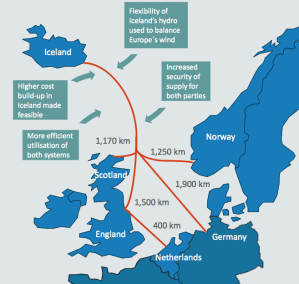
Iceland is currently a closed electricity market with no cable connections to other markets. This may soon change. Technology advancement, strong demand for more renewable energy, and high electricity prices in Europe are making a submarine high voltage direct current (HVDC) cable between Iceland and Europe more feasible than ever before.

Unharnessed renewable energy

Iceland can substantially increase its green electric power production at a reasonable cost. Iceland is the only country in Western Europe that still has several large unharnessed hydro power options. Also, Iceland’s geophysical conditions offer numerous possibilities for low cost utilization of geothermal power, and Iceland has stronger and more stable winds than most of Europe.

Some of this natural energy will be harnessed for varied domestic industries, such as new data centers, metallurgical-grade silicon production, etc. Iceland also has the possibility to do business with electric power through a submarine cable to Europe. Such a connection would not only be based on Icelandic hydro- and geothermal power, but would open up the possibility of large-scale harnessing of Icelandic wind power.

Choosing the best business model

So far the longest submarine HVDC-cable is the NorNed between Norway and the Netherlands (580 km / 369 miles). The interconnector between Iceland and Europe would be at least double that length, so it will definitely be a challenging project.

Such an  interconnector would not only enable sales of renewable electricity at high prices but also have various other benefits for the Icelandic electricity system, such as more efficient use of the generation capacity and enhance the security of supply. Currently, three scenarios are being studied. The first concerns an interconnector that would be used for export/import only, based on market prices.  The second involves a cable used for export only, and the third assumes an interconnector used in part for export/import and in part for export.

Green AND competitively priced

The main drivers behind an electric cable between Iceland and Europe are high electricity prices in Western Europe and the growing demand in Europe for more renewable energy.

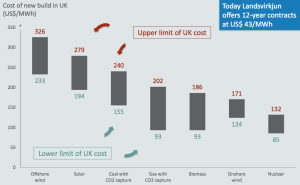
According to engineering and management firm Parsons Brinckerhoff and consultancy firm  Mott MacDonald Group, as presented by Landsvirkjun, Iceland’s electricity prices are much lower than can possible be offered by new electricity generation projects in the United Kingdom (UK). This is especially interesting when having in mind UK’s energy policy, with the goal of increasing its renewable energy consumption from the present 54 TWh to 234 TWh no later than 2020.

This goal, which is based on European Union’s (EU) and UK’s energy policy, will only be achieved with major investments in new green energy projects. Those projects will for example include very expensive and controversial onshore and offshore wind farms in the UK. For example, the minimum cost for offshore wind electricity in the UK is equivalent to 233 USD/MWh.

When comparing this to Icelandic renewable energy cost, it is quite obvious that an electric cable between Iceland and UK is an exciting option (Icelandic Landsvirkjun is currently offering long-term electricity contracts at 43 USD/MWh). Thus, it is not surprising that Mr. Hörður Arnarson, CEO of Landsvirkjun, has described the laying of a submarine cable to Europe, together with vigorous industrial development in Iceland, as probably being “one of the biggest business opportunities Iceland has faced”.

The two charts above are from a presentation by Landsvirkjun, given at an energy seminar in Reykjavik in last May (2012).

Hydro and geothermal country

Electricity production in Iceland is 100% from renewable sources (hydro and geothermal).

And more than 85% of total primary energy supply in Iceland is derived from domestically produced renewable energy sources. Of that total, 20% comes from hydropower- and 65% from geothermal sources. This is the world’s highest share of renewable energy in any national total energy budget.

Hydropower is the main source of the electricity production in Iceland, accounting for approximately three-quarters of all electricity generated and consumed in the country. The total annual production now is around 17,000 GWh, where almost 12,600 GWh is generated by hydropower stations.

The remaining quarter is generated in geothermal power stations. Actually, geothermal heat is the main energy source in Iceland. This great natural resource accounts for about 90% of space heating, thanks to the country’s geophysical conditions and extensive district heating system. As mentioned above, geothermal energy makes up around 65% of all primary energy use in Iceland.

Geothermal- and hydropower utilization in Iceland has increased fast in the last few years. However, so far only half of the best options have been utilized. Construction is under way for both new geothermal and hydropower projects. In addition, Iceland has interesting potentials for harnessing the wind as a power source.

Icelandic transportation is still mainly powered by fossil fuels. The government and private businesses are working towards changing this. Green solutions in the transport sector include electric cars powered by electricity from renewable sources and green fuels like bio-methane and methanol.

KEY FACTS ABOUT ICELAND’S HYDROPOWER UTILIZATION: *

  • Total hydro generating capacity:  1,879 MW
  • Total annual hydroelectric production:  12,592 GWh
  • Share of hydroelectricity in total generation:  73.81%
Numbers from 2010, published by the Icelandic National Energy Authority in December 2011.


KEY FACTS ABOUT ICELAND’S GEOTHERMAL POWER:

  • Total geothermal generating capacity:  575 MW *
  • Total annual geothermal electricity production:  4,466 GWh *
  • Share of geothermal in all electricity production:  26,18% *
  • Geothermal heat production (electricity production not included): 22,020 GWh **

 *  Numbers from 2010, published by the Icelandic National Energy Authority in December 2011.
** Numbers from 2006, published by the Icelandic National Energy Authority in December 2007. 

The charts above are from the website of Iceland’s National Energy Authority.

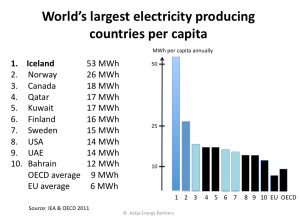
World’s largest electricity producer per capita

Iceland is the world’s largest electricity producer per capita. Norway comes in second place, by generating approximately half the electricity per capita of that of Iceland.

Other countries on the top-ten list of the world’s largest electricity producers per capita are Canada, Qatar, Kuwait, Finland, Sweden, United States of America (USA), United Arab Emirates (UAE) and Bahrain.

Most of the countries on the top-ten list of the world’s highest electricity producing countries per capita generate most or all their electricity from fossil fuels, especially gas and coal. However, both Iceland and Norway produce close to 100% of their electricity from renewable sources (both countries draw from hydroelectric power, but Iceland has a unique energy source in its geothermal power). Thus, Iceland and Norway are not only the largest producers of electricity (per capita) in the world, but also by far the world’s largest green electricity producers (per capita).

Canada, Finland and Sweden all have extensive hydropower sources and utilize them for electricity generation. Thus, they might be described as semi renewable electric producers (thus marked with light blue color on the graph, whereas Iceland and Norway are marked with dark blue). It is also noteworthy that Canada generates approximately