Skip to content

Posts from the ‘Wind Power’ Category

1 GW Iceland-UK electric subsea cable may be close

The governments of United Kingdom (UK) and Iceland may both be interested in a subsea electric connection between the countries.
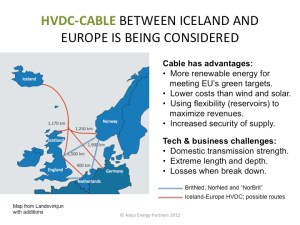
HVDC-Cable-Iceland-Europe-map-slide

The main purpose of the cable would be to bring electricity from Iceland’s renewable sources to the UK. The UK has ambitious plans to substantially increase renewable energy in UK’s energy mix. According to legally binding goals, set by the member states of the European Union (EU), the UK needs to dramatically increase production and imports of renewable energy. Iceland could become an important player in that green transformation.

Renewable electricity could be provided by Iceland to the UK even at a cheaper cost than offshore wind. In addition the Icelandic hydro- an geothermal power is a very reliable power source. The plans being discussed concern a 1,100-1,200 km subsea cable with a capacity of 1GW. The package might be worth an estimated GBP 4 billion, with the inclusion of related generation and onshore transmission investments and could be operational by within a decade.

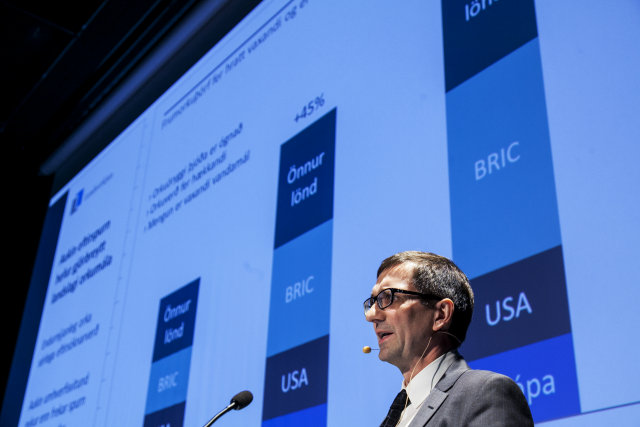
bjorgvin-sigurdsson-landsvirkjunMr. Bjorgvin Sigurdsson, executive vice president of Iceland’s main power company (Landsvirkjun), has expressed that the company is now looking at this much more seriously than ever before.  “The technology seems to be there to make it work… the issue is whether this makes sense economically.”

At present, Iceland benefits from some of the most competitive electricity prices in Europe. All the electricity in Iceland comes from renewable hydro- and geothermal sources, which offer the possibility of a very low cost generation. The director general of the National Energy Authority of Iceland (NEA), Mr. Guðni Jóhannesson, has said that the interconnector could provide power to the UK at around 60 to 70 percent of the price of offshore wind.
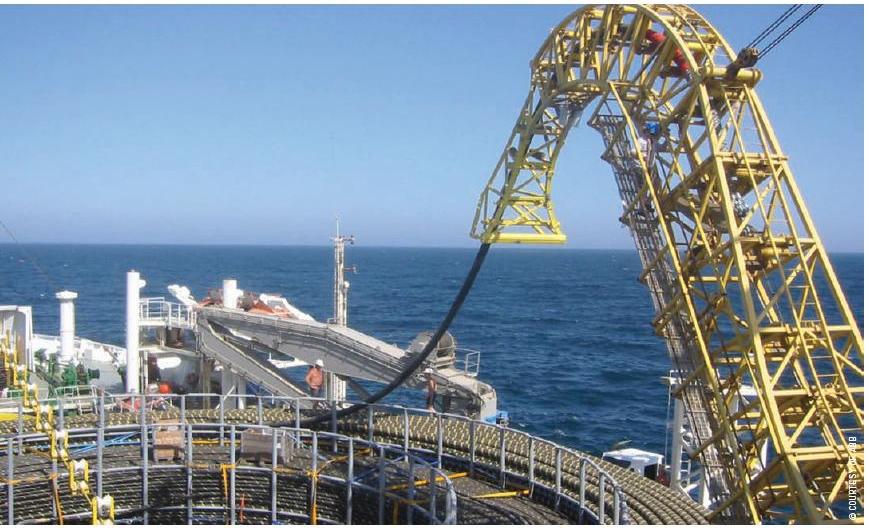
hvdc-cable-nornedAs Iceland still has numerous options of unharnessed hydro- and geothermal energy, an electrical cable might create a win-win situation for Iceland and the UK. The idea of exporting energy from Iceland to the UK is not a new one, as it was first mentioned decades ago. However, it is not until recently that technological advancement and rising electricity prices in Europe made the idea feasible.
Positive attitudes towards wind energy

According to a survey recently conducted by Capacent Gallup, the overwhelming majority of the Icelandic public is in favour of utilizing wind energy in Iceland.

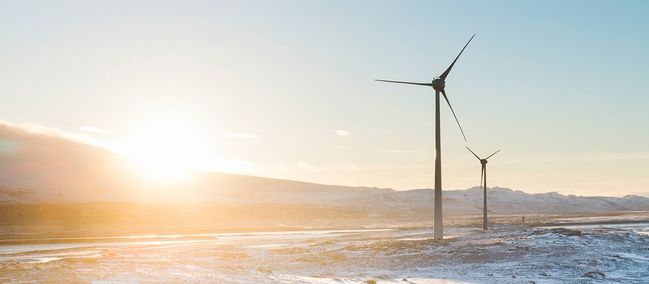
Wind-Power-IcelandUntil now almost 100 percent of all electricity in Iceland is been generated by hydro- and geothermal power plants. However, Iceland recently took the first steps towards harnessing its wind resources for electricity generation. The operation of two research wind turbines, which were constructed in December 2012 in South Iceland, has so far been successful and has highlighted the potential for energy generation, via wind energy, in Iceland.

Positive Attitudes in Iceland

According to a new survey conducted by Capacent Gallup, the overwhelming majority of the Icelandic public is in favour of raising a wind farm in Iceland (around 81% of respondents were positive). Support is overwhelming with over half of the respondents stating that they were either very supportive or completely supportive of the idea. Only 7% were against the idea.

Now the Icelandic national power company Landsvirkjun intends to continue its research and has hopes that wind energy could become the third pillar in Landsvirkjun’s operations. The next step includes the assessment of the Hafið area and neighbouring areas to ascertain the feasibility of a wind farm. The generation capacity of the area must also be assessed and differing proposals for wind farms put forward. Considerations would include social and environmental implications and the feasibility of such a development and its operation.

Wind Energy As the Third Pillar

Hydropower and geothermal power will continue to be the two main pillars of electricity generation in Iceland, offering very stable production. However, wind energy is an interesting third option for Landsvirkjun as it offers the possibility of utilising the flexibility of hydropower to balance the fluctuations that accompany wind power. 

Landsvirkjun-Wind-Power-Station-erected-1The possibility of raising a wind farm in Iceland has not been analysed before with any precision and requires pioneering work including an environmental impact report, an assessment of the need for organisational changes, an assessment of the value of a wind farm for the electricity system as a whole and the opportunities afforded by the interaction of hydro and wind power. The goal of the project is to ensure that Landsvirkjun is able to rely on detailed analyses and data with regard to decisions on the development of wind power as the third pillar in the electricity system

The project is twofold; consultancy services for the project design and consultancy services for an environmental impact assessment. The Icelandic engineering company Mannvit will provide consultancy services pertaining to the environmental impact assessment. Mannvit is working in cooperation with the Norwegian consultancy agency Ramböll Ltd. and Icelandic firm Landslag Ltd. The project design is under the auspices of another Icelandic engineering company (Efla) which is in cooperation with the Swedish consultancy agency Pöyry SwedPower Ltd. and the Belging institute for meteorology.  The project will be executed between 2013 and 2015.

Lower Costs are Creating International Trend

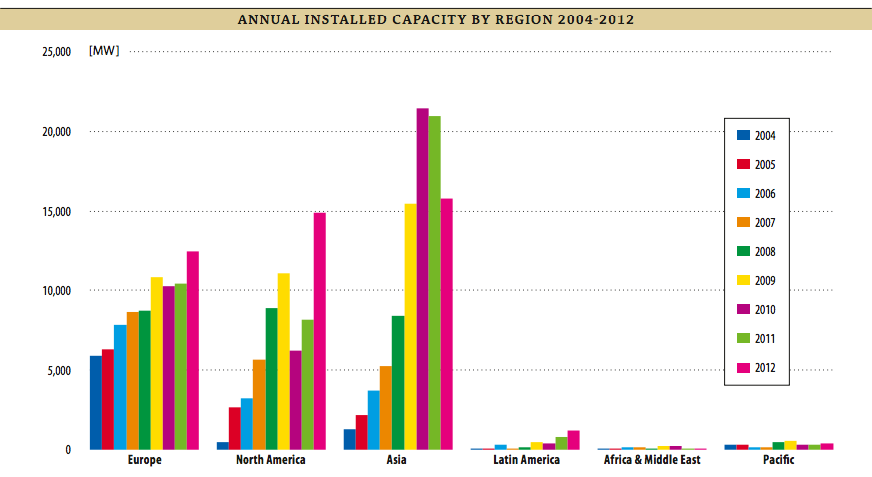
The evolution of wind energy has been rapid worldwide and extraordinary progress has been made within a relatively short period of time. At the end of 2012, over 3% of the world’s electricity supply was sourced from wind energy. At the same time, financing and operational costs have decreased significantly and this trend promises to continue. The World Wind Energy association (WWEA) predicted that the installed capacity of wind turbines would double worldwide before the end of 2016 and that installed wind capacity could reach one million MW, matching the installed capacity of hydropower today.

World-Wind-Installed-capacity-region_2004-2012

Conditions in Iceland are unusually favourable for the utilisation of wind energy. Wind research shows high levels of wind power at a relatively low height above sea level. This increases the feasibility of utilising wind energy as the masts could be lower than usual, which would in turn lower costs. Construction takes a short period of time and wind farms can be built in phases (according to need and market demand). The environmental impact of wind turbines is relatively low and completely reversible. The visual impact is a reality and the choice of location is therefore an important consideration. Wind velocity is at its highest during the winter period when there is a decrease in flow to the Landsvirkjun’s reservoirs; the possible synergy of wind and hydropower is therefore high. More information about the project can be seen on the website of Landsvirkjun.

Landsvirkjun promotes university research and education

The Icelandic power company LandsvirkjunReykjavík University (RU), and the University of Iceland have joined forces to support and encourage the development of expertise within the field of renewable energy. The cooperation will strive to create a source of shared value for Landsvirkjun, the universities and Icelandic society by supporting those disciplines where more education and research are vital.

Landsvirkjun-university-cooperation-2013In total, Landsvirkjun has pledged 80 million ISK to the universities over a five year period, to promote education and research in geochemistry, electric power engineering and other academic disciplines within the universities. The cooperation agreement with the University of Iceland has the main objective of promoting and supporting teaching and research in the disciplines of geochemistry, geology, mechanical and industrial engineering. An emphasis will be placed on developing expertise in the field of renewable energy sources. Landsvirkjun and Reykjavík University will also cooperate in promoting research and university education in the field of renewable energy.

Hordur-Arnarson-Landsvirkjun-CEO-presentingWhen signing the Agreement Mr. Hörður Arnarson, CEO of Landsvirkjun, stated that in building a dynamic cooperation between Landsvirkjun and the universities will create shared value for the economy and for society, by sharing expertise and supporting innovation and development in renewable energy sources. The University of Iceland has a long established history in building upon its expertise in these fields and the contract is an extension of decades of cooperation between the university and Landsvirkjun in the disciplines of engineering and the natural sciences. In recent years the Reykjavik University has also been actively developing dynamic courses and expertise in technical subjects, including the utilisation and distribution of renewable energy sources. The financial support from Landsvirkjun will substantially strengthen education, research and the development of projects related to renewable energy within the universities, and increase opportunities for expertise and creativity.

10 TWh of green energy available

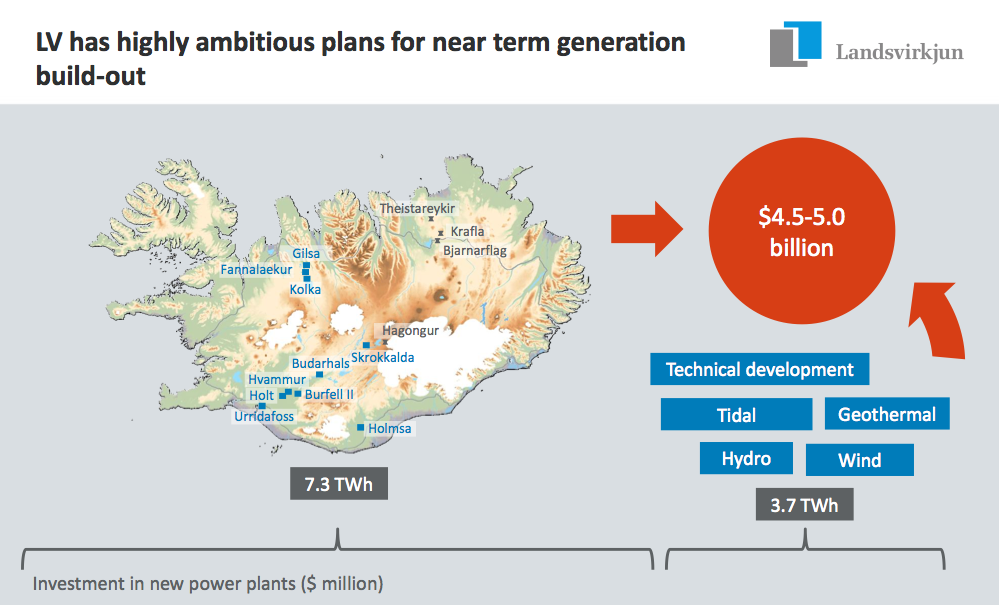
Iceland-Landsvirkjun-New-Renewable-Electricity-GenerationThe Icelandic power company Landsvirkjun has introduced plans for several new renewable energy projects.

If all these projects will be realized, they will add close to 7 TWh of annual generation from natural hydro- and geothermal sources. All the projects have been identified. As Landsvirkjun is owned by the Icelandic government, formal decisions about which of the projects will be realized first depends on the Icelandic parliament.

In addition, Landsvirkjun has put a figure on several other possible new power projects, that could be generating electricity within a decade or so. In total, Iceland may within near future be producing 9-10 TWh more electricity than today. This is not an exact figure; the new additional capacity could be somewhat less or even more. This will depend on the interest of new users of electricity, such as data centers, silicon industry etc. However, the most interesting option may be selling part of the new electricity production to markets in Europe.

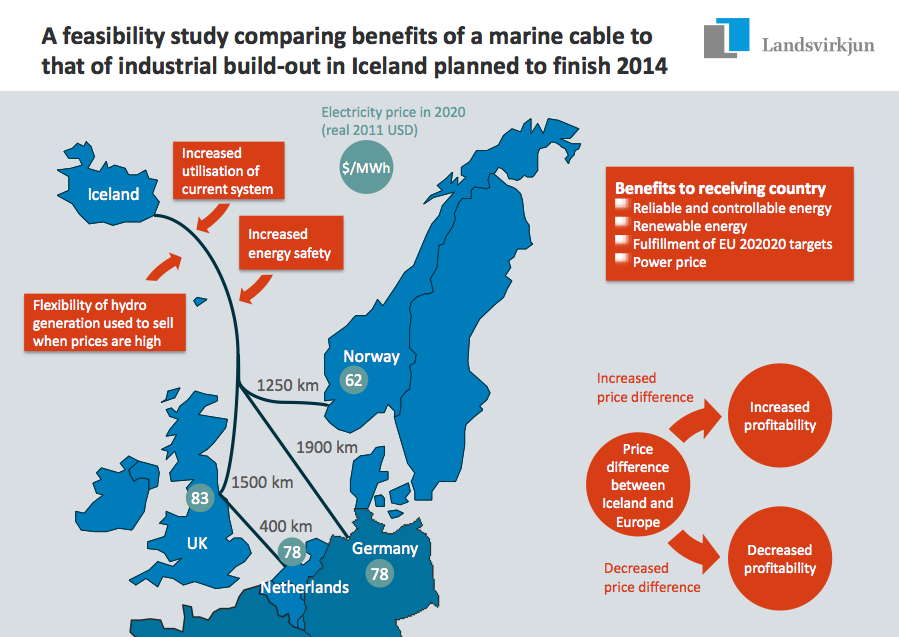
Iceland-Landsvirkjun-HVDC-Feasabilty-StudyA feasibility study on a possible electrical cable (high voltage direct current cable; HVDC) between Iceland and Europe is currently being carried out by a special working group. The group includes people from the Icelandic power sector and other stakeholders, appointed by the Icelandic Minister of Industries and Innovation. It is expected that the working group will deliver its report  during next year (2014).

The high electricity prices in Europe make a cable to Europe an especially interesting option for the Icelandic power generating firms. During the last few years, wholesale electricity prices in Western Europe have often been around three times higher than in Iceland. Thus, an electric cable between Iceland and Europe could increase the profits of Icelandic power companies  substantially.

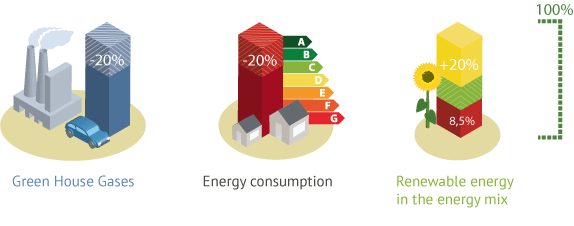
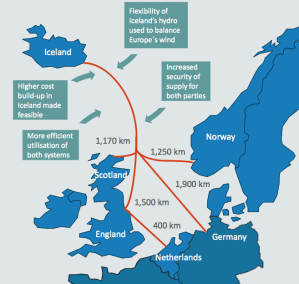
EU-energy-policy-20-20-20There would be numerous other positive gains from such a cable, as presented on the slide at left (the slide is from a presentation by Landsvirkjun). For example, the Icelandic power companies would be able to maximize the current capacity, resulting in more production. Europe would enjoy access to new green electricity generation, which would help the member states of the European Union (EU) in achieving climate- and energy goals (the EU aims at raising the share of EU energy consumption produced from renewable resources to 20% no later than 2020). The issues of such a connection between Iceland and Europe was described in more details in one of our earlier posts.

In the forthcoming months it will hopefully become clearer if Europe may gain access to the geothermal- and hydropower of Iceland.

Landsvirkjun becomes wind power operator

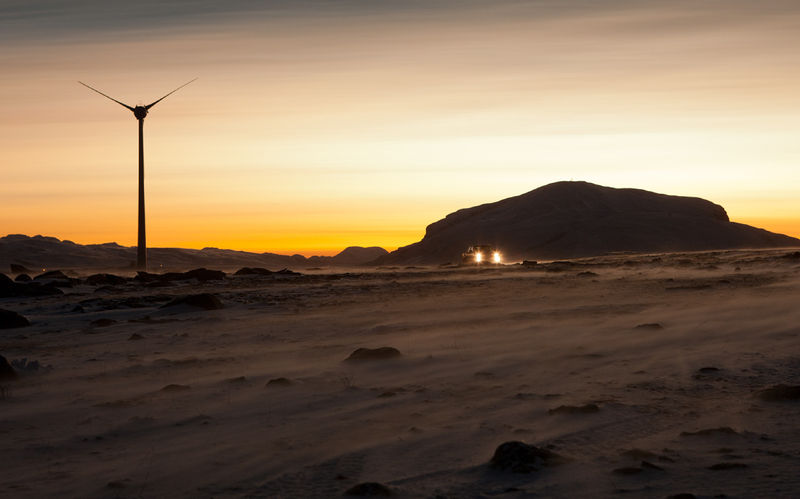
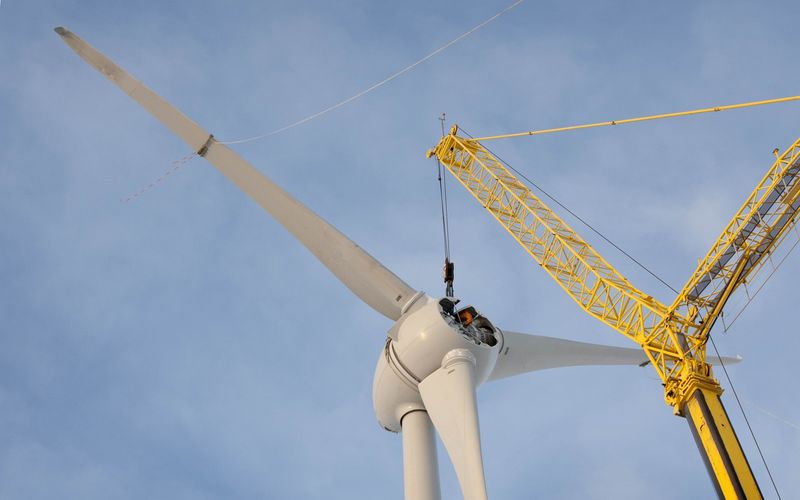
Last Thursday, the Icelandic power company Landsvirkjun started the operation of two wind turbines close to the Búrfell Hydropower Station in Southern Iceland. These are the first large wind turbines in Iceland.

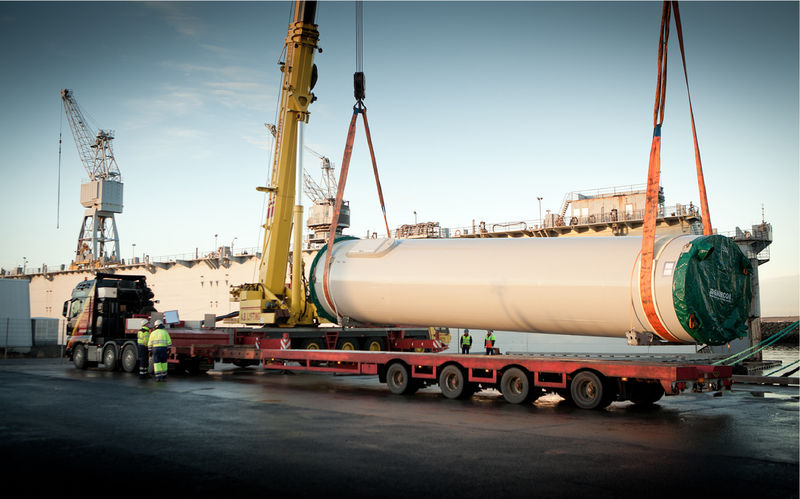
Landsvirkjun-Wind-Power-Station-erected-1The wind turbines each have a 900 kW capacity (1.8 MW of installed power in total). Together their generating capacity could be up to 5.4 GWh per year. The masts reach a height of 55 metres and each spade measures 22 metres in length. When the spades are at their highest position the unit will achieve a height of 77 metres.

The wind turbines are produced by the German company Enercon (model Enercon E-44). Enercon specialises in manufacturing direct-drive wind turbines, where the the generator produces electricity with fewer turns and thus reduced mechanical stress, increased engine life and reduced energy loss and noise.

The turbines operate at or around full capacity at wind speeds of 15-28 m/sec. Below 3 m/sec and above 34 m/sec, electricity generation stops. They connect to an 11kV underground electric cable running along a road towards Búrfell Hydropower Station. All additional electricity- and data cables are underground, in order to minimize environmental impact.

Landsvirkjun-Wind-Power-Station-erected

The turbines are located in an area with quite stable winds, with medium wind speed of  10-12 m/sec (stronger in winter than summer) at mast height (55 m). The towers and equipment were erected in last December (2012). Since then, Enercon has carried out and completed necessary tests for the project. Now the project has been handed over to Landvirkjun, and the turbines formally started operating. Their generation can be followed in real time at Landsvirkjun’s website.

There are a number of areas in Iceland that show great potential for the successful utilisation of wind energy. The project is part of Landsvirkjun’s research and development project on the advantageous of wind power in Iceland. The main objective of the project is to obtain operational experience with wind turbines far inland and in the Icelandic climate. Various climatic studies will be carried out during operation, including wind measurements and research on icing, the impact of snow, ash and soil erosion as well as the effects on birds and other wildlife.

Landsvirkjun-Wind-Power-Station-erected-3It is also of nterest, that the Icelandic Meteorological OfficeLandsvirkjun, the Icelandic Icelandic TSO Landsnet and the University of Iceland are all participants in a special research project called Icewind ,supported by the Nordic Top-level Research Initiative and the Nordic wind energy industry. The project objectives, related to offshore wind, include resource mapping near Iceland and improved land-wind resource map such that full-scale studies can be carried out on the integration of hydro- and wind power in Iceland. This may offer new and very economical opportunities to increase renewable electricity generation in Iceland.

Utilizing the Icelandic wind power resource

While many countries, for example in Western Europe, are focusing on wind power to increase the share of renewable energy, Iceland has not yet constructed a single operating wind farm. The reason is simple: Icelandic energy firms have always had the privilege of being able to harness abundant low-cost geothermal- and hydropower options.

However, Iceland may be a perfect setting for extensive utilization of wind energy. Iceland is a windy country. According to early research by the Icelandic National Power Company Landsvirkjun, wind farms in Iceland can be expected to be almost 100% more efficient than in Europe or USA. And due to low population density and extensive areas of land with few natural or manmade barriers, there is plenty of space for large wind parks.

Large-scale wind power utilization in Iceland may be especially attractive in connection with a subsea electrical HVDC-cable between Iceland and Europe. Instead of constructing very expensive offshore wind farms outside the coast of countries like Denmark, Germany, Netherlands and United Kingdom, investing in wind power in Iceland may be both less costly and offer lower political thresholds.

There are several areas in Iceland that may be good locations for wind farms. The map below is from a presentation by Landsvirkjun, showing some of the most interesting sites.

Currently, Landsvirkjun is preparing the construction of two wind turbines close to one of its hydropower stations in the river of Þjórsá in southern Iceland. These will be the first large wind turbines in Iceland. This will be an interesting experiment, offering valuable information on the feasibility of wind power in Iceland. Operation and maintenance cost will to be studied along with availability-percentage of the turbines in the windy and sometimes harsh Icelandic nature.

Landsvirkjun is also participating in a Nordic research project Icewind, which will include the production of icing atlas for Sweden and Iceland based on long term meteorological statistics. The Risø Research Institute, Denmark, heads the project in which corporations and scientists from Denmark, Finland, Iceland, Norway and Sweden take part. Besides Landsvirkjun, other project participants from Iceland are the Icelandic Meteorological Office and the University of Iceland, with the Icelandic TSO Landsnet also joining as a collaborator. The project formally began in 2010 and is expected to end in 2014.

You can find information about wind energy potentials in Iceland on our wind page.

The Iceland-Europe interconnector

Iceland is currently a closed electricity market with no cable connections to other markets. This may soon change. Technology advancement, strong demand for more renewable energy, and high electricity prices in Europe are making a submarine high voltage direct current (HVDC) cable between Iceland and Europe more feasible than ever before.

Unharnessed renewable energy

Iceland can substantially increase its green electric power production at a reasonable cost. Iceland is the only country in Western Europe that still has several large unharnessed hydro power options. Also, Iceland’s geophysical conditions offer numerous possibilities for low cost utilization of geothermal power, and Iceland has stronger and more stable winds than most of Europe.

Some of this natural energy will be harnessed for varied domestic industries, such as new data centers, metallurgical-grade silicon production, etc. Iceland also has the possibility to do business with electric power through a submarine cable to Europe. Such a connection would not only be based on Icelandic hydro- and geothermal power, but would open up the possibility of large-scale harnessing of Icelandic wind power.

Choosing the best business model

So far the longest submarine HVDC-cable is the NorNed between Norway and the Netherlands (580 km / 369 miles). The interconnector between Iceland and Europe would be at least double that length, so it will definitely be a challenging project.

Such an  interconnector would not only enable sales of renewable electricity at high prices but also have various other benefits for the Icelandic electricity system, such as more efficient use of the generation capacity and enhance the security of supply. Currently, three scenarios are being studied. The first concerns an interconnector that would be used for export/import only, based on market prices.  The second involves a cable used for export only, and the third assumes an interconnector used in part for export/import and in part for export.

Green AND competitively priced

The main drivers behind an electric cable between Iceland and Europe are high electricity prices in Western Europe and the growing demand in Europe for more renewable energy.

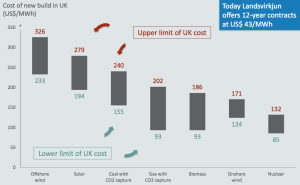
According to engineering and management firm Parsons Brinckerhoff and consultancy firm  Mott MacDonald Group, as presented by Landsvirkjun, Iceland’s electricity prices are much lower than can possible be offered by new electricity generation projects in the United Kingdom (UK). This is especially interesting when having in mind UK’s energy policy, with the goal of increasing its renewable energy consumption from the present 54 TWh to 234 TWh no later than 2020.

This goal, which is based on European Union’s (EU) and UK’s energy policy, will only be achieved with major investments in new green energy projects. Those projects will for example include very expensive and controversial onshore and offshore wind farms in the UK. For example, the minimum cost for offshore wind electricity in the UK is equivalent to 233 USD/MWh.

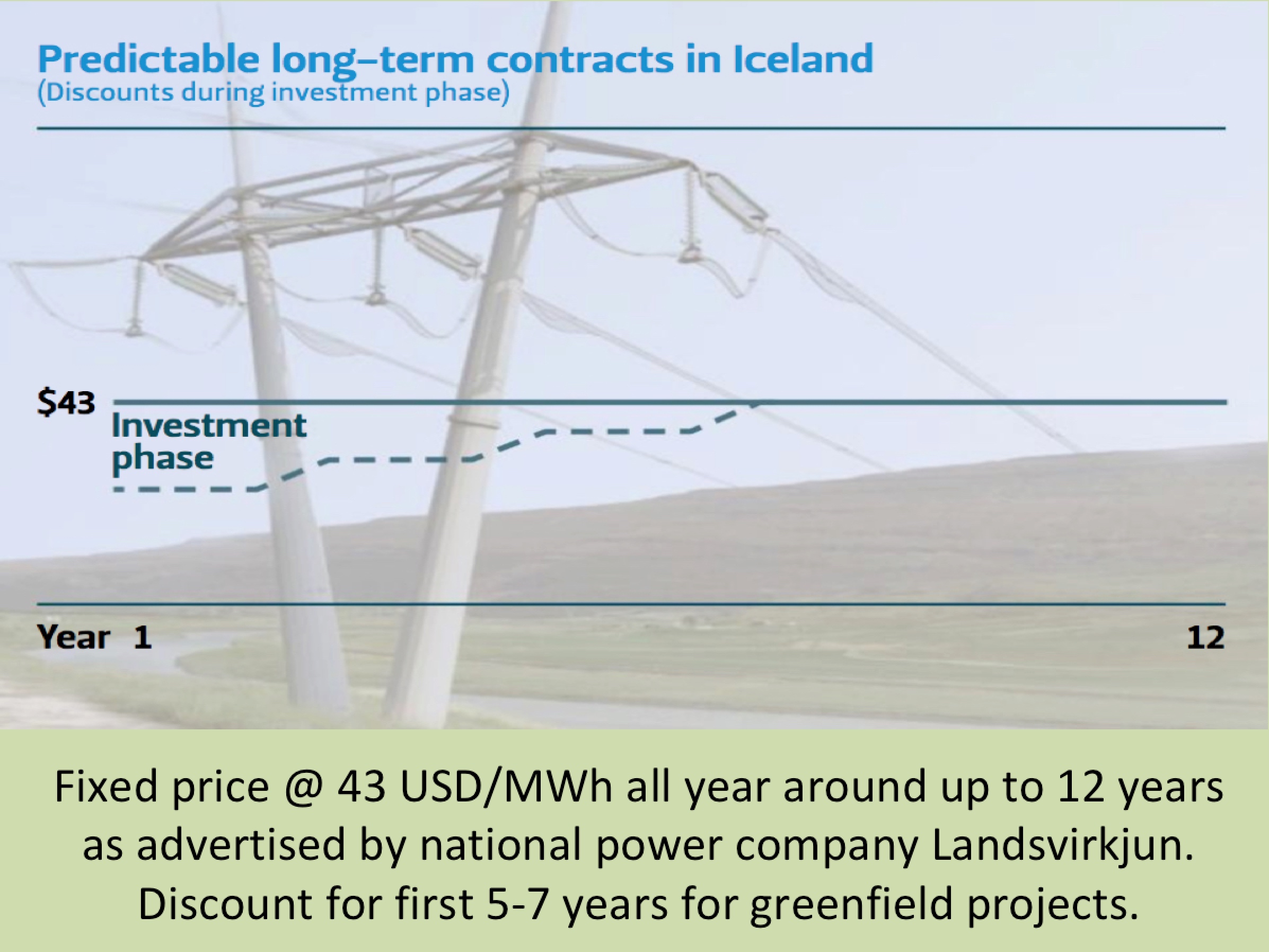
When comparing this to Icelandic renewable energy cost, it is quite obvious that an electric cable between Iceland and UK is an exciting option (Icelandic Landsvirkjun is currently offering long-term electricity contracts at 43 USD/MWh). Thus, it is not surprising that Mr. Hörður Arnarson, CEO of Landsvirkjun, has described the laying of a submarine cable to Europe, together with vigorous industrial development in Iceland, as probably being “one of the biggest business opportunities Iceland has faced”.

The two charts above are from a presentation by Landsvirkjun, given at an energy seminar in Reykjavik in last May (2012).

Positive Winds

Iceland may be a perfect setting for extensive utilization of wind energy.

Wind farms in Iceland can be expected to be almost 100% more efficient than in Europe or USA (according to early research). Due to low population density and extensive areas of land with few natural or manmade barriers, there is plenty of space for large wind parks.

Large-scale wind power utilization in Iceland may be especially attractive in connection with a subsea electrical HVDC-cable between Iceland and Europe. Instead of constructing very expensive offshore wind farms outside the coast of countries like Denmark, Germany, Netherlands and United Kingdom, investing in wind power in Iceland may be both less costly and offer lower political thresholds.

You can find information about wind energy potentials in Iceland on our wind page.