Skip to content

Posts from the ‘Geothermal Power’ Category

Icelandic geothermal know-how in Africa

Last week, the Icelandic Minister for Foreign Affairs, Mr. Össur Skarphéðinsson, presented the most extensive development project Iceland has participated in.
This is an international project in collaboration with the World Bank. The project is part of the World Bank Global Geothermal Development Plan, estimated to amount to USD 500 million (ISK 64 billion, EUR 393 million).

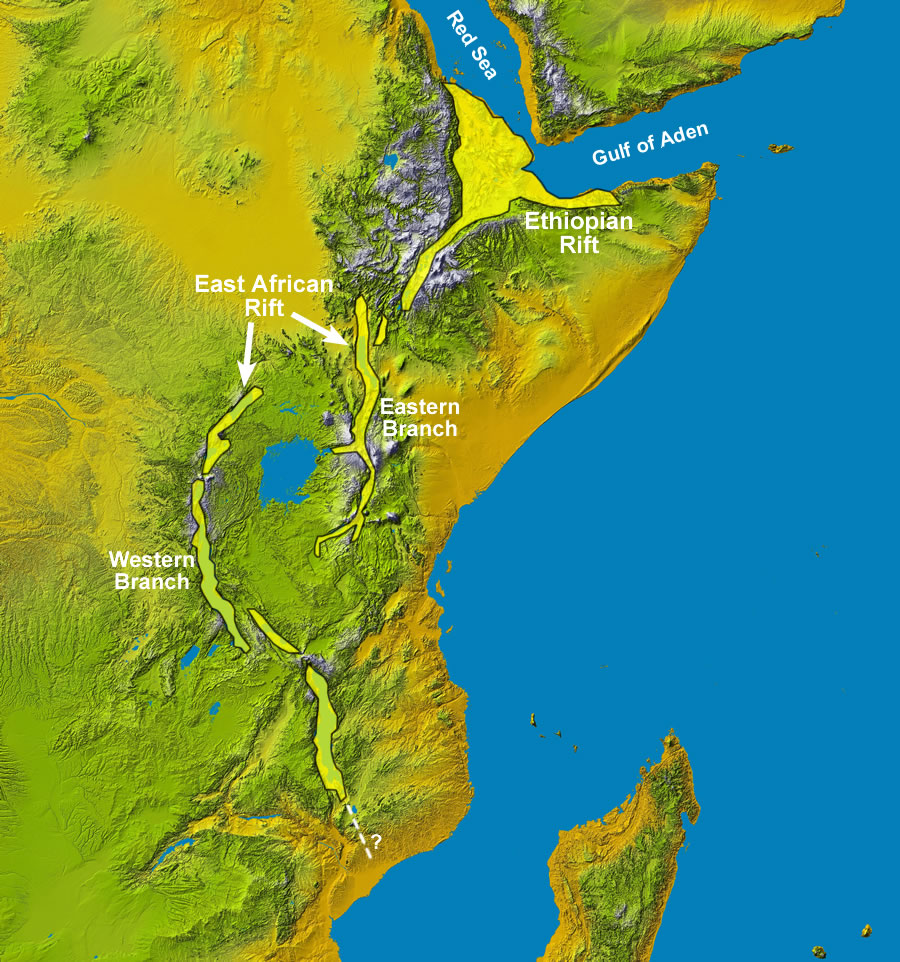
The project targets thirteen countries of the Great Rift Valley in East Africa. They include Burundi, Djibouti, Eritrea, Ethiopia, Kenya, Malawi, Mozambique, Rwanda, Somalia, South-Sudan, Tanzania, Uganda, and Zambia. The Great Rift Valley is known for widespread geothermal activity. However, little of this energy has been harnessed, due to limited access to both capital and know-how.

This collaboration between Iceland and the World Bank is the largest initiative so far for promoting the utilization of geothermal energy in developing countries. The World Bank  will provide finance for geothermal feasibility assessments and test drilling. The Nordic Development Fund (NDF) and the Government of Iceland will also provide part of the funding. The Icelandic International Development Agency, ICEIDA, will be the lead agency for this component.

Iceland will assist the respective states with geotechnical investigations of promising sites, detailed geophysical, seismic, environment and chemical tests including test drilling and assessments. The World Bank will collaborate with Iceland, other partners and funding agencies to establish a flexible financing facility that can in part share the costs and risks of specific drilling programs in the target countries.
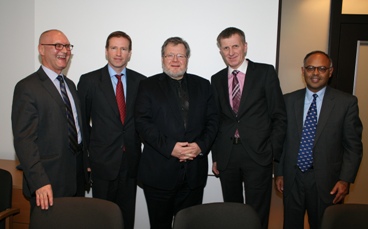
The agreement on the project was signed in Reykjavik in last week. In addition to the Icelandic Minister for Foreign Affairs, it was signed by Mr. Pasi Hellman, Managing Director of the Nordic Development Fund, Mr. Engilbert Guðmundsson, Director General of Iceland‘s International Development Agency, and Mr. Rohit Khanna, Program Manager of the Energy Sector Management Assistance Program (who represented the World Bank).

McKinsey on Icelandic energy issues

The management and consulting firm McKinsey & Company recently published an independent report on the current state of the Icelandic economy and its future priorities. The title of the report is “Charting a Growth Path for Iceland”.

According to the report, the Icelandic power industry has provided the foundation for a strong export-based heavy industry sector. However, McKinsey also points out that capital productivity in the Icelandic energy sector is the lowest across all sectors of the Icelandic economy:

“With 25-30% of the capital stock directly or indirectly invested in the energy sector, this is a serious matter for resolution. We identify several important themes to this end, e.g. diversification of the industrial buyer market and systematic enablement of the most profitable expansion projects based on their ability to pay. Additionally, the opportunity to connect the Icelandic electricity market to Europe via a physical interconnector is an attractive option that should be explored in detail.”

McKinsey then goes on making some suggestions on how to increase value capture from the energy sector. According to the report, the keyword for higher capital productivity is increased integration with other markets. Since the Icelandic power system is an island-system there is, according to McKinsey, a “significant slack in the system to ensure that sufficient margins are in place to meet domestic demand.”

McKinsey argues that the isolated market is “reflected in the design of hydro plants where investments have been optimized accordingly, i.e. with relatively small reservoirs allowing surplus water to bypass generation as there are no alternative markets available.”  Hence, nearly 15 per cent of the energy available for electricity production is wasted each year (on average).

McKinsey emphasizes that these factors will have to be taken into consideration during the next growth phase to maximize the value captured. In this regard, McKinsey seems ecpecially positive towards constructing an interconnector between Iceland and Europe:

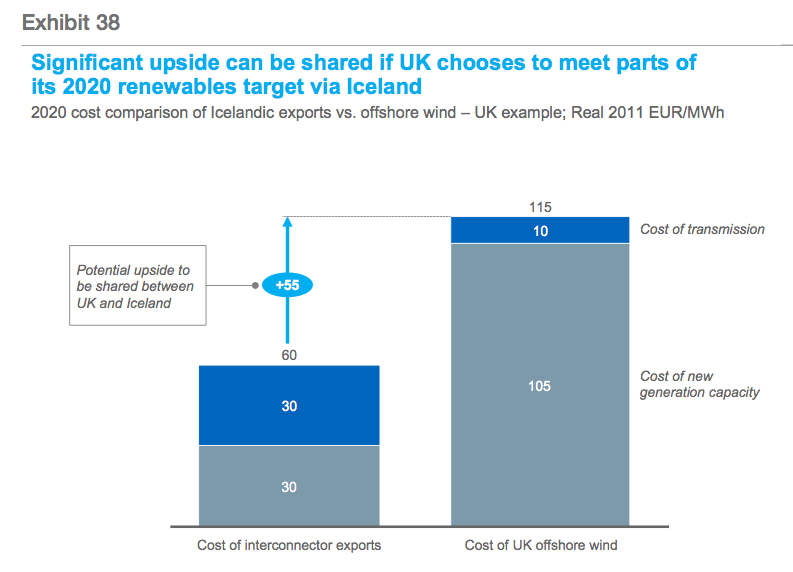
“The economic rationale for an interconnector is based on the opportunity of supplying the receiving market with green energy and thus contributing to decarbonization more efficiently than through other means e.g. offshore wind power. Iceland could share the benefit of such cost savings with the partner. Taking into account generation costs in Iceland, the cost of the interconnector itself and the anticipated cost of offshore wind power in 2020, cost savings of around EUR 60/Mwh could be shared.”

What makes the business model of an interconnector especially interesting, is the fact that so far Iceland has only harnessed  20-25 percent of its theoretically available hydro and geothermal energy. With environmental considerations and the economic feasibility of the investments taken into account, new projects could probably almost double current production (from 17 TWh to approximately 34 TWh annually). This is a substantially less costly renewable energy option than for example wind power in the United Kingdom.

The report concludes with strong future prospects. McKinsey is of the opinion that “Iceland is in the privileged position of having multiple growth levers that can greatly improve average production in the economy. The country therefore has good reason to be optimistic, provided policymakers utilize the opportunities available.” To access the report follow this link.

Icelandic geothermal know-how

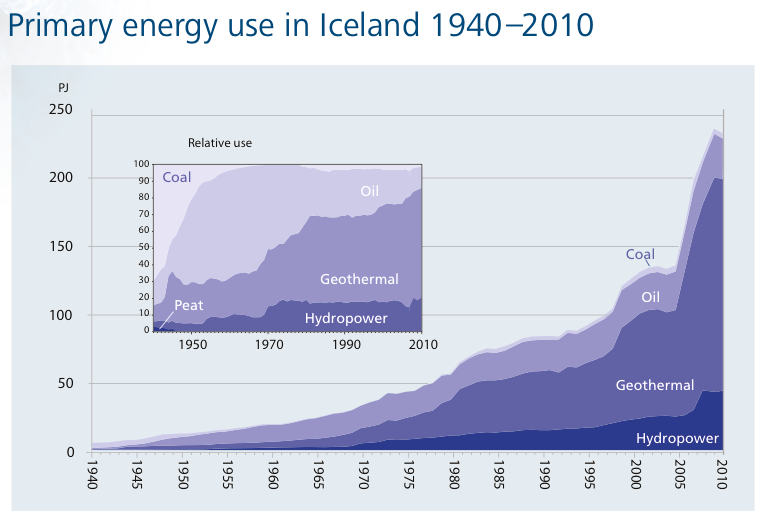
Iceland produces a substantial share of its electricity by harnessing geothermal resources. Geothermal plants now account for approximately one-quarter of all electricity generated and consumed in Iceland. In addition, Iceland has a long tradition harnessing low geothermal heat for central district heating. This explains why geothermal is such a large share of the primary energy use in Iceland (in total, close to 65% of Iceland’s consumption of primary energy is geothermal energy).

Several European countries are looking towards utilizing geothermal heat, not least as a source for electricity production. However, these countries do not share Iceland’s geophysical conditions – low-cost geothermal electricity is not an option unless you have access to very high temperatures. On the other hand it may be an excellent option for many European countries to harness their low geothermal heat for central heating.

This is an area of expertise where Iceland has great strength. Iceland has a long tradition harnessing low geothermal heat for central district heating, which explains why geothermal is such a large share of the primary energy use in Iceland.

Icelandic engineering firms have been exporting this know-how to countries on the European continent. This for example applies to Hungary. There, the company Mannvit has provided engineering, procurement, and construction management of a geothermal district heating plants. These types of plants are replacing fossil-fuel powered district heating systems with environmentally-friendly and sustainable geothermal energy.

This type of geothermal harnessing is an option that could be appealing for many communities in numerous countries in Europe. In addition to Hungary, this for example applies to Britain, Germany, France, Slovenia and several other countries. In a nutshell, domestic geothermal energy is a resource Europeans should consider very seriously for district heating.

Photo at left: An official groundbreaking ceremony marked the beginning of the construction process of the geothermal district heating plant in the town of Szentlőrinc, Hungary. The cornerstone was laid by Mr. Össur Skarphéðinsson, Foreign and External Trade Minister of Iceland, Pál Kovács, Deputy Secretary of Energy Policy from the Ministry of Development and, Dr. Márk Győrvári, the Mayor of Szentlőrinc.

Energy producers in Iceland

There are several energy companies in Iceland, producing electricity and heating. In total, they generate about 17 TWh of electricity annually and close to 22 TWh of geothermal heat. Almost all this energy comes from renewable sources (hydropower and geothermal power). In total, close to 85% of Iceland’s consumption of primary energy is renewable energy. This is the world’s highest share of renewable energy in any national energy budget.

The largest energy generating firms in Iceland are Landsvirkjun, Orkuveita Reykjavíkur (Reykjavik Energy), and HS Orka. State owned Landsvirkjun is by far the largest, providing approximately 76% of all the electricity produced in Iceland. More than 96% of all hydro generation in Iceland is produced by Landsvirkjun, and its share in the generation of electricity from geothermal power is around 11% of the total.

Landsvirkjun owns eleven hydropower stations and two geothermal power stations with a combined capacity of 1,895 MW.  Lansdvirkjun is also the main owner of the Icelandic Transmission System Operator (TSO), with a share of 65%.

Landsvirkjun receives much of its revenue in foreign currency (USD) as a result of extensive electricity sales to large foreign-owned aluminum smelters in Iceland (80% of the electricity Landsvirkjun generates is sold to energy intensive industries via long term contracts). The economic turbulence Iceland experienced recently did not affect Landsvirkjun nearly as much as most other Icelandic firms (the devaluation of the Icelandic currency did not have negative effects on Landsvirkjun’s income).

Landsvirkjun is one of Iceland’s largest companies and currently it has more equity than any other Icelandic firm . Of all the Icelandic power companies, Landsvirkjun is by far the strongest player and currently the only large Icelandic power company expanding its operations.

Orkuveita Reykjavíkur (OR, but also called Reykjavik Energy) is Iceland’s second largest energy firm. This public utility company provides both electricity and hot water for heating. It is by far the largest local provider of electricity and heating to end-users. The main service area of the company is the larger Reykjavik Metropolitan Area. OR’s largest single customer is Norduaral Aluminum Smelter, that is located not far from Reykjavik. In recent years OR has been struggling with heavy debt, which has led to rising costs for its general customers.

OR’s power-generation plants have a total capacity of 435 MW. Most of the electricity from OR is generated at two geothermal plants that utilize high-pressure steam. Besides producing and distributing electricity, OR sells and distributes both hot and cold water. The water from OR for space heating comes from low-temperature fields in and close to the city and from the combined heat and power plants at the Nesjavellir and Hellisheiði Stations. Cold water is collected from groundwater reservoirs outside of Reykjavík. Also OR operates an extensive sewage system for the Reykjavik area, as well as some adjacent municipalities.

HS Orka is the third main energy firm in Iceland. Until 2007 it was a public company owned by the Icelandic state and municipalities in Southwest Iceland. It was later privatized and today its largest shareholder now is the Canadian Alterra Power. The rest is owned by a group of Icelandic pension funds. HS Orka operates two geothermal power stations with a total capacity of 175 MW. HS Orka owns a few subsidiaries, including ¼ of the well known Blue Lagoon.

The Iceland-Europe interconnector

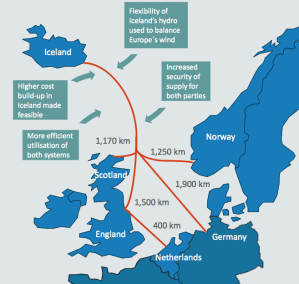
Iceland is currently a closed electricity market with no cable connections to other markets. This may soon change. Technology advancement, strong demand for more renewable energy, and high electricity prices in Europe are making a submarine high voltage direct current (HVDC) cable between Iceland and Europe more feasible than ever before.

Unharnessed renewable energy

Iceland can substantially increase its green electric power production at a reasonable cost. Iceland is the only country in Western Europe that still has several large unharnessed hydro power options. Also, Iceland’s geophysical conditions offer numerous possibilities for low cost utilization of geothermal power, and Iceland has stronger and more stable winds than most of Europe.

Some of this natural energy will be harnessed for varied domestic industries, such as new data centers, metallurgical-grade silicon production, etc. Iceland also has the possibility to do business with electric power through a submarine cable to Europe. Such a connection would not only be based on Icelandic hydro- and geothermal power, but would open up the possibility of large-scale harnessing of Icelandic wind power.

Choosing the best business model

So far the longest submarine HVDC-cable is the NorNed between Norway and the Netherlands (580 km / 369 miles). The interconnector between Iceland and Europe would be at least double that length, so it will definitely be a challenging project.

Such an  interconnector would not only enable sales of renewable electricity at high prices but also have various other benefits for the Icelandic electricity system, such as more efficient use of the generation capacity and enhance the security of supply. Currently, three scenarios are being studied. The first concerns an interconnector that would be used for export/import only, based on market prices.  The second involves a cable used for export only, and the third assumes an interconnector used in part for export/import and in part for export.

Green AND competitively priced

The main drivers behind an electric cable between Iceland and Europe are high electricity prices in Western Europe and the growing demand in Europe for more renewable energy.

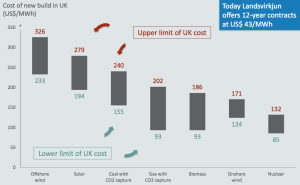
According to engineering and management firm Parsons Brinckerhoff and consultancy firm  Mott MacDonald Group, as presented by Landsvirkjun, Iceland’s electricity prices are much lower than can possible be offered by new electricity generation projects in the United Kingdom (UK). This is especially interesting when having in mind UK’s energy policy, with the goal of increasing its renewable energy consumption from the present 54 TWh to 234 TWh no later than 2020.

This goal, which is based on European Union’s (EU) and UK’s energy policy, will only be achieved with major investments in new green energy projects. Those projects will for example include very expensive and controversial onshore and offshore wind farms in the UK. For example, the minimum cost for offshore wind electricity in the UK is equivalent to 233 USD/MWh.

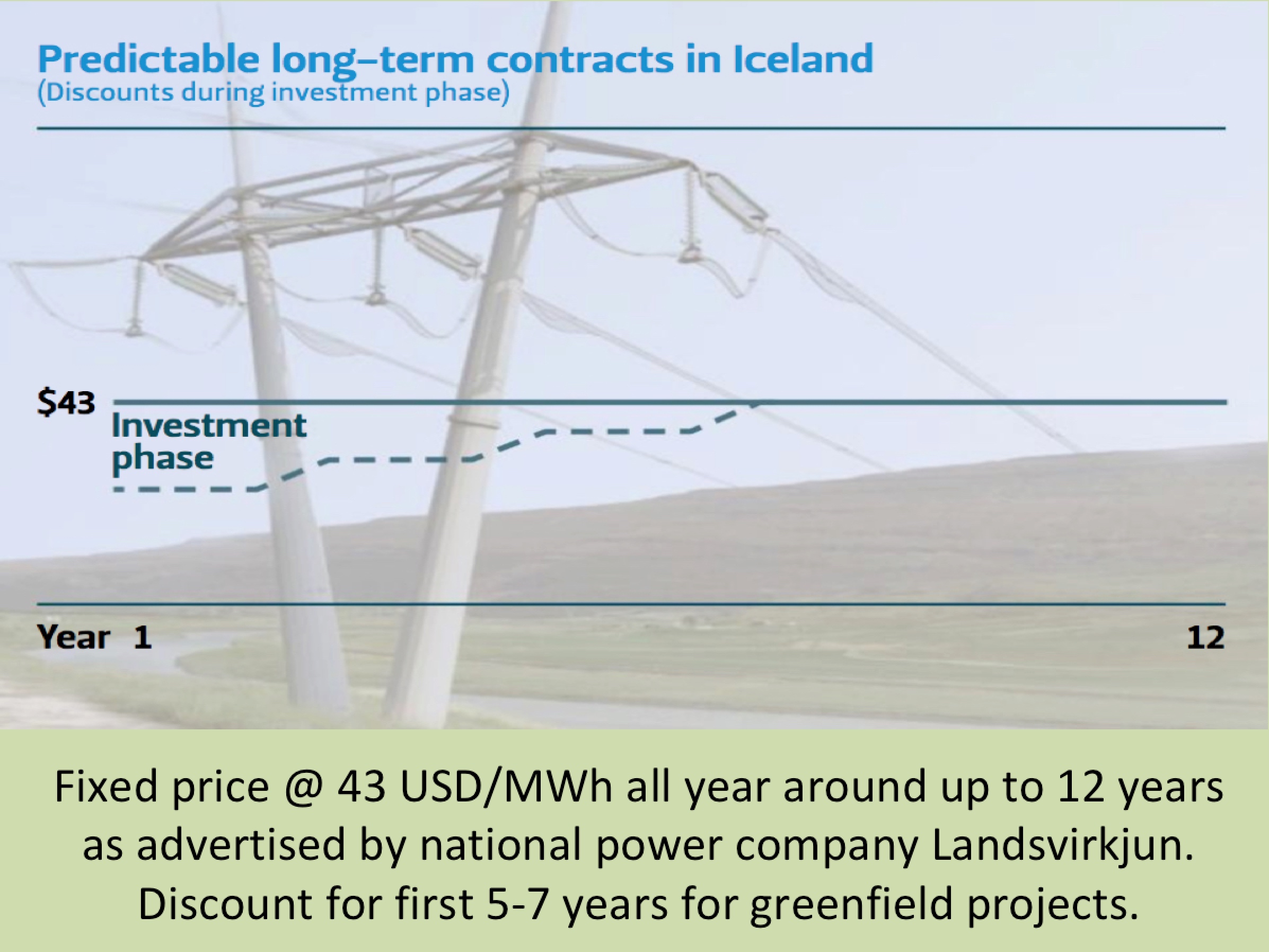
When comparing this to Icelandic renewable energy cost, it is quite obvious that an electric cable between Iceland and UK is an exciting option (Icelandic Landsvirkjun is currently offering long-term electricity contracts at 43 USD/MWh). Thus, it is not surprising that Mr. Hörður Arnarson, CEO of Landsvirkjun, has described the laying of a submarine cable to Europe, together with vigorous industrial development in Iceland, as probably being “one of the biggest business opportunities Iceland has faced”.

The two charts above are from a presentation by Landsvirkjun, given at an energy seminar in Reykjavik in last May (2012).

Understanding geothermal

Iceland produces substantial share of its electricity by harnessing geothermal resources. Geothermal plants now account for approximately one-quarter of all electricity generated and consumed in Iceland.

Several European countries are also looking towards geothermal heat as a source for electricity production. This for example applies both to Germany and Britain. However, these countries do not share Iceland’s  geophysical conditions and low-cost geothermal electricity is not an option unless you have access to very high temperatures, .

In Iceland, geothermal electricity generation is only considered feasible in areas where geothermal heat is at least 200°C  at a depth that is less than 1,000 m. This applies to many areas within the orange zone on the map above. Outside of this zone the heat is lower and more similar to what can be found in several areas in Europe.

Countries like Germany and Britain are building geothermal power plants in low-heat areas that would not be consider competitive in Iceland. However, it is understandable that European countries want to harness even their low geothermal heat for electricity generation. Wind energy is also an expensive option and so is solar energy (whether PV or CSP). There simply are very limited low-cost options available in European renewable generation.

Interestingly, it may be an excellent option for European countries to harness their low geothermal heat for central heating rather than generating electricity. This is an area of expertise where Iceland has great strength. Iceland has a long tradition harnessing low geothermal heat for central district heating, which explains why geothermal is such a large share of the primary energy use in Iceland (as can be seen on the chart above).

Recently, Icelandic engineering firm Mannvit exported this know-how to Hungary. There, the company provided engineering, procurement, and construction management of a geothermal district heating plant in the town of Szentlőrinc in the southwestern part of the Hungary.

The plant provides heating and hot water for some 900  homes in Szentlőrinc, and has excess capacity for further expansion. This new geothermal plant replaces the town’s natural-gas powered district heating system with environmentally-friendly and sustainable geothermal energy.

This type of geothermal harnessing is an option that could be interesting for many communities in numerous countries in Europe. In addition to Hungary, this for example applies to Germany, France, Slovenia and several other countries.

In a nutshell, geothermal is a resource Europeans should consider very seriously for district heating. This especially applies to local communities, taking an initiative not only towards more renewable energy but at the same time greatly  improving peoples living conditions. Instead of focusing too much on wind and solar and renewable electricity generation, governments need to understand and realize the multiple potentials of geothermal.

Hydro and geothermal country

Electricity production in Iceland is 100% from renewable sources (hydro and geothermal).

And more than 85% of total primary energy supply in Iceland is derived from domestically produced renewable energy sources. Of that total, 20% comes from hydropower- and 65% from geothermal sources. This is the world’s highest share of renewable energy in any national total energy budget.

Hydropower is the main source of the electricity production in Iceland, accounting for approximately three-quarters of all electricity generated and consumed in the country. The total annual production now is around 17,000 GWh, where almost 12,600 GWh is generated by hydropower stations.

The remaining quarter is generated in geothermal power stations. Actually, geothermal heat is the main energy source in Iceland. This great natural resource accounts for about 90% of space heating, thanks to the country’s geophysical conditions and extensive district heating system. As mentioned above, geothermal energy makes up around 65% of all primary energy use in Iceland.

Geothermal- and hydropower utilization in Iceland has increased fast in the last few years. However, so far only half of the best options have been utilized. Construction is under way for both new geothermal and hydropower projects. In addition, Iceland has interesting potentials for harnessing the wind as a power source.

Icelandic transportation is still mainly powered by fossil fuels. The government and private businesses are working towards changing this. Green solutions in the transport sector include electric cars powered by electricity from renewable sources and green fuels like bio-methane and methanol.

KEY FACTS ABOUT ICELAND’S HYDROPOWER UTILIZATION: *

  • Total hydro generating capacity:  1,879 MW
  • Total annual hydroelectric production:  12,592 GWh
  • Share of hydroelectricity in total generation:  73.81%
Numbers from 2010, published by the Icelandic National Energy Authority in December 2011.


KEY FACTS ABOUT ICELAND’S GEOTHERMAL POWER:

  • Total geothermal generating capacity:  575 MW *
  • Total annual geothermal electricity production:  4,466 GWh *
  • Share of geothermal in all electricity production:  26,18% *
  • Geothermal heat production (electricity production not included): 22,020 GWh **

 *  Numbers from 2010, published by the Icelandic National Energy Authority in December 2011.
** Numbers from 2006, published by the Icelandic National Energy Authority in December 2007. 

The charts above are from the website of Iceland’s National Energy Authority.

World’s largest electricity producer per capita

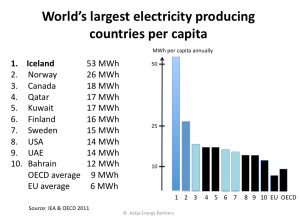
Iceland is the world’s largest electricity producer per capita. Norway comes in second place, by generating approximately half the electricity per capita of that of Iceland.

Other countries on the top-ten list of the world’s largest electricity producers per capita are Canada, Qatar, Kuwait, Finland, Sweden, United States of America (USA), United Arab Emirates (UAE) and Bahrain.

Most of the countries on the top-ten list of the world’s highest electricity producing countries per capita generate most or all their electricity from fossil fuels, especially gas and coal. However, both Iceland and Norway produce close to 100% of their electricity from renewable sources (both countries draw from hydroelectric power, but Iceland has a unique energy source in its geothermal power). Thus, Iceland and Norway are not only the largest producers of electricity (per capita) in the world, but also by far the world’s largest green electricity producers (per capita).

Canada, Finland and Sweden all have extensive hydropower sources and utilize them for electricity generation. Thus, they might be described as semi renewable electric producers (thus marked with light blue color on the graph, whereas Iceland and Norway are marked with dark blue). It is also noteworthy that Canada generates approximately

100% Green Electricity

Important basic facts:

›  Electricity production in Iceland is 100% from renewable sources.

›  Iceland produces more electricity than any other country (per capita).

›  So far only half of the best options have been utilized. Construction is under way for both new geothermal and hydropower projects. In addition, Iceland has interesting potentials for harnessing the wind as a power source.

›  With rising energy demand in the world, climate concerns, and EU’s ambitious renewable energy targets (20/20/20) Iceland’s green energy sources will become more competitive than ever before.

All electricity in Iceland comes from renewable power sources (hydro and geothermal). Icelandic electricity is also utilized in producing green fuels. Natural geothermal heat supplies most of the nation with low cost central heating and offer numerous other industrial possibilities. In comparison, more than three-quarters of the EU’s electricity comes from fossil fuels and nuclear plants.

Several attractive hydro and geothermal locations in Iceland are still unharnessed and there are new projects currently in development. Furthermore, it is likely that Iceland will soon focus on harnessing its excellent potential for wind power. The same applies to marine energy; the coast around Iceland offers numerous promising  locations for experimenting with marine energy technology and possibly harnessing it in the future.

You will find more information about upcoming power projects under our renewable sources menu.

Geothermal Leader

Unique geophysical conditions in Iceland offer numerous possibilities for low cost utilization of geothermal power.

Besides electricity generation, this for example includes direct central heating in Icelandic private homes, harnessing geothermal resources for spas and swimming pools, use of greenhouse farming and aquaculture, and even heating some of the streets in Reykjavik during winter to keep them from freezing over

Thus, it is not surprising that geothermal power utilization is a fast-growing industry in Iceland. Additionally, due to its cool climate, very competitive electricity prices and new cable connections, Iceland may become an especially interesting location for data centers.

The photo shows the Krafla Power Plant in Northeast Iceland that has a current capacity of 60 MW.  An expansion is expected to make it twice as large within a few years. For more information about the Icelandic geothermal sector please visit our geothermal pages.