Skip to content

Posts from the ‘Investing and Legal Issues’ Category

Canadian Methanex invests in Iceland

The Vancouver-based Methanex has announced an initial USD 5 million investment in Icelandic Carbon Recycling International (CRI), a privately held company with headquarters in Reykjavik, Iceland. Methanex becomes one of the key shareholders of CRI, with Board representation.

Methanex-CRI-investment-2013In Iceland, CRI operates the world’s first renewable methanol plant, which utilizes CRI’s emissions-to- liquids (ETL) technology, utilizing renewable energy to convert carbon dioxide emissions to methanol. CRI markets this product in Europe as renewable methanol, under the registered brand name Vulcanol. The Vulcanol can be blended with gasoline and can also be used for production of biodiesel. Vulcanol is certified by the International Sustainability and Carbon Certification system (ISCC) as an ultra-low carbon advanced renewable transport fuel with no biogenic footprint.

According to press announcements, Methanex and CRI intend to collaborate on large scale projects based on CRI’s ETL technology by leveraging Methanex’s operational experience and global reach and CRI’s unique expertise in the production of ultra-low carbon renewable methanol. The companies say they are targeting to expand the use of methanol blended fuels in Europe.

Methanex-logoMethanex is the world’s largest supplier of methanol to major international markets. It is a publicly traded company; Methanex shares are listed for trading on the Toronto Stock Exchange in Canada under the trading symbol “MX” and on the Nasdaq Global Market in the USA under the trading symbol “MEOH“.

Mr. John Floren, President and CEO of Methanex, says that the fastest growing markets for methanol are in the energy sector and that Methanex believes renewable methanol will play an important role in future applications. Mr. Floren has also pointed out that the team at CRI has demonstrated the ability to develop this technology, operate a production plant and successfully market renewable methanol, which further reinforces the value of this investment by Methanex.

The investment of Methanex in CRI shows that the Icelandic energy- and technology sectors are becoming increasingly interesting for foreign investors. Currently, several other foreign companies are considering investments in for example oil exploration on the Icelandic continental shelf and in silicon production in Northeast Iceland.

Verne Global in Iceland scores high

Iceland’s green data centers are receiving growing interest. They run 100% on renewable energy and offer the lowest carbon footprint in the industry.

LV-Renewable-banner-2

It does indeed matter if a data center is green or not. According to a report by UBM Tech and InformationWeek, 22 percent of 100 executives said they regularly track energy usage in their data centers, and close to 60 percent of IT decision makers say the state of their data center is fair, serious or urgent, and at the brink of running out of capacity in 2014. For many of those executives and IT people, Iceland may be the perfect location for their data.

Small and large companies alike are looking for greener options. Adobe, eBay, Facebook, Hewlett-Packard, Salesforce and Symantec have joined the Future of Internet Power initiative to showcase low-carbon power. IBM is heavily into promoting green data center design; the European Union Commission honored 27 of them in January 2012. EBay also has raised the bar by with its Digital Service Efficiency (DSE) methodology, which links how many “buy” or “sell” business transactions are completed per kilowatt-hour.

Recently, the GreenBizGroup listed 12 green data centers and co-location facilities that stand out for innovative cooling, green energy or head-turning designs. One of them is the data centre of Verne Global in Iceland. According to GreenBiz, the geothermal and hydroelectric-powered campus of Verne Global in Southwest Iceland calls itself the first zero-carbon data center. Among its customers are automaker BMW Group and the Climate Action organization.

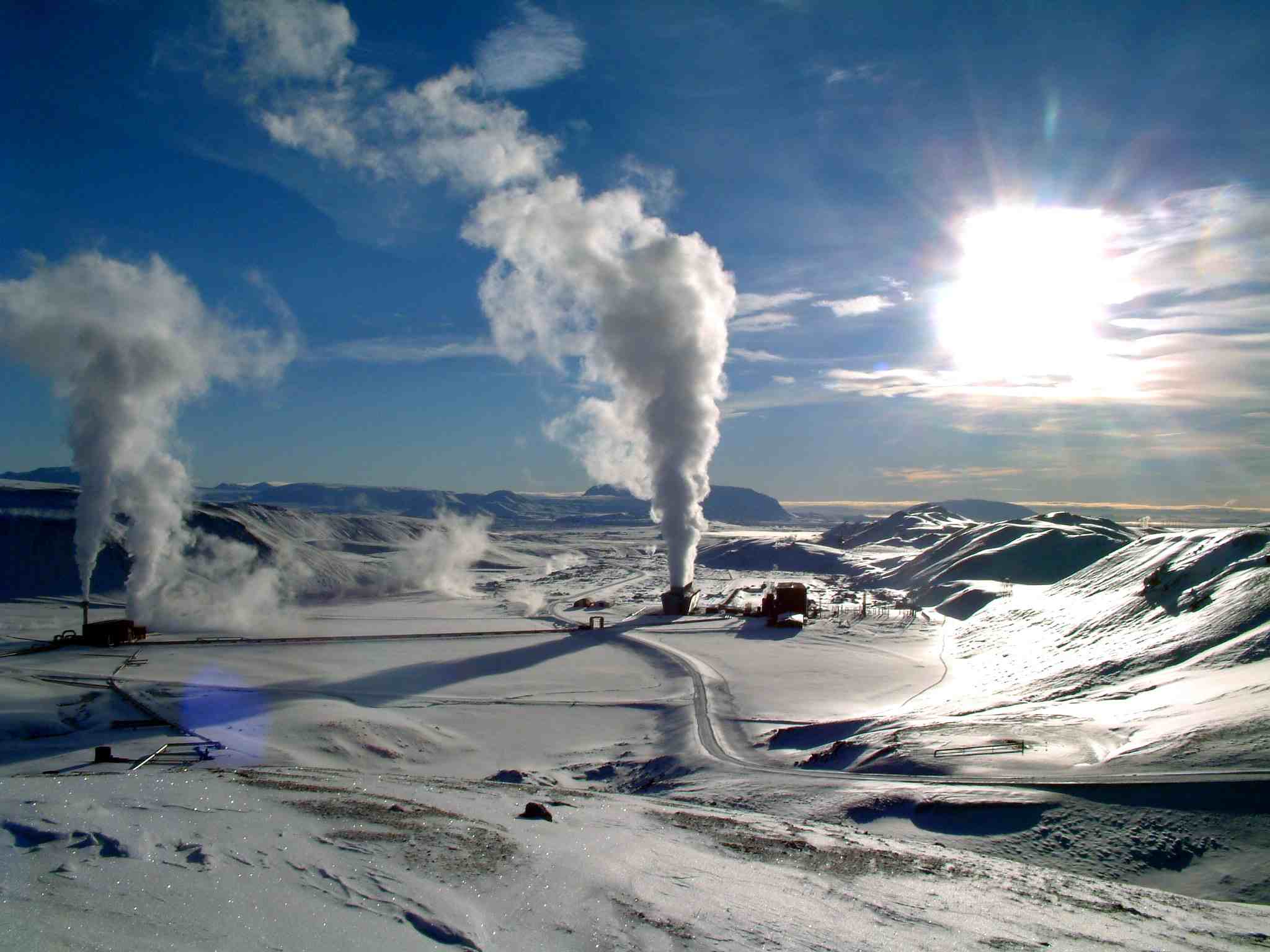
Krafla_geothermal_power_station_winter_LandsvirkjunBMW is using the campus of Verne Global for crash simulations, aerodynamic calculations and other computer-aided design (CAD) purposes. This requires plenty of electricity, both for the transactions and to keep the infrastructure cool. By moving ten of its  high-performance computing clusters (HPC) to Iceland from Germany, BMW hopes to reduce annual carbon emissions by 3,570 metric tons.

What is no less interesting for BMW and other companies considering where to host their data, Iceland not only offers green electricity and natural cooling, but also electricity prices that are lower than anywhere else in Europe. Therefore, it is quite obvious that Iceland has excellent possibilities for becoming a leading data centre hub.

Green high performance computing cloud node opens in Iceland

Managed hosting provider Datapipe has launched a green cloud node in Iceland. The company has made its high performance computing (HPC) cloud platform available out of Verne Global’s facility in Southwestern Iceland, which uses 100 percent renewable energy.

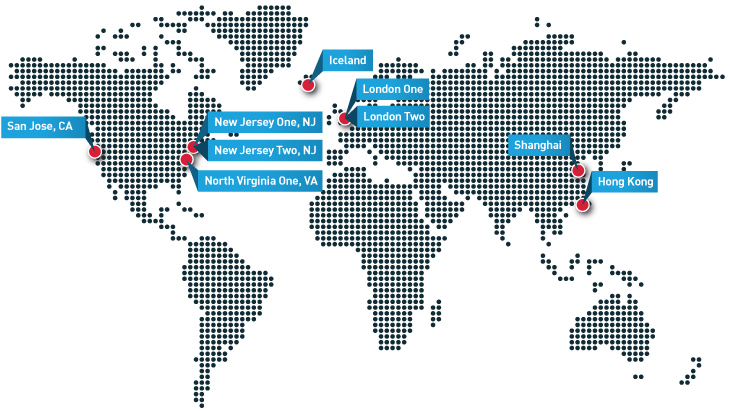
Datapipe-Data-Center-World-MapDatapipe is an existing tenant, but its expansion is a reflection of increased data center activity in Iceland. Low cost, renewable energy, improved connectivity, and a location between North America and Europe add up to an enticing proposition. Datapipe clients have immediate access to the new Iceland node. It’s available through the same portal as its other locations in Silicon Valley, the New York Metro area, Ashburn Virginia, London, Hong Kong, and Shanghai. “Iceland is a great in-between point with our U.S. and UK infrastructure, it’s great for disaster recovery., says Ed  Laczynski, Datapipe’s VP of Cloud Strategy.

The Statosphere HPC cloud platform is a high performance solution targeted at Big Data wokloads. Typical verticals that the company attracts are manufacturing, financial service, and research and development. The platform is API driven and utilizes all SSD storage with guaranteed IOPS (input/output per second) . Stratosphere can be configured with public or private resources, with up to 32 physical core equivalents per instance, a half terabyte (TB) of RAM, and tens of thousands of IOPS per volume, all residing on a 10GE network. It’s known as the most widely deployed Apache CloudStack environment on the market.

datapipe-logoDatapipe has been committed to using as much renewable energy as it can, and is finding that customers are increasingly asking for it as well. “As we grow new solutions, we’re seeing more and more green qualifications as a requirement to do business,” says Laczynski. “The kind of customers we’re talking about really do care about this; these are multinational corporations looking for sustainable solutions.” Recognized as a Green Power Partner by the U.S. Environmental Protection Agency (EPA) since 2010, Datapipe achieved EPA Leadership Club status in 2011 and is currently ranked #9 on the EPA Green Power Partner Top Tech & Telecom list.

Iceland-waterfall-1Verne Global offers a 100 percent renewably powered data center solution, which features access to geothermal and hydroelectric power sources, free-cooling provided by Iceland’s ambient air temperature and lower power prices that can be locked in over a 20 year period. “Power availability and costs are becoming two of the leading constraints for HPC clouds and clusters,” says Jeff Monroe, CEO of Verne Global. “Together, Verne Global and Datapipe are meeting these challenges with the first truly green HPC Cloud for the European and North American markets.”

Iceland as a leading data centre hub

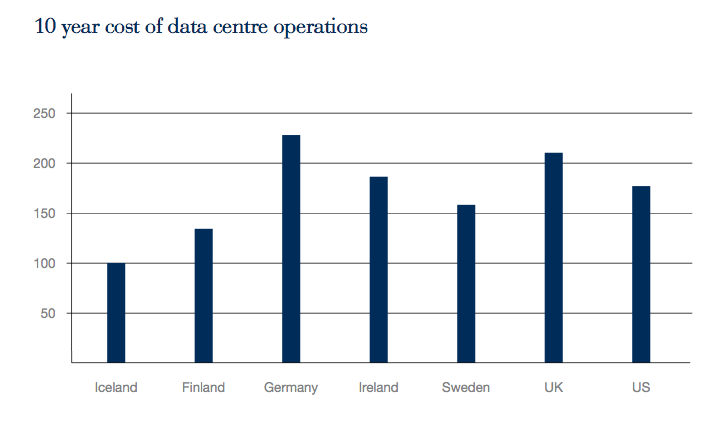
Data-Centre-Operation-Cost-comparedIceland is a highly attractive place to locate a data centre and is positioned to become an international data centre hub, according to an independent study conducted by BroadGroup Consulting. On the key issue of power, encompassing everything from costs to quality to regulation, Iceland scores higher than leading global data centre locations, such as the USA, UK, Sweden, Singapore and Hong Kong. When all the issues are taken together, Iceland has truly become an extremely attractive location in which to site a data centre. Reasons include:

1.  All the basic factors in place

The reality for most data centre users is that they need all basic issues to be in place. This includes cheap energy and strong connectivity, and also areas as telecoms, power, reliability, taxation and business environment, and the legal/regulatory framework. According to BroadGroup, Iceland has these factors in place.

2.  Low-cost power

Iceland is also highly attractive in terms of differentiating factors such as power costs and availability, government support and incentives, and operating costs. Power is the biggest operating cost item for data centre users. Iceland is highly competitive on power pricing today, and can provide commitments for ten years or potentially more. Iceland power costs can be halve those in Scandinavia, and significantly more competitive than other European countries. Iceland’s power costs remain very likely to stay much lower than other countries, particularly given the opportunity to cap such prices for ten years or even longer for greenfield projects. Factoring in all data centre cost factors over a ten year period, shows the significant savings available in choosing Iceland (as per chart).

3.  Excellent reliability

Power reliability and quality are extremely high. Iceland has a long history with a key group of power-intensive users already (such as the aluminum smelters). Such users, including global leaders such as Rio Tinto and Alcoa, can have requirements of >400MW and have expanded their sites in Iceland due to the strong reliability and availability. These are users for whom an outage of more than an hour would cause serious damage, and have selected Iceland and expanded in Iceland due to its power reliability. For these businesses, there have no disruptions due to natural disasters since the first smelter started operating in Iceland in over 40 years ago.

4.  Base-load renewable energy

Icelandic power is 100% green. Iceland is one of few countries in Western Europe with large quantities of competitively priced, renewable carbon neutral electricity. Setting Iceland apart from most countries, it produces electricity using exclusively hydropower, geothermal energy and onshore wind. These are sustainable, environmentally “green” resources with zero carbon trade-offs. This makes it an ideal location for addressing corporate responsibility considerations.

5.  Good connections

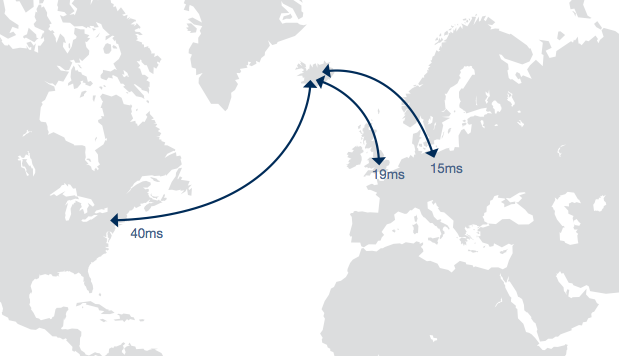
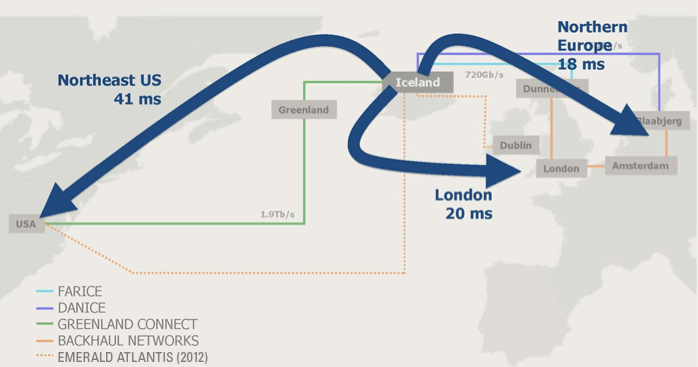
Iceland-Telecom-Network-Latencies-MapOn telecoms, existing connectivity, Greenland Connect, FARICE and DANICE are being substantially upgraded, while significant new capacity is planned to be added over the next several years, enabling up to 30 Tbit/s of full capacity. In terms of telecoms pricing, large international users are able to negotiate prices which are comparable with transatlantic prices into mainland Europe. For example, Icelandic prices are close to the Telegeography Median 10G transatlantic prices reported in Q4 2012. The telecoms pricing attractiveness is illustrated by existing users in Iceland, such as Opera Software, which uses >50 Gbit/s of capacity. Furthermore, Iceland is ideally situated between the US and Europe, and is highly accessible with 20+ airlines landing on the island. Many of the Iceland data centers are also within a short drive of Reykjavik airport.

6.  High educational skills and modern European business environment

There is a high education level in Iceland and strong availability of highly skilled technical staff. A major issue for data centre users is how a location will evolve over the 15+ years of the facility. Some of the large, existing data centre locations are facing key challenges such as lack of land, power availability and the threat from natural disasters. By contrast, Iceland is rapidly developing as a global data centre location, with a highly committed, stable and democratic government and clear focus on the sector, and a legal system in line with the European Union.. 

7.  Positive political support

The Icelandic economy is strongly supportive of IT investment, and has particularly looked to ensure it is attractive to those looking to site data centers in the country. This has attracted an impressive range of global companies who already have data centers in the country, including Opera Software, COLT Telecom, BMW, Datapipe and the Joint Nordic Supercomputer. It has also attracted data centre outsourcing companies such as Advania and Verne Global. The Iceland government has also developed specific incentives for the industry.

8.  Low natural risk

Iceland does have earthquakes, but most are tiny (<2 on Richter scale). They also tend to be well away from the best data centre sites, and the electricity production and distribution infrastructure has been developed in such a way that it is not vulnerable to earthquakes or strong winds. Indeed, earthquakes and volcanic eruptions of the last decades have caused no real damage and had no disrupting effect on the services of electric power transmission, power production or telecommunication in the country as a whole and no effect on local services for the potential sites. A detailed independent study has shown that estimated risk from earthquakes and volcanoes is still relatively low, especially compared with places like California. Indeed, even New York State had 400 earthquakes with Richter magnitude greater than 2.0 recorded between 1700 and 1986. Iceland also has negligible risks from other natural disasters such as hurricanes, heat waves, droughts, wildfires and tsunamis.

9.  Plenty of space available

Iceland also offers two of the other key requirements of many data centre users – space and flexibility. There is plenty of space to build data centers of different designs, rather than being forced to use refurbished buildings or multi-storey sites. For example, land is available at suitable locations close to both the capital Reykjavik and the Keflavik International Airport. And there is flexibility to provide different solutions, from high-connectivity, purpose-built technology parks to sites that are close to energy sources and offer a green and low-cost option.

From colocation facilities to major internet giants

In the last few years, Iceland has been seeing new investments in the form of colocation facilities.

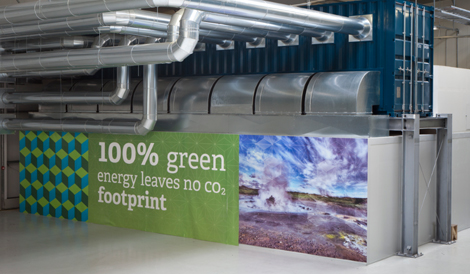
Iceland-green-renewable-askja-energyLong term contracts for fixed price low cost power, free cooling promoting a year-round power usage effectiveness, well-educated workforce, and several high-speed telecom subsea cables make Iceland a perfect location for data centers with a minimum of cost and complexity.

Verne Global opened its data centre in 2012 and has taken on BMW on as a major and expanding client. The Advania-owned highly effective Thor Data Centre hosts search engine Opera’s environment and the supercomputer used by the National High Performance Computing organizations of Norway, Denmark, Sweden and Iceland.

Gullfoss-eveningIceland is likely to attract increasingly more colocation facilities, offering equipment space and bandwidth for rental to retail customers. With plenty of renewable energy to spare, Iceland may soon also lure a major internet-giant to host its data in Iceland. Companies like Yahoo!, Facebook and Google have all been looking towards Iceland in this respect.

In next post we will be introducing an independent analysis of Iceland as a global data centre hub. This new study was undertaken by BroadGroup, which made a comparison using a wide variety of criteria with today’s leading data centre locations from around the world. The results were strongly in Iceland’s favor.

Opera Software chooses Iceland

Iceland is experiencing increased interest from companies overseas for hosting their data in Icelandic data centers.

Opera-Software-logoRecently, Advania signed an agreement with Opera Software for the expansion of its operations in Advania’s green data center in Iceland. Advania is a leading Nordic Information Technology (IT) company and owner of Thor Data Center in Iceland. This new agreement continues the ongoing buildup at the data center with a near doubling of Opera’s current capacity.

Advania-Green-Data-Centre-IcelandAdvania’s data center is arguably one of the world’s greenest data centers as all of the energy used at the site is generated from renewable sources and less energy is used for cooling due to the natural cool climate in Iceland. Opera Software uses the data center to facilitate web browsing for more than 230 million Opera Mini users around the world. Already more than half of Iceland’s Internet traffic runs through the Advania Thor Data Center, and this expansion is set to increase this traffic even further.

Opera Software was one of the first companies to seize the opportunity represented by Iceland’s affordable green energy and free cooling. This allows for an extremely efficient operation while still maintaining harmony with the environment since there are no carbon emissions from Iceland’s energy production. You can read more about how data centers in Iceland offer dramatic savings here.

Ithaca Energy on the Icelandic continental shelf

Ithaca Energy has bought the British oil- and gas exploration company Valiant Petroleum for GBP 203 million (approximately USD 310 million), in cash and stock.

Ithaca-Energy-logoIthaca Energy is a North Sea oil and gas exploration, development and production company with offices in Calgary, Canada and Aberdeen, Scotland. The Company was incorporated in Canada in 2004. Ithaca’s strategy is to grow through project asset acquisitions, development of assets within the portfolio and through license rounds.

Smaller oil producers and explorers in the North Sea are consolidating in a drive to revive flagging output in British waters. The deal will enable Ithaca to double its 2013 production forecast from oilfields in the North Sea, to 14,000-16,000 barrels of oil equivalent per day. Ithaca has stated  the deal will help it transform itself into a leading mid-cap North Sea oil and gas operator, with proven and probable reserves of about 74 million barrels of oil equivalent.

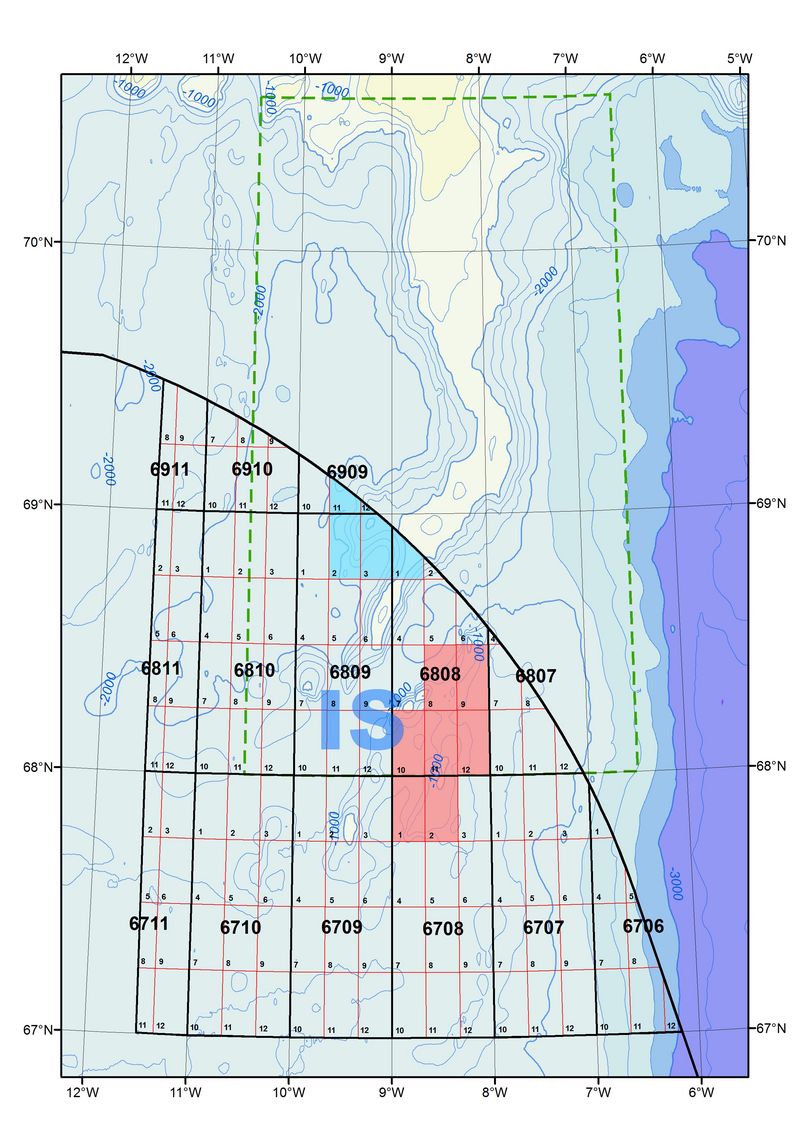
Iceland-Oil-Exploration_Faroe-Petroleum-Valiant-Petroleum-litud-areas-DrekiIn a study published in last December, the University of Aberdeen forecasted that British oil output from the North Sea will rise in the next few years, reflecting more investment, high prices and tax breaks. What is more interesting, in an Icelandic perspective, is that Ithaca Energy now becomes a direct player in oil exploration on the Icelandic continental shelf. Last year (2012), Valiant Petroleum was awarded a license for exploration and production of hydrocarbons in the Dreki Area, Northwest of Iceland (area marked with blue color on the map).

According to movements on the stock market it seems that the acquisition is expected to strengthen the projects that were part of Valiant’s portfolio. This may be good new for Iceland. When the deal was announced, Valiant’s share price rose 35 per cent. How the aquisition will affect exploration on the Icelandic continental shelf will be realized in the coming summer and years.

10 TWh of green energy available

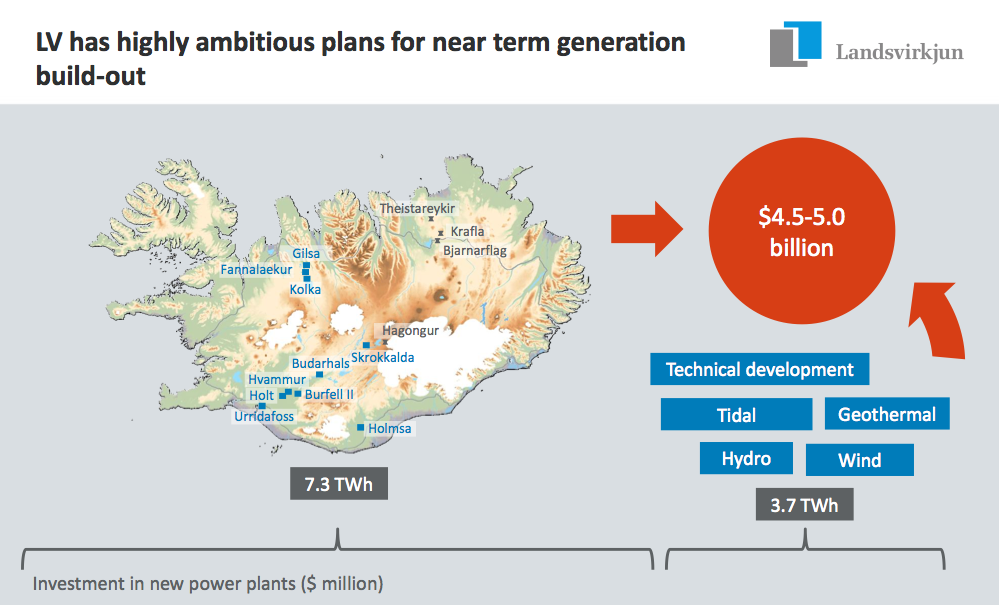
Iceland-Landsvirkjun-New-Renewable-Electricity-GenerationThe Icelandic power company Landsvirkjun has introduced plans for several new renewable energy projects.

If all these projects will be realized, they will add close to 7 TWh of annual generation from natural hydro- and geothermal sources. All the projects have been identified. As Landsvirkjun is owned by the Icelandic government, formal decisions about which of the projects will be realized first depends on the Icelandic parliament.

In addition, Landsvirkjun has put a figure on several other possible new power projects, that could be generating electricity within a decade or so. In total, Iceland may within near future be producing 9-10 TWh more electricity than today. This is not an exact figure; the new additional capacity could be somewhat less or even more. This will depend on the interest of new users of electricity, such as data centers, silicon industry etc. However, the most interesting option may be selling part of the new electricity production to markets in Europe.

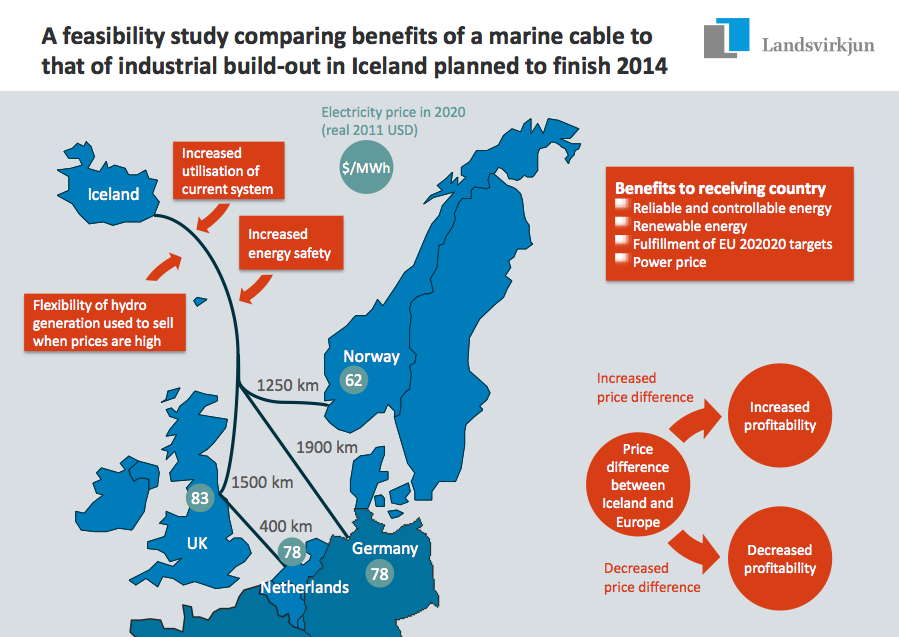
Iceland-Landsvirkjun-HVDC-Feasabilty-StudyA feasibility study on a possible electrical cable (high voltage direct current cable; HVDC) between Iceland and Europe is currently being carried out by a special working group. The group includes people from the Icelandic power sector and other stakeholders, appointed by the Icelandic Minister of Industries and Innovation. It is expected that the working group will deliver its report  during next year (2014).

The high electricity prices in Europe make a cable to Europe an especially interesting option for the Icelandic power generating firms. During the last few years, wholesale electricity prices in Western Europe have often been around three times higher than in Iceland. Thus, an electric cable between Iceland and Europe could increase the profits of Icelandic power companies  substantially.

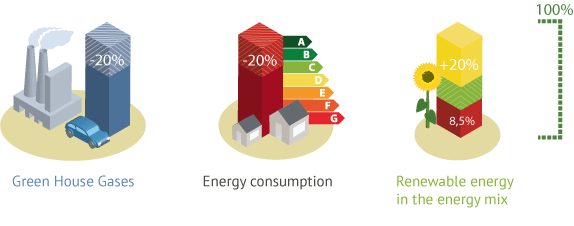
EU-energy-policy-20-20-20There would be numerous other positive gains from such a cable, as presented on the slide at left (the slide is from a presentation by Landsvirkjun). For example, the Icelandic power companies would be able to maximize the current capacity, resulting in more production. Europe would enjoy access to new green electricity generation, which would help the member states of the European Union (EU) in achieving climate- and energy goals (the EU aims at raising the share of EU energy consumption produced from renewable resources to 20% no later than 2020). The issues of such a connection between Iceland and Europe was described in more details in one of our earlier posts.

In the forthcoming months it will hopefully become clearer if Europe may gain access to the geothermal- and hydropower of Iceland.

Data centers in Iceland offer dramatic savings

Businesses overseas are turning to Iceland to host their data, making use of cheaper energy and natural cooling resources. Icelandic datacenters do not only offer very competitive prices, but also reduce carbon footprint and improve green credentials, as they are powered by renewable electricity only (from natural hydro- and geothermal resources).

datacenter-icelandA recent study by PricewaterhouseCoopers found that the operating expenditure of a 10,000 sqf data center in Iceland, over a 15 year period, is USD 130 million cheaper than running it in the United Kingdom or in Continental Europe. Thus, Iceland offers dramatic savings in the long run.

According to Invest in Iceland, a government body provides information to foreign investors, a fifth of data centre costs are spent on power. Half of that is used for cooling. In Iceland, businesses have access free-air cooling all year round and thus saving substantially on cooling costs.

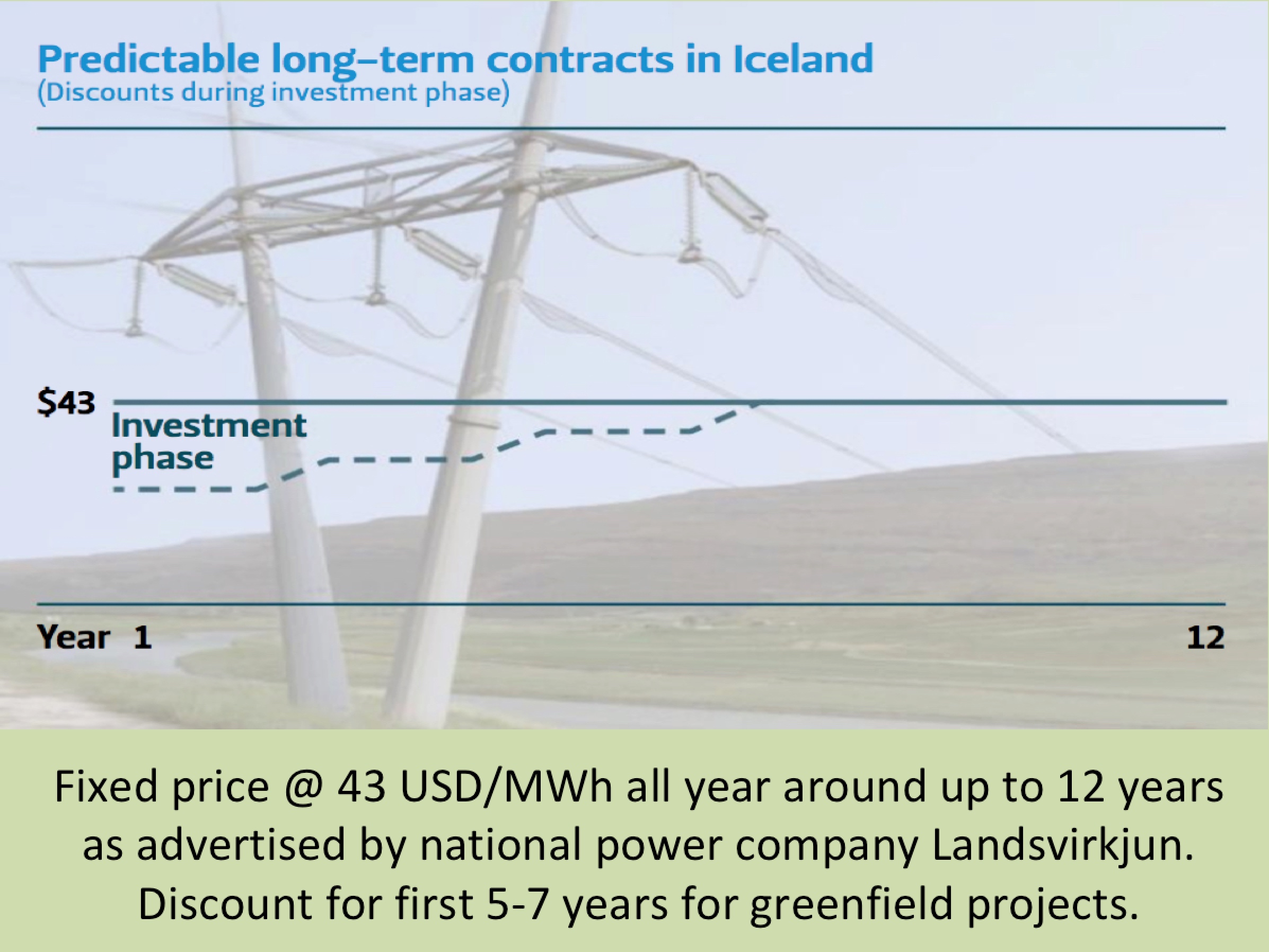
In addition, the electricity is much cheaper in Iceland than in the rest of Europe. In Iceland, data centers are currently being offered power at the price of USD 0.043 (4.30 cents) per kWh, which is less than half of the price which is common in other European countries. This low Icelandic price can be locked up for at east 12 years, offering businesses a clear understanding of operating expenses in the long run.

Furthermore, while cost is one of the major factors attracting data centre investment and services to Iceland, carbon footprint is also an important driver for European businesses to consider Iceland as a location for their data. As European carbon taxes begin to bite, companies are looking towards Iceland’s carbon free data centers as a long-term option to demonstrate their commitment to green IT. Currently, three data centers have been constructed; the Advania, GreenCloud and Verne Global.

Iceland-Data-Fiber-ConnectionsThe Icelandic electricity generation and distribution ranks as one of the most reliable in the world. Thus, Iceland data centers offer 99.999% uptime, and power companies are willing to put that uptime in the contract agreement. Connectivity to the Icelandic data center facilities is provided by redundant, high-capacity, multi-terabit-per-second connections, including Farice, Danice and Greenland Connect.

Volcanic activity in Iceland may have the effect making investors reluctant to invest in data centers in Iceland and same may apply to businesses regarding hosting their data in the country. But the fact is, that large areas in Iceland have no volcanic activity and none seismic risk. In a nutshell, the risk for data centers from natural hazards or extreme weather are no higher in Iceland than in most other European countries.

Reykjavik-Center-WinterThe regulatory environment in Iceland is clear and is built on European standards (Iceland is a full member of the European Economic Area; EEA). Numerous agencies and local governments are willing to assist companies interested in investing. Our readers are welcome to contact us at the Icelandic Energy Portal for more information. You can call us at +354-863-8333 and/or send message through our contact-form.

Data centers in Iceland

In 2007, a benchmarking study by PricewaterhouseCoopers  (PWC) showed Iceland to be a favorable location for new data centre activity. The report concluded with Iceland being supportive and welcoming in the respect of issues as governmental legislation, immigration and permits.

Operational cost for data centres in Iceland is minimum due to the low cost cooling and electricity. Presently, the Icelandic power company Landsvirkjun is offering electricity contracts at the price of 43 USD/MWh. Those competitive rates are available as fixed for up to 12 years. Furthermore, Iceland has significantly less of a security risk than almost any other Western or emerging countries. Its geographic location, low population density and lowered post-Cold War strategic value make it an unlikely target for either external or internal forces.

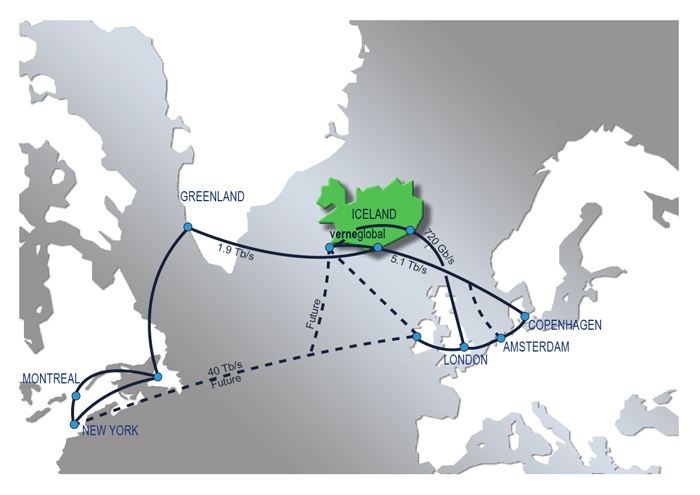
Iceland-Telecom-Cable-MapThe Icelandic infrastructure for telecommunications networks and services is highly advanced. Mobile phone and Internet penetration in Iceland are among the highest in the world. Iceland is linked with Europe and North America via number of fiber-optic submarine systems. They are Farice-1 to the UK (with a capacity of 0.72 terabits per second and was originally installation in 2003), the Danice cable to Denmark and the Netherlands (with a capacity of 5.1 terabits per second), and Greenland Connect which connects Iceland to Canada and the Northeast United States (with a total capacity of 1.9 terabits per second). Additionally, the new Emerald Express trans-Atlantic cable (with a connection to Iceland) is scheduled to be ready for service before end of this year (2013).

Verne Global and Thor Data Center are examples of new data-centres that have started operation in Iceland in recent years. Besides running on low-cost 100% renewable energy, the growing data-center industry in Iceland is also enjoying a major upgrade of the international submarine telecom capacity between Iceland and mainland Europe

Verne-Global-logo-taglineVerne Global is a company that owns and operates a data center campus in Keflavik in Southwest Iceland. The 18-hectare (approximately 45-acre) Verne Global data centre complex is just west of Reykjavik, the capital of Iceland, minutes from Keflavík International Airport. Verne Global’s facility has been designed to fully utilise Iceland’s unique environmental power advantages: 100% powered by renewable energy resources and 100% cooled by the natural environment of Iceland, without the use of chillers or compressors.

The largest investor in Verne is the UK investment foundation Wellcome Trust. Verne Global offers data centre decision makers a 100% carbon neutral and affordable power solution with a very precise pricing predictability, a range of server density options and efficiency without extra expense, using natural cooling. The customers of Verne Global customers range in size from those requiring multi-kilowatts to multi-megawatts. With its headquarters in the United Kingdom, Verne Global is led by an experienced team with proven success in the data centre industry.

Thor-Data-Center-Advania-logoThor Data Center (THORDC) in Hafnarfjordur is owned by the Nordic IT company Advania. The Thor Data Center facility is located 10 minutes from  Reykjavik, and a 30 minute drive from Keflavik International Airport. Due to the physical and natural elements in Iceland and the specific datacenter design, Thor Data Center is claimed to be one of the most energy efficient data centers in the world. It is powered by clean renewable hydro- and geothermal energy sources and offers unique value proposition for companies demanding a reliant and cost effective hosting service in a 100% green, zero carbon footprint  environment.