Skip to content

Posts from the ‘Hydro Power’ Category

Premature story in the Guardian

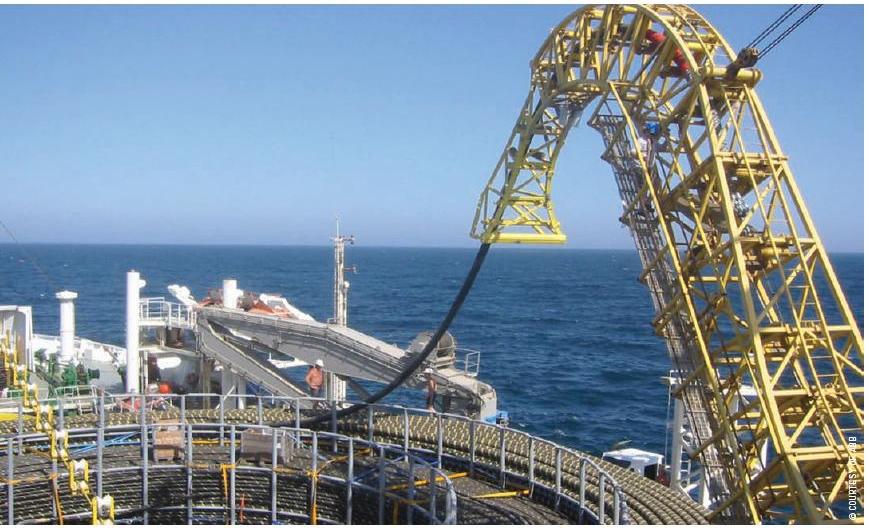
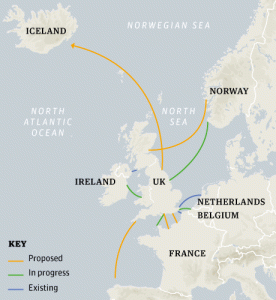
Yesterday, the Guardian published a story about Iceland seeking UK funding for subsea cable project. This is a somewhat premature statement by the Guardian. It is certainly true that the possibility of an electric cable between Iceland and the UK is being considered. However, no formal decision on such a project has been taken yet.
UK-Electric-Subsea-Cables-Map

The Guardian correctly states that such a project could possibly deliver 5 TWh’s of green electrity a year to Britain. And the price of the electricity could be very competitive (lower than from British offshore wind farms). It is also correct that all the electricity from Iceland would be generated by harnessing renewable natural sources (especially hydropower, but also geothermal and wind).

The project would most likely strongly appeal to the UK. The Guardian correctly points out that the highly reliable potential energy in Iceland’s hydro dams can be seen as neatly dovetailing with Britain’s expanding, but unpredictable, wind power generation:

“As wind has become an increasing component of UK electricity generation, those tasked with matching UK supply with demand are increasingly facing a difficulty when usage spikes at times of when wind speeds drop. Few sources of generation, other than hydropower, can be brought on-stream at short notice to cover for lulls in wind.”

According to the Guardian, Iceland’s president Mr. Ólafur Ragnar Grímsson is expected this week to call on the British government to provide financial support for the construction of the subsea electricity cable – which will be the longest in the world – linking the electricity grid’s of Iceland and the UK.  Actually, it is more likely that the president will urge the British government to further cooperate with Iceland in necessary research and development that will be necessary if the cable is to be realized.

HVDC-Cable-Iceland-Europe-map-slideAs mentioned in the Guardian’s article, the governments of Iceland and the UK have already stared exploring proposals for a cable, after a ministerial meeting in May last year (2012). It would be a sensible step to strengthen the cooperation between the two countries in preparing to link the countries with an electric cable. Hopefully, the necessary cost analysis and research on for example the sea-bed can take place soon. When this will be finished, the financing of the cable may become a relevant issue.

NB: The Guardian says that the length of the cable would be 10,000 km. This is of course wrong; an electric cable between Iceland and the UK would be close to 1,200 km (somewhere between 1,000 and 1,500 km). The Guardian also says that the electricity industry in Iceland produces 12 GWh of electricity annually. The correct number is of course much higher or close to 17.2 TWh (17,200 GWh). Hopefully, the Guardian will correct their numbers. More information about the Icelandic power sector can be found here.

1 GW Iceland-UK electric subsea cable may be close

The governments of United Kingdom (UK) and Iceland may both be interested in a subsea electric connection between the countries.

HVDC-Cable-Iceland-Europe-map-slide

The main purpose of the cable would be to bring electricity from Iceland’s renewable sources to the UK. The UK has ambitious plans to substantially increase renewable energy in UK’s energy mix. According to legally binding goals, set by the member states of the European Union (EU), the UK needs to dramatically increase production and imports of renewable energy. Iceland could become an important player in that green transformation.

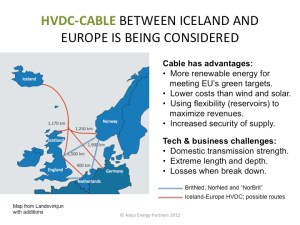
Renewable electricity could be provided by Iceland to the UK even at a cheaper cost than offshore wind. In addition the Icelandic hydro- an geothermal power is a very reliable power source. The plans being discussed concern a 1,100-1,200 km subsea cable with a capacity of 1GW. The package might be worth an estimated GBP 4 billion, with the inclusion of related generation and onshore transmission investments and could be operational by within a decade.

bjorgvin-sigurdsson-landsvirkjunMr. Bjorgvin Sigurdsson, executive vice president of Iceland’s main power company (Landsvirkjun), has expressed that the company is now looking at this much more seriously than ever before.  “The technology seems to be there to make it work… the issue is whether this makes sense economically.”

At present, Iceland benefits from some of the most competitive electricity prices in Europe. All the electricity in Iceland comes from renewable hydro- and geothermal sources, which offer the possibility of a very low cost generation. The director general of the National Energy Authority of Iceland (NEA), Mr. Guðni Jóhannesson, has said that the interconnector could provide power to the UK at around 60 to 70 percent of the price of offshore wind.

hvdc-cable-nornedAs Iceland still has numerous options of unharnessed hydro- and geothermal energy, an electrical cable might create a win-win situation for Iceland and the UK. The idea of exporting energy from Iceland to the UK is not a new one, as it was first mentioned decades ago. However, it is not until recently that technological advancement and rising electricity prices in Europe made the idea feasible.

Landsvirkjun promotes university research and education

The Icelandic power company LandsvirkjunReykjavík University (RU), and the University of Iceland have joined forces to support and encourage the development of expertise within the field of renewable energy. The cooperation will strive to create a source of shared value for Landsvirkjun, the universities and Icelandic society by supporting those disciplines where more education and research are vital.

Landsvirkjun-university-cooperation-2013In total, Landsvirkjun has pledged 80 million ISK to the universities over a five year period, to promote education and research in geochemistry, electric power engineering and other academic disciplines within the universities. The cooperation agreement with the University of Iceland has the main objective of promoting and supporting teaching and research in the disciplines of geochemistry, geology, mechanical and industrial engineering. An emphasis will be placed on developing expertise in the field of renewable energy sources. Landsvirkjun and Reykjavík University will also cooperate in promoting research and university education in the field of renewable energy.

Hordur-Arnarson-Landsvirkjun-CEO-presentingWhen signing the Agreement Mr. Hörður Arnarson, CEO of Landsvirkjun, stated that in building a dynamic cooperation between Landsvirkjun and the universities will create shared value for the economy and for society, by sharing expertise and supporting innovation and development in renewable energy sources. The University of Iceland has a long established history in building upon its expertise in these fields and the contract is an extension of decades of cooperation between the university and Landsvirkjun in the disciplines of engineering and the natural sciences. In recent years the Reykjavik University has also been actively developing dynamic courses and expertise in technical subjects, including the utilisation and distribution of renewable energy sources. The financial support from Landsvirkjun will substantially strengthen education, research and the development of projects related to renewable energy within the universities, and increase opportunities for expertise and creativity.

Green high performance computing cloud node opens in Iceland

Managed hosting provider Datapipe has launched a green cloud node in Iceland. The company has made its high performance computing (HPC) cloud platform available out of Verne Global’s facility in Southwestern Iceland, which uses 100 percent renewable energy.

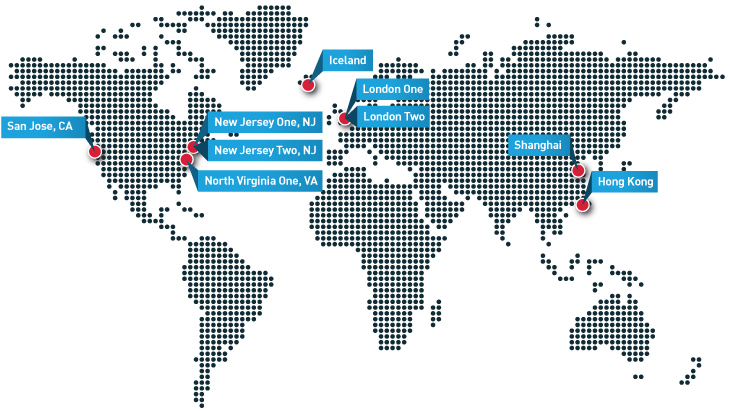
Datapipe-Data-Center-World-MapDatapipe is an existing tenant, but its expansion is a reflection of increased data center activity in Iceland. Low cost, renewable energy, improved connectivity, and a location between North America and Europe add up to an enticing proposition. Datapipe clients have immediate access to the new Iceland node. It’s available through the same portal as its other locations in Silicon Valley, the New York Metro area, Ashburn Virginia, London, Hong Kong, and Shanghai. “Iceland is a great in-between point with our U.S. and UK infrastructure, it’s great for disaster recovery., says Ed  Laczynski, Datapipe’s VP of Cloud Strategy.

The Statosphere HPC cloud platform is a high performance solution targeted at Big Data wokloads. Typical verticals that the company attracts are manufacturing, financial service, and research and development. The platform is API driven and utilizes all SSD storage with guaranteed IOPS (input/output per second) . Stratosphere can be configured with public or private resources, with up to 32 physical core equivalents per instance, a half terabyte (TB) of RAM, and tens of thousands of IOPS per volume, all residing on a 10GE network. It’s known as the most widely deployed Apache CloudStack environment on the market.

datapipe-logoDatapipe has been committed to using as much renewable energy as it can, and is finding that customers are increasingly asking for it as well. “As we grow new solutions, we’re seeing more and more green qualifications as a requirement to do business,” says Laczynski. “The kind of customers we’re talking about really do care about this; these are multinational corporations looking for sustainable solutions.” Recognized as a Green Power Partner by the U.S. Environmental Protection Agency (EPA) since 2010, Datapipe achieved EPA Leadership Club status in 2011 and is currently ranked #9 on the EPA Green Power Partner Top Tech & Telecom list.

Iceland-waterfall-1Verne Global offers a 100 percent renewably powered data center solution, which features access to geothermal and hydroelectric power sources, free-cooling provided by Iceland’s ambient air temperature and lower power prices that can be locked in over a 20 year period. “Power availability and costs are becoming two of the leading constraints for HPC clouds and clusters,” says Jeff Monroe, CEO of Verne Global. “Together, Verne Global and Datapipe are meeting these challenges with the first truly green HPC Cloud for the European and North American markets.”

From colocation facilities to major internet giants

In the last few years, Iceland has been seeing new investments in the form of colocation facilities.

Iceland-green-renewable-askja-energyLong term contracts for fixed price low cost power, free cooling promoting a year-round power usage effectiveness, well-educated workforce, and several high-speed telecom subsea cables make Iceland a perfect location for data centers with a minimum of cost and complexity.

Verne Global opened its data centre in 2012 and has taken on BMW on as a major and expanding client. The Advania-owned highly effective Thor Data Centre hosts search engine Opera’s environment and the supercomputer used by the National High Performance Computing organizations of Norway, Denmark, Sweden and Iceland.

Gullfoss-eveningIceland is likely to attract increasingly more colocation facilities, offering equipment space and bandwidth for rental to retail customers. With plenty of renewable energy to spare, Iceland may soon also lure a major internet-giant to host its data in Iceland. Companies like Yahoo!, Facebook and Google have all been looking towards Iceland in this respect.

In next post we will be introducing an independent analysis of Iceland as a global data centre hub. This new study was undertaken by BroadGroup, which made a comparison using a wide variety of criteria with today’s leading data centre locations from around the world. The results were strongly in Iceland’s favor.

What explains the high energy intensity in Iceland?

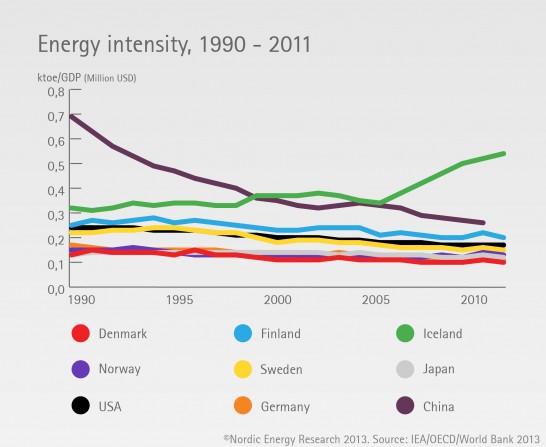
The worlds major economies have gradually been reducing their energy intensities (using less energy to produce one unit of GDP). This, for example, applies to all the Scandinavian countries. However, this does not apply to Iceland; Iceland has been increasing its energy intensity.

Nordic-Energy-intensity-1990-2011-with-China-Germany-Japan-USA

Reducing energy intensity means increasing the energy efficiency in the economy. China is an example of a country where the trend towards more energy efficiency has been evident. As the Chinese economy has increased productivity and moved towards higher value products, GDP has increased much faster than energy consumption.

Industry is often classified into three sectors;  primary, secondary, and services (tertiary sector). The primary sector involves the retrieval and production of raw materials, while the secondary sector involves the transformation of raw or intermediate materials into goods. The services- or tertiary sector involves the supplying of services to consumers and businesses.

Economies previously dominated by primary and secondary sectors, such as in Denmark, have steadily decreased their energy intensities since 1990. The economies in Sweden and Finland also follow this trend – although their energy intensity increased in the early 1990s due to an economic recession.

The reason for the present high energy intensity in Iceland, is the recent expansion of energy-intensive industries in the country. It is especially the aluminum industry that has expanded at a much faster rate than the general economy in Iceland has grown.

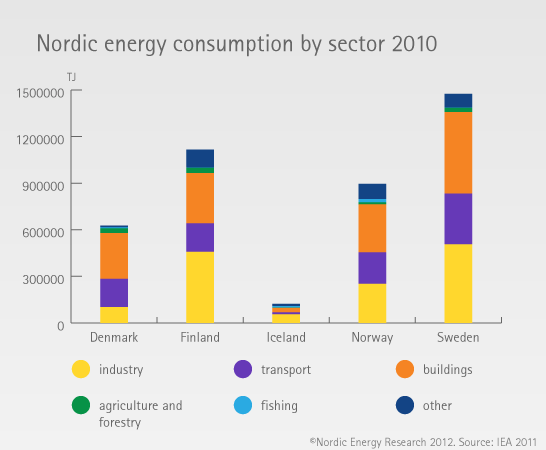
On average, industry accounts for about a third of the energy use in the Nordic countries. This is considerably higher than in most other developing countries.

Nordic-Energy-Consumption-by-Sector-20101

Both Iceland and Norway have significant metal manufacturing. This is due to historically cheap and plentiful hydroelectricity (and geothermal energy in Iceland). Because of the electricity consumption by the aluminium industry and other energy-intensive industries, Iceland and Norway actually have the world’s highest electricity consumption (and production) per capita!

10 TWh of green energy available

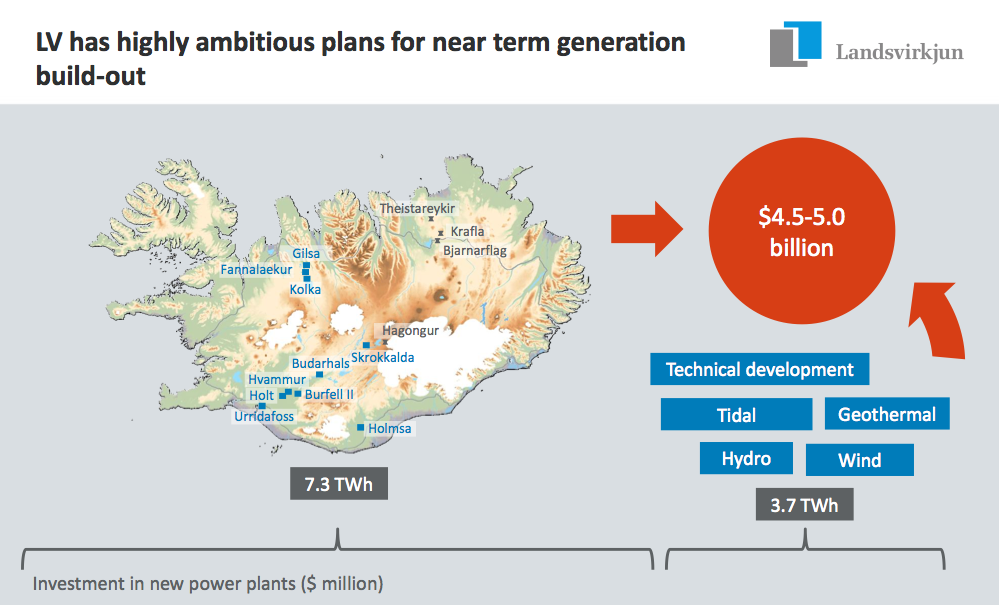
Iceland-Landsvirkjun-New-Renewable-Electricity-GenerationThe Icelandic power company Landsvirkjun has introduced plans for several new renewable energy projects.

If all these projects will be realized, they will add close to 7 TWh of annual generation from natural hydro- and geothermal sources. All the projects have been identified. As Landsvirkjun is owned by the Icelandic government, formal decisions about which of the projects will be realized first depends on the Icelandic parliament.

In addition, Landsvirkjun has put a figure on several other possible new power projects, that could be generating electricity within a decade or so. In total, Iceland may within near future be producing 9-10 TWh more electricity than today. This is not an exact figure; the new additional capacity could be somewhat less or even more. This will depend on the interest of new users of electricity, such as data centers, silicon industry etc. However, the most interesting option may be selling part of the new electricity production to markets in Europe.

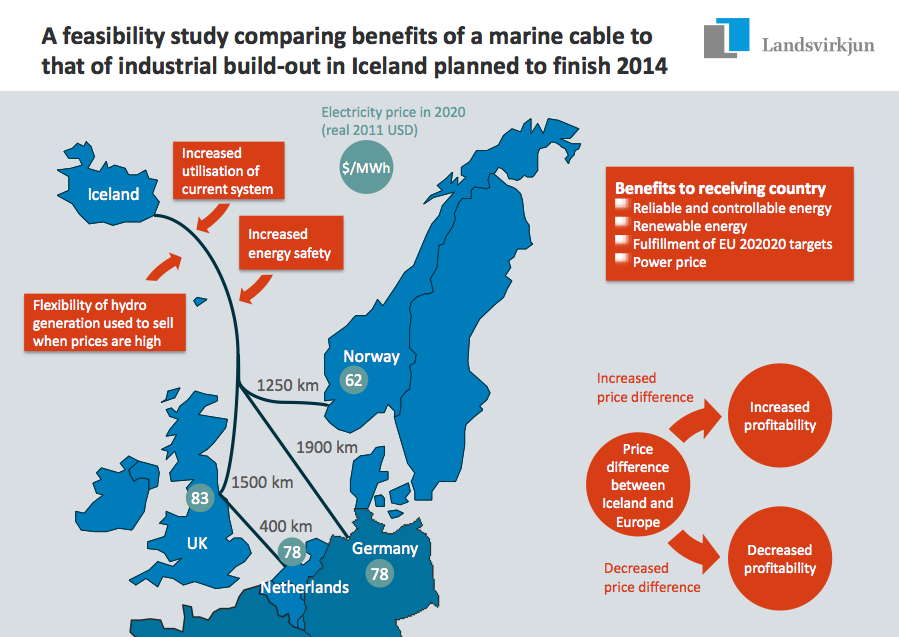
Iceland-Landsvirkjun-HVDC-Feasabilty-StudyA feasibility study on a possible electrical cable (high voltage direct current cable; HVDC) between Iceland and Europe is currently being carried out by a special working group. The group includes people from the Icelandic power sector and other stakeholders, appointed by the Icelandic Minister of Industries and Innovation. It is expected that the working group will deliver its report  during next year (2014).

The high electricity prices in Europe make a cable to Europe an especially interesting option for the Icelandic power generating firms. During the last few years, wholesale electricity prices in Western Europe have often been around three times higher than in Iceland. Thus, an electric cable between Iceland and Europe could increase the profits of Icelandic power companies  substantially.

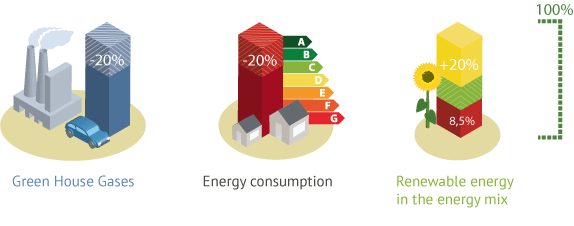
EU-energy-policy-20-20-20There would be numerous other positive gains from such a cable, as presented on the slide at left (the slide is from a presentation by Landsvirkjun). For example, the Icelandic power companies would be able to maximize the current capacity, resulting in more production. Europe would enjoy access to new green electricity generation, which would help the member states of the European Union (EU) in achieving climate- and energy goals (the EU aims at raising the share of EU energy consumption produced from renewable resources to 20% no later than 2020). The issues of such a connection between Iceland and Europe was described in more details in one of our earlier posts.

In the forthcoming months it will hopefully become clearer if Europe may gain access to the geothermal- and hydropower of Iceland.

Data centers in Iceland offer dramatic savings

Businesses overseas are turning to Iceland to host their data, making use of cheaper energy and natural cooling resources. Icelandic datacenters do not only offer very competitive prices, but also reduce carbon footprint and improve green credentials, as they are powered by renewable electricity only (from natural hydro- and geothermal resources).

datacenter-icelandA recent study by PricewaterhouseCoopers found that the operating expenditure of a 10,000 sqf data center in Iceland, over a 15 year period, is USD 130 million cheaper than running it in the United Kingdom or in Continental Europe. Thus, Iceland offers dramatic savings in the long run.

According to Invest in Iceland, a government body provides information to foreign investors, a fifth of data centre costs are spent on power. Half of that is used for cooling. In Iceland, businesses have access free-air cooling all year round and thus saving substantially on cooling costs.

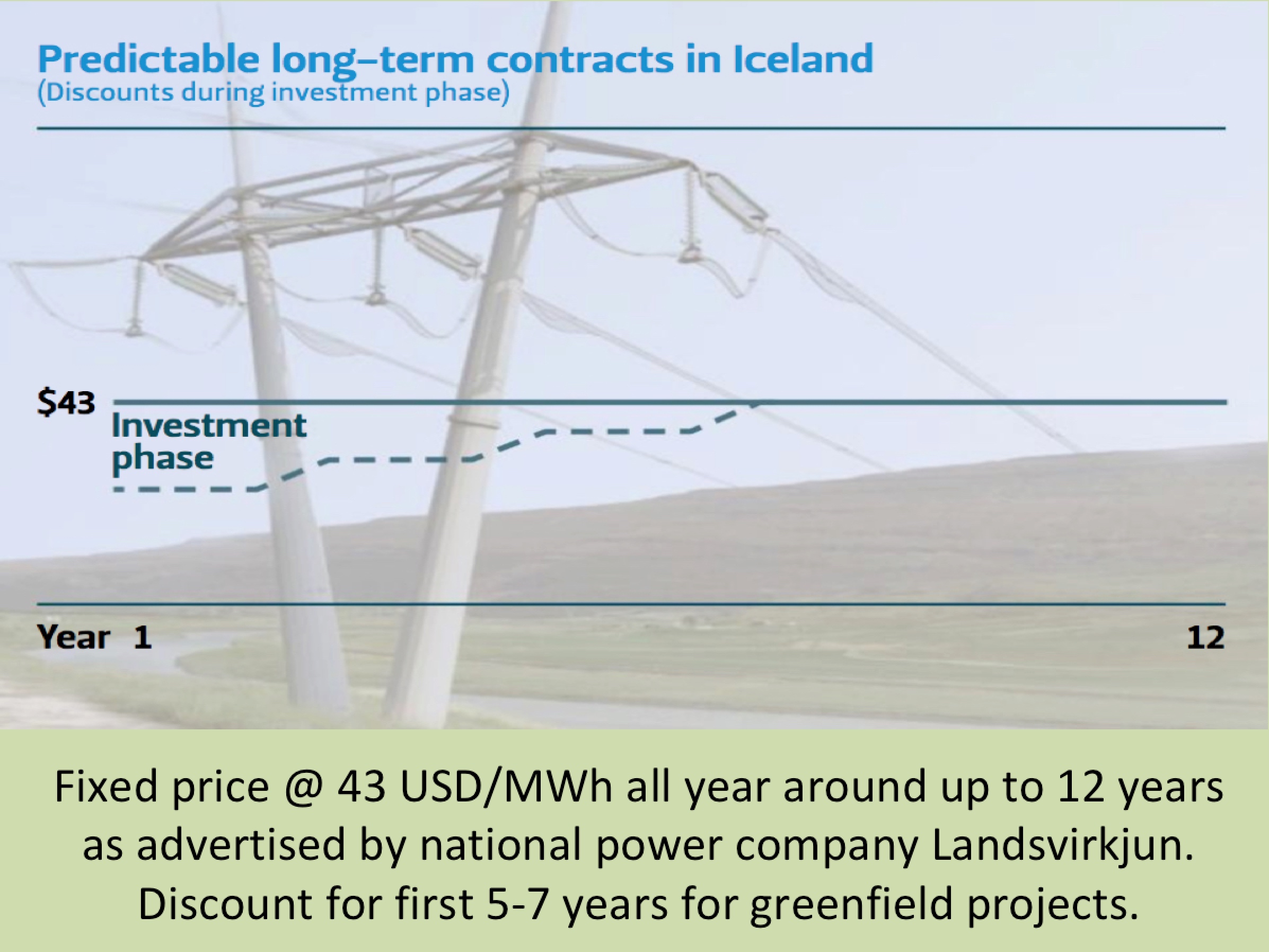
In addition, the electricity is much cheaper in Iceland than in the rest of Europe. In Iceland, data centers are currently being offered power at the price of USD 0.043 (4.30 cents) per kWh, which is less than half of the price which is common in other European countries. This low Icelandic price can be locked up for at east 12 years, offering businesses a clear understanding of operating expenses in the long run.

Furthermore, while cost is one of the major factors attracting data centre investment and services to Iceland, carbon footprint is also an important driver for European businesses to consider Iceland as a location for their data. As European carbon taxes begin to bite, companies are looking towards Iceland’s carbon free data centers as a long-term option to demonstrate their commitment to green IT. Currently, three data centers have been constructed; the Advania, GreenCloud and Verne Global.

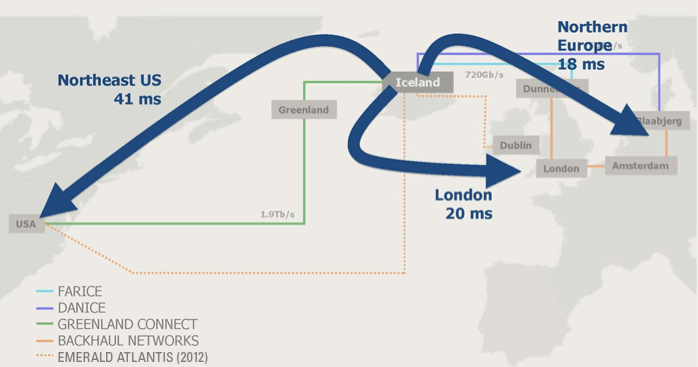
Iceland-Data-Fiber-ConnectionsThe Icelandic electricity generation and distribution ranks as one of the most reliable in the world. Thus, Iceland data centers offer 99.999% uptime, and power companies are willing to put that uptime in the contract agreement. Connectivity to the Icelandic data center facilities is provided by redundant, high-capacity, multi-terabit-per-second connections, including Farice, Danice and Greenland Connect.

Volcanic activity in Iceland may have the effect making investors reluctant to invest in data centers in Iceland and same may apply to businesses regarding hosting their data in the country. But the fact is, that large areas in Iceland have no volcanic activity and none seismic risk. In a nutshell, the risk for data centers from natural hazards or extreme weather are no higher in Iceland than in most other European countries.

Reykjavik-Center-WinterThe regulatory environment in Iceland is clear and is built on European standards (Iceland is a full member of the European Economic Area; EEA). Numerous agencies and local governments are willing to assist companies interested in investing. Our readers are welcome to contact us at the Icelandic Energy Portal for more information. You can call us at +354-863-8333 and/or send message through our contact-form.

Icelandic energy in the New York Times

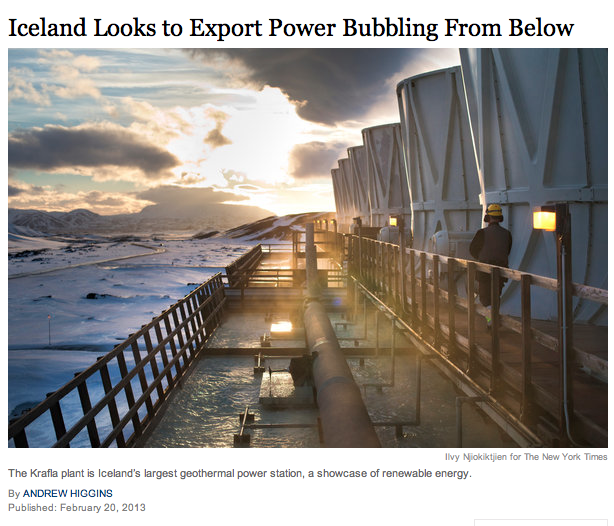
“In a nation with only 320,000 people, the state-owned power company, Landsvirkjun, which operates the Krafla facility, sells just 17 percent of its electricity to households and local industry. The rest goes mostly to aluminum smelters owned by the American giant Alcoa and other foreign companies that have been lured to this remote North Atlantic nation by its abundant supply of cheap energy.”

NYT-Iceland-electric-cable-feb-2013These words are from an article published by the New York Times (NYT) a few days ago. The article describes how electricity generated by harnessing Iceland’s extensive renewable energy sources may possibly be exported to consumers in the European Union (EU). Such an export could result in a very substantial increase in profits for the generating companies in Iceland. The aluminum smelters are paying prices believed to be less than 30 USD per MWh. Which is, according to the NYT, less than half the going rate in the EU and barely a quarter of what, according to the Renewable Energies Federation, a Brussels-based research unit, is the average tariff, once tax breaks and subsidies are factored in, for renewable electricity in the EU.

Currently, Landsvirkjun is conducting a research into the possibility of a submarine electric cable (a High Voltage Direct Current cable or HVDC) to connect the electricity markets of Iceland with the European market. The cable would be approximately three times longer than the link between Norway and the Netherlands, which is currently the world’s longest submarine electricity cable. It is to early to say what would be the preferable connecting point in the EU; it could be Scotland, the Netherlands, Germany, or even Norway.

A connector between Iceland and Europe would not only offer the Icelandic electricity generating companies the possibility of substantially higher price for their product. Such a cable would also make it possible to import electricity to Iceland in periods of low electricity prices at the other end of the cable (such as during the night). The connector would also increase the energy security in Iceland, as the country would be less dependent on keeping large emergency reserves, as it does now. For the EU this would also be an attractive project – not least as the Union’s 27 member states agreed in 2009 to a mandatory target of deriving at least 20 percent of its energy from renewable sources by 2020.

Hordur-Arnarson-Landsvirkjun-CEOLandsvirkjun’s CEO, Mr. Hörður Arnarson, has described the possible cable as a very promising project.  “We have a lot of electricity for the very few people who live here.” Compared with the rest of the world, he said to the NUT, Iceland produces “more energy per capita by far, and it is very natural to consider connecting ourselves to other markets.”

It is expected that final decision on the cable will be taken within two years or so. For more information about the cable and the importance of EU’s energy policy for Iceland, please check out our earlier post on the issue.

Icelandic electricity generation and transmission

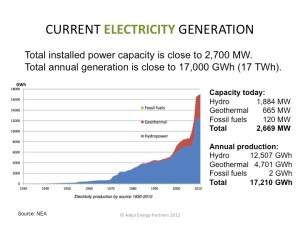
The Icelandic electricity generation capacity and production has more than doubled in a decade. Today, the total capacity is 2,669 MW. The annual generation 2011 was 17,210 GWh.

ELECTRICITY GENERATION BY SOURCE:

Hydro Power              1,884 MW            12,507 GWh
Geothermal Power       665 MW              4,701 GWh
Fossil Fuels                   120 MW                      2 GWh
Total                            2,669 MW            17,210 GWh

Slide08Close to 100% of the electricity generation in Iceland is produced by harnessing renewable sources. Hydropower is the largest source with close to 73% of the annual generation. Geothermal accounts for about 27% of the generation. In addition, there are a few fossil fuel generating plants.

Several new power stations are under planning (both hydropower and geothermal power). The most recent one (now being constructed in South Iceland) will become operational in late 2013 .

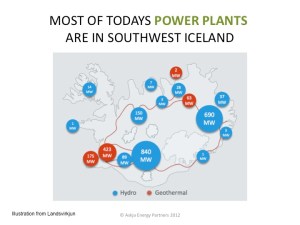
Slide10The power stations in Iceland are located all around the country. The geothermal power plants (marked by red on the illustration at left) are of course to be found where it is easiest to harness the geothermal heat for electricity generation. All the main hydropower stations utilize glacial water, flowing from Iceland’s glaciers.

The largest hydropower system is the Þjórsá and Tungnaá river system in Southern Iceland (marked by a large blue dot on the map at left) . However, Iceland’s largest power station is in the Northwestern part of the country. This is the 690 MW Fljótsdalur / Kárahnjúkar hydropower plant, that started operating in 2007 (marked on the map by the large blue dot north of Vatnajökull Glacier).

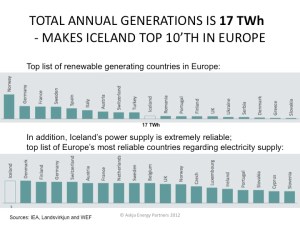
Slide09The total annual Icelandic electricity generation of 17,210 GWh (17 TWh) makes Iceland one of Europe’s largest producers of renewable power.

Norway is in a strong first place with its massive hydropower capacity, generating approximately 120 TWh annually. However, the electricity price in Iceland is much lower than in Norway or other European countries. Iceland  has no electricity connections with other countries. Thus, the generating firms in Iceland do not have access to the large electricity markets in Northwestern Europe, where electricity prices tend to be much higher than in Iceland.

Slide11

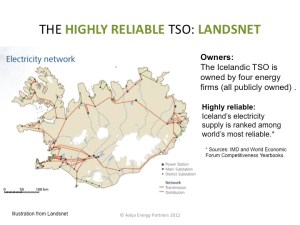
Despite Iceland’s isolated electricity market and sometimes severe weather conditions, the electricity supply in Iceland is renown for its reliability (see for example IMD’s and WEF’s World Competitiveness reports). This high reliability is the result of Iceland’s large reservoirs and the solid transmission system, which is operated by the Icelandic Transmission System Operator or TSO (Landsnet). The TSO connects all the large power stations to the Icelandic electrical grid, which runs around the country (all the nation lives in the lowlands, with the majority located in Southwestern Iceland).